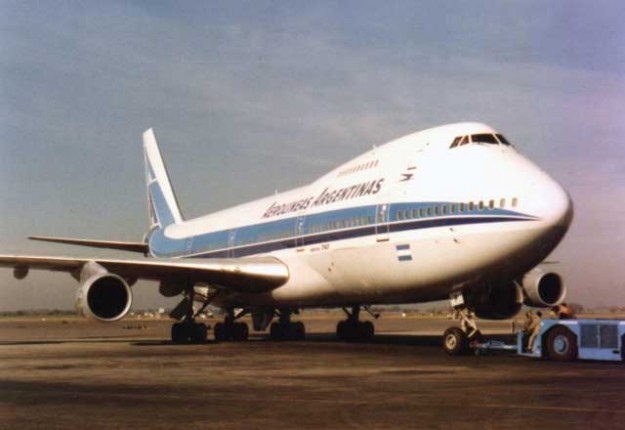

Most of the stories about Boeing begin saying that William Edward Boeing (1881-1956) was a Seattle businessman that a friend invited to take a ride on airplane, and when finished the flight said “I can build a plane better than this”. Truth or fantasy, it is certain that met the challenge.
Boeing Airplane was founded in 1916 and from the very beginning was dedicated to building airplanes and air services, business at that time, nobody knew in detail. When in 1927 the U.S. Mail postal tendered the line that would link the east US coast with the west one, Boeing & Hubbard were awarded the route Chicago – Los Angeles; they soon formed a company called Boeing Air Transport. At that time the star of the group was the Boeing 40A, a biplane capable of carrying two passengers and cargo. Those were times of explosive growth in the U.S. airline industry. In the late twenties Frederick Rentschler William Boeing formed United Aircraft & Transport, which controlled:

- Pratt & Whitney Aircraft Company.
- Boeing Airplane.
- Chance Vought.
- Sikorsky.
- United Airlines.
- Hamilton Aero Manufacturing Co.
- Standard Steel Propeller.
- Northrop.
- Stearman.
- Stout Airlines.
But this cluster was not alone, because it competed with the North American Aviation Company of Clement M. Keys that came to control an equivalent group of companies. The struggle between these two titans, which included much of politics and corruption, was epic and nobody can really say that there was a clear winner.
However, if we focus on Boeing commercial aircraft manufacturer, we can say that he had bad luck with their propellers products. The model 247 in 1933 seemed the epitome of industry, but the company policy of selling only to its subsidiary United made their competitors to request Douglas for a similar aircraft, which resulted in the DC-2 and DC-3, which were the preferred by airlines, in spite of Boeing´s plane was faster. Pan American commissioned to the company an aircraft capable of crossing the Atlantic, which led to the Boeing 314, probably the most romantic aircraft in the history, although very few units were sold. In these years, Boeing produced the first pressurized aircraft that entered service, the Stratoliner, but she had many design problems and like the 314 model, went out of production as a result of the war. After the war the company proposed the Stratocruiser, a plane with many innovations but technical problems that did not sell well.
Although stumbling on the civilian market, Boeing was consolidated in the military, with products like the B-17, B-29 and B-50. When they reached the jet engines, it was the first U.S. manufacturer who saw that the future, and that was in the first row of military jets, the B-47, B-52 and KC-135.
With all this experience, since the late fifties, Boeing was positioned as the first and largest manufacturer of commercial jets, a title which only in recent years is being contested by Airbus.

The Boeing 747
Commercial jets, which entered service by 1958, brought to market a deep change, which quickly resulted in a noticeable increase in traffic and business profits. The aircraft industry, after the first big jets, was able to offer to companies with a fairly broad spectrum of models, covering almost all needs between 70 and 250 seats, with ranges of more than 7,000 kilometers.
Traditional alternatives to create a new model were two: make a bigger aircraft, or make it faster. The technology did not allow both alternatives at the same time. The real demand at this moment did not require a larger machine than the DC-8 Series 60, so operators starting looking at a supersonic as the next step.
French and English partners built the Concorde, and the Americans also thought to develop a supersonic transport. As state funding would be held a design contest to win Boeing with its model 2707, capable of carrying 250 passengers to 2,860 kilometers per hour, but airlines were not interested in the project, which also presented complex technical problems and was eventually abandoned.
On the other side, the Soviets produced their supersonic Tupolev Tu 144, much like the Concorde and a little faster, which first flew in 1968.
Abandoned the supersonic dream, John Trippe, CEO of Pan American, concluded that the next step had to be mass transportation, crossing the North Atlantic for $ 100, and proposed to get the right aircraft for the challenge. They raised the idea to the leading American manufacturers. Since Boeing could not enlarge the 707, took in 1966 the challenge of designing a new aircraft for over 350 seats.

It was a tough bet. Trippe and Boeing were putting at risk the future of their companies, Boeing would build a new plant (in fact built the tallest building in the history without interior columns) and convince the airlines of the reasonableness of using an aircraft of this size. Meanwhile, PanAm had to find the passengers needed to fill twenty machines valued 520 million dollars. At least, other companies were convinced by the idea, and before the aircraft flew for the first time in 1969, Boeing had enough orders to ensure the continuity of the project.
The first Boeing 747/100 left the factory in September 1968, first flew in February 1969, and received its airworthiness certificate in December 1969. These timeframes, compare to those of 787, seem unreal. Of course, when it entered service there were unforeseen problems that needed to be solved. One of the most serious was that the engines would not start in extreme windy conditions.
In a clear allusion to the size, Pan American baptized the plane ‘Jumbo’, the name of the largest elephant who performed in the circus of Barnum, Bailey & Hutchinson in the late nineteenth century. The name stuck in the public, but there were trademark issues, and could never be traced to designate the aircraft.
The first difficulty for plane owners was getting enough passengers to reach good occupancy factors, and companies were regulating their Jumbos commissioning. But the biggest problem came in 1973, after the Yom Kippur War, in which the Arabs suffered a major defeat: oil-producing countries decided first cut its oil exports, and then increase its price by about three hundred percent. The West could not immediately absorb this blow, and an unprecedented crisis was created.
The ups and downs of the economy directly affect the demand for air travel, and this time the impact on airlines was terrible. The new aircraft had three times the previous capacity, and the passengers had suddenly disappeared. In this situation the companies had to find a way to survive, and raised its single aisle aircraft, which had less operating cost and this made them more attractive when airlines had to fly empty planes. During those years, the Boeing 747 combined in a single aircraft the qualification of technological wonder and nightmare for financial analysts.

There were several Jumbo models. The Boeing 747/100, in addition to have many seats that supposedly would lower the cost of seat/kilometer, had a lounge on the upper deck, which somehow emulated the dining room of Boeing 314 or the Stratocruiser´s bar. The 747/200, which replaced the 100 model soon, enlarged the space and filled it with seats, which prevailed capacity. Then came the SP model, which was shorter, but could fly farther and faster; that one was not very successful.
The 747/300 came in the early eighties with an elongated top deck, and therefore more seats, but it was a transition model, since at the end of the decade would be the 747/400, with the same fuselage but other wings, electronically controlled flight and fuel efficiently engines. This model became the standard until the arrival of 747/8, longer and with a flight system similar to the 787, which first flew in 2010. These were the basic models, but there were several variants depending on the needs of individual customers.
The interior design of the series 100 and 200 had some issues of comfort, because the passenger cabin was a controlled chaos in the seats layout, which in some places was definitely uncomfortable. There were also problems with the toilets, which were in front of some seats, to the point that one of the biggest claim issues from Aerolíneas Argentinas’ passengers was the smell that had to endure while traveling in those areas.
The Jumbo in Argentina
In 1973, after nearly seven years of military governments, general elections were held again in Argentina, which brought a Peronist government, with a nationalism flavor. At that time Aerolineas Argentinas was flying a fleet of Boeing 707 and 737, although some Avro 748 were still in service, and the Caravelle was in the decommissioning process. The Comet IV had already been irradiated. In 1974 the company bought the first Fokker F-28, and changed the paint scheme of the entire fleet.
To analyze the incorporation of a wide-body aircraft at the seventies was the duty of all airlines, Aerolineas Argentinas did the job. The fleet of Boeing 707 was adequate to the real demand that the company, but had competition problems because some operators (Pan American, Air France) were pushing for the authorization to operate bigger airplanes, and the Argentina´s company thought she must be at the same level.
Varig offered flights from Rio de Janeiro to New York with McDonnell-Douglas DC-10 starting June 1974, and some time after that, Iberia and Alitalia flown to Ezeiza with such airliners. Air France was the first airline to come to Argentina with the Boeing 747 in June 1976.
Comparative studies between the Boeing 747 and McDonnell-Douglas DC-10 were advanced in 1973, to the point that in April of that year, local press published some rumors about the government trying to close the purchase of any of those aircrafts before the change of authorities that would occur in May.

Aerolineas Argentinas officials in charge of the purchase of new planes should face choosing the best plane for the company together with the manufacturer’s pressure, who were willing to do anything to sell aircraft that the market would not absorbe due to the crisis. It is understandable that doubts have arisen throughout the process, especially by the magnitude of the investment considered.
McDonnell-Douglas published a pamphlet in late 1973 entitled Aerolineas Argentinas and the DC-10, which discussed the advantages of this aircraft based on the needs of the company, and carefully showed that the Boeing 747 aircraft was not needed by Aerolineas Argentinas, which would mean higher costs and more time in the return of investment.
A compromised solution seemed to be leasing. In the first half of 1974, an agreement with Pan American to lease a Boeing 747-100 was discussed but was canceled in June because of some members of the Congress requesting reports about the deal to the President, adding a series of arguments on the performance of the 747 compared to the DC-10. That demonstrated an accurate read of the above mentioned pamphlet. Lawmakers finally argued that the commissioning of widebodies by the local airline would only serve -in the state of air transport in these years – to allow their competitors to increase their seats offerings under reciprocal agreements, with no objective benefits to the country flag company. Despite pressure from Boeing, the aircraft was not hired by Aerolineas Argentinas because the company could not reach an agreement with the crew on salaries that would apply to fly a Jumbo. If this transaction would have taken place, it would have been totally new for the airline, because until then the company had always been on owned fleet, and had only rented machines to meet seasonal demands.

However manufacturers did not stop and continued their contacts, and even conducted advertising campaigns in Buenos Aires newspapers. Finally, in August 1974, a new deal with Boeing Airplane was closed for leasing one Boeing 747/100 and buying another one, which would be financed by Eximbank. The news was published in Buenos Aires on September 5.
As per local regulations, this agreement had to be approved by the President, whose signature was expected starting March 10, 1975, but the Ministry of Economy – which was weathering a monumental crisis- never approved the operation. The aircraft was registered in Argentina as LV-LRG,[1] and was available from April 15 at a cost of 6,500. – USD per day. Due to the lack of the presidential decree the plane did not leave the factory. Meantime Aerolineas Argentinas, painted the Jumbo in company colors and order audio and video equipment at its own expense. These extra costs were lost because the aircraft was never received.
There was a complaint from the National Office of Administrative Investigations on the existence of these unauthorized expenditure and other irregularities in the handling of the contract. The opinion from the bureau would come in September 1977, and accused the presidents of the company, Mr. Guasco and Mr. Martorano, to take decisions outside their control, causing losses to the company. The prosecution did not question the need to provide Aerolineas Argentinas of this type of aircraft, or that they had made a direct hire. But even taking into consideration the intentions pursued by the presidents of the national state company, said the failure of reach legal conditions had created a liability exceeding the framework of mere administrative irregularities.

The National Office of Administrative Investigations charged negligence in the handling of funds that the time had shown as a serious managing mistake. The amount of losses was estimated by company officials at $ 193,663.50, although the prosecution thought it was higher.
According to the doctrine, they overtook the defendants liable for these acts, administrative or criminal, but later a Court of Auditors conducted some additional legal actions.
As a culmination of problematic discussions with Boeing, on July 28, 1978, the U.S. Regulatory Commission for Stocks Exchange Activities accused Boeing Airplane to disburse at least USD 54 million in questionable or unjustifiable payments in order to stimulate sales of its aircraft to fifteen countries, including Argentina, through the issue to U.S. Justice Department. There were no comments on this topic in Argentina.
|
Advertisement
|
The Aerolíneas Argentinas Jumbo
Mrs. Peron’s Administration was overthrown by the armed forces in March 1976. Aerolineas Argentinas came to be led by Argentine Air Force Brigadier San Juan, and corporate policy now took a tone of frank expansion of its offers to customers, for which accelerated the study procedures for incorporating new aircraft, and there were no disadvantages to complete the deal for the Boeing 747. Then, the first unit (rented) was received on December 31, 1976, surrounded by an advertising campaign that touted as “the place … (where) … only our responsibility exceeds your demands”. The airplane flew a twice-weekly service to Europe. Between 1979 and 1981 six additional Jumbos arrived in Argentina, increasing the fleet to seven aircrafts. But one (registered LV-MLO) was subcontracted for a long time by Flying Tigers, who used it to fulfill their contracts of US military personnel transportation.

At the begining the operation was difficult at Ezeiza airport, but the World Cup 1978 was the pretext for a major expansion of airport facilities, which were completed by 1979. When these improvements were ready, the boarding to the Aerolineas Argentinas 747 could be done exclusively by fingers straight from terminal building, so it was more comfortable.
With the arrival of more Jumbos since 1979, the airline began the non-stop flights to the United States and Europe, and the Boeing 707 was withdrawn from passenger service. Aerolineas Argentinas also bought a 747 simulator, that had its delivery delayed because of the Malvinas (Falklands) war for many years.
Late seventies was an ‘easy money’ era and international credits were accepted thanks to the policies of President Videla and his Ministry of Economy Martínez de Hoz. The airline did not stay behind and in that period ended remodeling the company´s head building in Buenos Aires downtown, opened the automated reservation system, and decided to buy Boeing 727 models. This choice was consistent with the composition of the fleet, but out of time because the oil crisis had shown that the future was for cheaper operational cost aircrafts.
At the same time, domestic inflation would not decrease, and the catastrophic economic policy was the indiscriminate request of international cheap credits. In this environment there was an inevitable boom in international travel, including tours to Miami shopping malls crowded by Argentine citizens that imposed the ineffable slogan “Give me two”. No doubt the Jumbo was one of the symbols of that culture.

But alongside this happy and partying environment that travel on Aerolineas Argentinas Jumbos, in those years there was another universe: the Argentines who fled their birth country, pursued a policy of terror. For many people, taking off from Ezeiza meant the end of fear of abduction and missing. Within this gloomy spirit of the 747 flights in those years, also have to remember the trip of Pope John Paul II to Argentina during the Falklands War[2]. The pontiff arrived in a Alitalia aircraft, but the return was made in an Aerolineas Argentinas Jumbo. Interestingly enough, during this visit was coined the term “popemobile” to describe the vehicle that transport the Pope. This term would be reissued by the local aviation to name the teams to transport mobility impaired passengers.
Different would be the second papal visit in 1987, who arrived to Aeroparque in a LAN Chile Boeing 767 and returned in a Jumbo of the Argentina state-owned company.
Many international travel included Cordoba city as a stop-over, but when the Jumbos began operating at the Pajas Blancas airport did not fit into the platforms, and must park in a taxi way, thus disrupting the operation of the entire airport.
As a culmination of the first era of Jumbos in Aerolineas Argentinas, flights to the Far East were opened on June 6, 1980, following the route Buenos Aires – Rio Gallegos – Auckland. The inaugural flight continued to Hong Kong to meet President Videla, who was there. The company advertising in local media talked about transpolar flights, but the fact was the route did not touch the Antarctic or the Antarctic Circle. These flights were not regular, were included in all-inclusive offers sold at a basic price of USD 3,500. – by the airline´s travel agency called Optar.
In 1980, Aerolineas Argentinas leased a Boeing 747SP (ex Braniff), that was in service for ten years. The commitments made by the leasing contract of this aircraft were arguable, and conditioned, in one way or another, the privatization project of Ministry Terragno. Contract cancelation was an object of the company for years, but the contract was leonine and very difficult to terminate.

Please give me an smaller plane
The eighties was stagnation of air transport under Argentina´s flag, and there were no remarkable events in the Jumbo fleet, which continued to operate without many ups and downs. Since 1985 the machines were upgraded with new leather seats and a video system known commercially as Air Show, which included information about flight conditions, and other emergency instructions. As a prominent figure we can add some charter flights from Buenos Aires to Bariloche, and little else.
But the nineties would bring new events that began with the privatization of Aerolineas Argentinas, which was transformed from a state enterprise to a company controlled by Iberia which was owned by Spanish state.
Until then, the long-haul fleet of Aerolineas Argentina had been equipped exclusively by the Boeing 747. The business concept to purchase these aircraft was to offer mass service, mainly to Europe and the United States. These services could reach a maximum rate of a daily flight. The remaining commercial operators arriving to Ezeiza from abroad had similar concerns. Competition, attenuated by bilateral agreements, took place without major surprises, except the tariff issue, which led to more conflict, because Argentina refused to allow liberalization in this area until 1987.
The liberalization of the skies over Europe made that the old continent companies do sixth freedom flights to our country, resulting in some increase in traffic, but especially on those routes confirmed that large aircraft were an appropriate solution.
But in the U.S. routes, things were different. For years the American flag in our country was represented by Eastern and Pan American, who were in a difficult process, which ended with the bankrupt of both companies. They were fierce competitors, but when these companies were replaced by American and United, things changed, because they implemented very aggressive policies, which seriously affected Aerolineas Argentinas sales to U.S. (the destinations were then Miami, Los Angeles and New York .) In view of its growing market, U.S. companies sought to increase the available frequencies in the bilateral treaty, something that Argentina initially opposed, but the negotiation was to change the concept of flight frequencies by the seats offered. This allowed American to fly with smaller planes, and offer a flexible schedule that was not available to Aerolineas Argentinas, which had to concentrate the entire offer in the Jumbos. Taking into account that occupancy factor at this time was relatively low (60%), this was a defeat of Argentina. The result of this agreement is shown in the table below, where it is clear that sixteen is not equal to seven plus nine.
| Airline | Approved frequencies (for B-747) | Real frequencies |
| Aerolíneas Argentinas | 16 | 12 in B747/200 |
| American | 7 | 11 in MD-11 |
| United | 9 | 12 in B747SP and Boeing 767 |
Because of this, the Jumbo became a burden for the Argentinean company, which looked for an smaller plane for these services, finally opting for the cheapest they found, the Airbus A310, which was not economically suitable for make those flights, but that’s another story.

The beginning of the end
After several administrative issues, American Airlines joined Aerolineas Argentinas by mid-May 1998. Before the end of the year the company decided to replace the fleet of Jumbos for another fleet integrated by various Airbus A340 of different series. The first plane was not new, but next ones would be brand new aircrafts. Actually, this was a part of Iberia negotiation with the European manufacturer to purchase their own A340. The delivery of new aircrafts was delayed, but as the deprogramming of some Jumbo had already decided, the company had to suspend some routes. In the end, the fleet renewal operation took fourteen years.
In many ways the decision to radiate the 747 was logical, because the trend that showed almost all competitors on international routes was offer more frequencies with 250/300 seats aircrafts, and Aerolineas Argentinas had to follow that trend.

Soccer Jumbos
In the history of Aerolineas´ Jumbo jets there were three specially painted with soccer motives.
For the 1998 France World Cup, LV-MLP and LV-YPC received a special livery, consisting of some players distributed along their fuselage, without altering the basic design of the company at that time.
The other case was when Boca Juniors team played the Intercontinental World Cup in Japan in 2003. At this time, LV-OOZ received the inscription “Pentacampeones 2003” (“five championships 2003”), and several club yellow stars were painted. Interestingly, the trip to Japan was not done in this aircraft.
In addition, during the 1978 Argentina World Cup all aircraft had the logo of the event, and obviously the Jumbo moved many times Argentinean soccer team. Although she missed the more glorious flight, when the national team returned from 1986 Mexico World Cup, which was flown by a specially chartered Boeing 707.

Time off
The plan to incorporate the A340 was never fulfilled. Just came four 200 series used planes, with decidedly could not replace the Jumbo fleet, although the services were in a down size process.
American Airlines left Aerolineas Argentinas late in 1999. Iberia was in a privatization process that made no sense to have a subsidiary in Argentina, and the alleged investment banks Merrill Lynch and Bankers Trust Company fled in 2000[3]. Consequently Interinvest control (the real name of Aerolineas Argentinas owner) went to the Sociedad Estatal de Participaciones Industriales (SEPI – State Industrial Holdings Company), a Spanish state owned enterprise that was absolutely incompetent and probably equally corrupt. SEPI led the company into bankruptcy, after which it was sold to Marsans Group at the symbolic price of one US Dollar. The new owners started from the basis that its investment would be minimal. First chose about the long-haul fleet was to make no changes, and merely to perform the flights that may meet the available fleet at any given time. It was not too much, because the airplanes were at the end of theirs useful life.
In these circumstances, and in a complicated political and union environment, the company decided to add four Boeing 747/400, which were finally only three. New leased aircrafts began operating in the winter of 2004. While they were relatively old aircraft (they had been built between 1990 and 1992), these airliners were a tangible contribution to the fleet of a company that previously appeared in liquidation. The planes were used primarily in Spain routes, while the A340 fleet, whose number of aircrafts also increased, flown to the other airline destinations. After the failed experience of the A310, the company never had an medium size aircraft in the international routes, and maintained the four-engine fleet at all costs, a concept that was in retreat all over the world.

Aerolineas Argentinas became an Argentinean state enterprise again in 2008, and the management decided to retire the Jumbos from all routes. This decision raised strong protests from the pilots, who argued that these aircrafts were indispensable. But management authority prevailed. Some additional A340 joined the long-haul fleet, and finally the Boeing 747 commercial career in the company ended on February 1st, 2012.
| Aerolíneas Argentinas´Jumbos | |||||||
| Model | Argentine register | Serial number | Manufacture year | First service | Withdrawn from use | Origin | Comments |
| 747-287 | LV-LZD | 21189 | 1975 | 1976 | 1982 | Boeing factory | Owned plane |
| 747-287 | LV-MLO | 21725 | 1979 | 1979 | 2002 | Boeing factory | Owned plane. Leased to Flyng tigers |
| 747-287 | LV-MLP | 21726 | 1979 | 1979 | 2004 | Boeing factory | Owned plane. Also flew for Air Plus as EC-JDH |
| 747/287 | LV-MLR | 21727 | 1979 | 1979 | Boeing factory | Owned plane | |
| 747-287 | LV-OEP | 22297 | 1980 | 1980 | 2004 | Boeing factory | Owned plane |
| 747/287 | LV-OOZ | 22592 | 1981 | 1981 | 2004 | Boeing factory | Owned plane. Also flew for Air Plus as EC-IZL |
| 747/287 | LV-OPA | 22593 | 1981 | 1982 | 2008 | Boeing factory | Owned plane. Also flew for Air Plus as EC-JJG |
| 747-283 | EI-BWF | 21575 | 1979 | 1991 | 1992 | Philippine Airlines | Leased |
| 747/2L5 | PP-VNA | 22105 | 1980 | 1993 | 1994 | Varig | Leased. Painted with Aerolíneas livery. |
| 747-284 | SX-OAB | 20825 | 1973 | 1996 | 1996 | Olimpic Airways | Leased |
| 747-238 | LV-WYT | 20009 | 1971 | 1997 | 2000 | TWA | Leased |
| 747-212 | LV-YPC | 21938 | 1980 | 1998 | 2003 | Korean Air | Leased |
| 747/257 | LV-YSB | 20116 | 1971 | 1998 | 2001 | TWA | Leased |
| 747-SP27 | LV-OHV | 21786 | 1979 | 1980 | 1990 | Braniff | Long lease |
| 747-475 | LV-ALJ | 25422 | 1992 | 2004 | 2012 | Air Canada | Leased |
| 747-475 | LV-AXF | 24895 | 1991 | 2001 | 2012 | Air Canada | Leased |
| 747-475 | LV-BBU | 24883 | 1990 | 2005 | 2012 | Air Canada | Leased |
Aerolíneas Argentinas´ Jumbos in colours |
|||||||||||||
 |
|||||||||||||
| 747/200 y 747/400 profiles whre differences can be noted (art by Sebastián Acosta). |
|
||||||||||||
 |
|||||||||||||
The other Jumbos
Aerolineas Argentinas was the largest Jumbo operator in Argentina, keeping the plane as flagship of the entire fleet for 35 years, but there were other operators who used it.
The first was the charter company Aeroposta, which made regular flights to Miami during 1992 the summer season with a Boeing 747/100. Next winter the operator began regular flights without authorization to make such services. The Aerolineas Argentinas authorities, who were in a legal embarrassment with Iberia, tolerated the irregular status of Aeroposta’s flights, and during the following summer the company leased another Jumbo jet to meet the market season.
But the enthusiasm was short lived, because the government reached an agreement with Iberia, and one chapter of the deal was the cancelation of such non-scheduled operations.
For the anecdote is the fact that the first 747/100 of Aeroposta was the second one built in the history of the airplane and was first Jumbo delivered to Pan American in 1969. Her original registration was N747PA, and flew with the name of John T. Trippe. Its owner at that time was General Electric Capital Corporation, and after her experience in Argentina the plane did not return to flying commercially and was scrapped.

The other operator of Jumbos in Argentina was Southern Winds, who in 2004 briefly leased a Boeing 747/267 which was manufactured in 1983. She arrived just in time when became public for the “narcovalijas” (narco luggage) affair, which led to the cessation of operations of Southern Winds.
The last press release. A modern farewell
Aerolíneas Argentinas released a press announcement about the end of company´s Jumbo flights last February 1st, 2012 (read press release). Local press media copy and published the official information without any minimal research.
This press release was an unworthy farewell to a noble plane, because the text was plagued with mistakes. Someone fall under the magic realism that exists in the company (the transpolar flight that does not approach the pole), but others reveal the lack of a strong corporate culture. The commercial history told by Aerolineas Argentinas said that the flight began two year later than the real date (beginning in 1979 and not 1977), and ignores that LV-LZD was the first true aircraft operated by the company, instead of the LV-MLO, and counted a total of thirteen machines when they were at least seventeen.
Aerolineas also says she was the only Latin American company that flown the model, ignoring Avianca, Varig and Argentinean Aeroposta and Southern Winds, which also had Jumbos.
What is not forgotten in the press announcement is a photo of Mariano Recalde, the embattled chairman of the company. That is the current culture of that remains from “the condor”.
Foot notes:
[1] This register was not used by the B747 since the plane never arrive to the country, but it was reasigned to an Aerolíneas Argentinas Fokker F-28.
[2] The Pope had previously scheduled a visit to United Kingdom which was held on May 28. At that time the Falklands War was in its apogee, prompting the Vatican diplomacy to arrange a “compensatory” trip to Argentina, that took place between 11 and 12 June 1982.
[3] Described in this way, it sounds very crazy, but the reason is that all the money involved was provided by the Spanish government, that isssued credits to its American partners to Access the company without investing a cent. Then it was easy to leave the contract because they were really not partners.
Text translated by Fernando Puppio and revised by Ricardo Viti.

