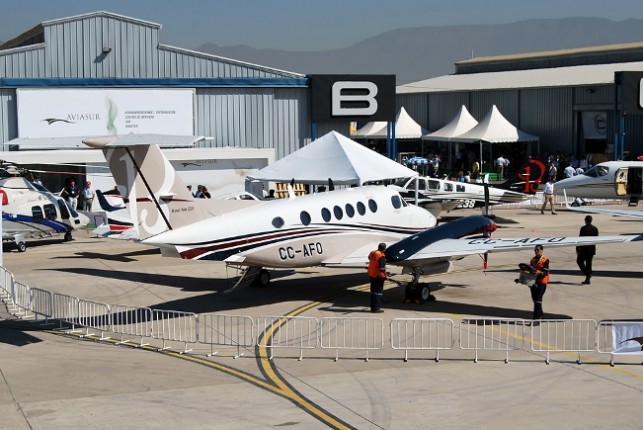

Updating and extending a relationship with FIDAE that dates back to the first FIDA edition in 1980, a workhorse in the Beechcraft stable was again on display at the fair in 2012. In spite of nearly five decades since first flight, what is now known as the Hawker Beechcraft King Air showed and told its value proposition for several applications in the executive and general aviation categories. As noticeable in the table below, King Airs and Super King Airs have been featured in at least nine editions of the fair and have been shown in a diversity of variants and owners throughout the years. From a CORFO King Air A100 to the first of only four cargo-door fitted Super King Air 200CTs (a Chilean civil aviation authority aircraft), from an Argentina Navy-modified maritime surveillance Super King Air B200 to several manufacturer demonstrators. For the first time in FIDAE, though, the aircraft was being exhibited and marketed by Aviasur, an integrated aviation unit formed in 2010 inside the Matetic business group to provide FBO, maintenance, air taxi and dealership services for Hawker Beechcraft, AgustaWestland and Diamond aircraft and helicopters.
King Air appearances at FIDA & FIDAE (1980-2010) |
||||||||||||||||||||||||||||||||||||||||||||
|
Ironically, this impressive presentation was taking place amidst uncertain times for the Wichita manufacturer. As the show was in full swing, aerospace and financial media started spreading rumours about a potential Chapter 11 filing due to Hawker Beechcraft’s heavy financial debt and bleak operating results. While announcing a late filing of its annual report on 2 April, Chief Executive Officer Robert S. (Steve) Miller said the on-going crisis revolved “around changes we are working on to restructure the debt taken on in 2007 when the company was acquired”. In March that year, the company was sold by Raytheon to GS Capital Partners and Onex Partners for approximately US $ 3.3 billion in cash. After a best-selling year in 2008, net sales, deliveries and orders declined year after year due to “the condition of the U.S. and global economies, the exchange rate of the U.S. dollar compared to other currencies, corporate profits and geopolitical events”, as stated in the 2011 annual report unveiled on 16 April. In 2011, the report said, the company booked US $ 2.4 billion net sales (13% below 2010 figures) and delivered 213 aircraft (an 11% decrease) while employing approximately 7,400 people (23% increase).
FIDAE 2012 offerings

The King Air was undeniably the final stage in the successful evolution initiated in 1945 by Walter and Olive Ann Beech with the popular Model 35 Bonanza. By stretching and powering up the basic Bonanza structure, they evolved the design into the Model 50 Twin Bonanza (first flown in 1949), the Model 65 Queen Air (1958) and, ultimately, the Model 90 King Air (1963). The turboprop branch of the family tree would stretch further, from the basic 9-seat Model 90 into the 15-seat Model 100 King Air (1969), the T-tailed Model 200 Super King Air (1972) and the more powerful Model 300 (1981). The type was also favoured by a growing military customer base, seeing action in electronic surveillance, reconnaissance, maritime patrol and utility transport duties both in the United States and abroad. The three basic surviving product lines (models 90, 200 and 300) started being sold under the consolidated “King Air” brand when the “Super” prefix was dropped in 1985 and remained in production through 2012, with well over 6,900 aircraft having been built since 1963.

Displayed centrally in the large Aviasur outdoors exhibition area was the first Chilean example of the King Air 250, CC-AFO, formally registered and operated by local air taxi, Aerocomercial Andes Air. The most recent variant in the 200 series (certified by the US Federal Aviation Administration in 2011), the King Air 250 evolved from the King Air B200GT attaining increased performance, range and payload by the addition of BLR Aerospace composite winglets (previously available as add-ons), Hartzell composite four-bladed scimitar-shaped propellers and a Raisebeck Engineering ram air recovery system. These features alone improved take-off roll by 18%, allowing the 250 to “access airports inaccessible to previous King Airs and strictly off limits to jets”, as Hawker Beechcraft literature put it. These performances were sure bound to make it attractive to regional corporations in need of a fast and reliable executive transport capable to access both international high-traffic areas and remote hard-to-access locations.

In addition, its square oval cabin accommodated six passengers plus a flight attendant in a comfortable environment incorporating “dual-zone climate controls and rotating, polarized sun shields” and “advanced sound-dampening technology” while the aft stowage area was “pressurized, heated and accessible in flight”. Providing what the manufacturer defined as “a simple, sophisticated and fully integrated” flight control system, the 250 packed the latest and most advanced in automation technology: Rockwell Collins Pro Line 21 avionics suite, three-screen electronic flight instrument system (EFIS), integrated flight information (IFIS), engine indicating (EIS) and flight management (FMS) systems, dual air data computers, altitude encoders and attitude heading reference systems (AHRS) and MDC-3000 maintenance diagnostic computer. Designed with pilot feedback generated in millions of flight hours and combined with an enhanced ground proximity warning system (TAWS+), wind shear alert and a traffic collision avoidance system (TCAS I), these features would allow King Air customers to “fly safely in all types of weather conditions, day and night”.

Another King Air airframe exhibited outdoors during the week end by Aviasur was as local sampler of the King Air 350i version. Registered CC-ABJ, the aircraft was flying for Aviasur Charter Services (a subsidiary of Hawker Beechcraft’s local dealer) and was marketing the largest, more powerful variant in the King Air product range. Powered by two 1,050 shp Pratt & Whitney Canada PT6A-60A engines, the 350i could carry up to two more passengers, fly 1% faster and up to 175% farther than the 250 described above; yet retaining many of the technical and on-board features found in its younger stable mate. Additionally, “the 350i’s Flexcabin system easily reconfigures seating to accommodate a variety of missions, from staff and VIP transport, to equipment and cargo” while a “Rockwell Collins Venue cabin management system delivers digital connectivity and entertainment to every passenger” on board, as described in company brochures. Feeding our suspicion that the “i” suffix on “350i” stands for “internet” or maybe “interactive”, the passenger cabin includes standard iPod docking station and an entertainment cabinet and can optionally be fitted with 10.4” personal video displays and Aircell Axxess II Iridium satellite communications systems.
Quo Vadis, Hawker Beechcraft?

Weathering the financial storm mentioned above, CEO Steve Miller explained on 2 April that Hawker Beechcraft continued to work “toward a comprehensive recapitalization [that will] better position the company for the future”. While asserting that the majority of the issues in recent financial statements reflected results as of 31 December 2011, he said the company had subsequently “moved aggressively to address many of these matters, most recently with our announcement […] that we have obtained additional liquidity from certain lenders to provide us with the time and flexibility to restructure the company’s balance sheet and better position Hawker Beechcraft for the long term”. Furthermore, their 2011 annual report said they would not cease operations in Plant I as previously envisaged; but also said they were “beginning to furlough employees in various departments […] as a result of difficulty in obtaining adequate composite materials in order to continue production as well as matching production to demand”. Their market trends were not very enthusiastic either, since the report expected “the business and general aviation industry as a whole will continue to experience depressed demand during 2012”. Not surprisingly, thus, financial and industry analysts have started evaluating attractive assets and market share that could be absorbed by other companies, including competitors such as Cessna and Embraer. Will the King Air dynasty be one of the victims of this crisis?
Sources: AIN on line, Aviasur (official), Aviation Week, BLR Aerospace (official), DGAC Chile (official), Hawker Beechcraft (official), Ian P. Burnett: Civil Aircraft Registers of Chile (Air Britain, England, 1985), R. W. Simpson: General Aviation (Airlife, England, 1995), Raytheon (official), Terra Chile/Economía and The Wichita Eagle. Luis Quintana also contributed to this report.

