
Formally speaking, Chile’s Air Force (Fuerza Aérea de Chile, FACH) was commemorating two historical events: The creation of the El Bosque Military Aeronautics School on 11 February 1913 and Chile’s first military flight by Captain Manuel Avalos Prado the following 7 March. Below the surface, however, FACH was furthering the military aviation contribution to national development and ostensibly portrayed only service evolution in the last 100 years. From Avalos’ founding flight to the first crossings of the Andes in 1918; from route-proving flights to Tacna in 1924 to creation of embryo airline LAN in 1929; from early exploratory raids abroad in 1922 to establishment of FACH in 1930. Or the additional capabilities added in the second half of the 20th Century with initial Antarctic (1947), Easter Island (1951) and massive disaster relief flying operations (1960). Or, more recently, with international projections gained through peacekeeping forces (1991) and initial deployments to the US (1998) and, ultimately, by crossing the “last frontier” to initiate space projects (2000).

Emphasizing that evolutionary track record, Commander-in-Chief, General Jorge Rojas Ávila, packed his centennial ceremony speech with figures illustrating how FACH has contributed to national integration and economic development in the last 100 years. He went into details by reviewing the process from inception into the 3 million people Chile of 1913, through several of the milestones in the last paragraph to the “modern and integrated” aviation system presently “contributing to the defence, connectivity and development” of their 16.5 million inhabitants. Highlighting FACH’s influence outside the purely military arena, Rojas also gave Air Force a good deal of credit for the development of a solid aerospace infrastructure and their support to a dynamic commercial, civil and sports aviation industry now operating well over 500,000 flights and carrying 15 million passenger per year with a fleet of “more than 1,600 civil-registered aircraft, sharing a 347-airport and 127-heliport network with their military counterparts from Arica to the Antarctic and overseas territories”.

Gratitude was also shown for FACH’s peer services due to their contribution to service foundation in 1930. Said Rojas: “From our military and naval ancestors, we got not only their crews, aircraft and facilities, but also a valuable legacy of experiences, values and traditions which have always eased our understanding and joint action in the framework of National Defence”. Appreciation was also shown for FACH’s 24 previous commanders-in-chief, the 10,000 officers graduating from the Aviation School since 1942 and the about 85,000 people who have integrated the institution throughout its history and “have kept it flying by and for the Chileans”. President Sebastián Piñera Echenique attended the centennial ceremony at El Bosque and was quoted as praising FACH for “always [being] at the forefront [of progress]” as well as for being “an integrating element which has helped [Chile] reach out to neighbouring countries” and the rest of the World.

El Bosque: From Blériot XI to F-16… in 100 years
The main ceremony started mid-morning on Wednesday 7 March at Aviation School facilities in El Bosque. Following conventional protocols, Air Force Commander-in-Chief Rojas, Minister of Defence Rodrigo Hinzpeter Kirberg and President Piñera got the event underway by reviewing about 1,000 Air Force, Army and Navy troops assembled on the ground. Twenty Aviation School T-35 Pillán trainers then flew West-to-East forming a “100” figure to represent the centennial and General Rojas took the stand as the event’s sole speaker. Next, the heads of the Argentine, Brazilian, Canadian, Colombian, Spanish, Paraguayan, Peruvian and Uruguayan air forces were bestowed the “Chilean Military Aviation and Aviation School Centennial” cross; with their counterparts from Germany, Ecuador, the USA, Italy, the UK and Turkey scheduled to get it through Chilean diplomats in their home countries. The cross was also conferred to the heads of all other Chilean defence and security services (Army, Navy, Carabineers and Investigations Police), Minister Hinzpeter and President Piñera plus the Aviation School, Naval Aviation and Army Aviation flags.

The ceremony was rounded-up by a 30-minute parade featuring Chilean troops, weapons systems and aircraft and eleven foreign delegations. The ground parade segment got under way with a FACH instrumental band tattoo demonstration followed by the Aviation School marching band taking up a central stand to provide the parade’s musical background. Leading the marching troops were Blériot XI replica “Capitán Avalos” and three crewmembers (pilot and two mechanics) dressed-up in antique clothing to recall early Chilean military flyers. Next came the parade commander, his staff and a pack of FACH flags from all service units; followed by air force academy delegations from Germany, Argentina, Brazil, Colombia, Ecuador, Spain, the USA, Italy, Peru, the UK, Turkey and Uruguay. Cadet companies from Air Force, Army, Navy and Carabineer officer schools and several Air Force NCO School companies came in next, with Army Aviation and Naval Aviation detachments parading subsequently. The last formation was described as a “Rapid Deployment Detachment” and comprised a large number of anti-aircraft and special forces, commando and air infantry troops displaying man-portable an truck-mounted air defence missile, anti-aircraft artillery and radar systems.

The air parade section lasted a flashing 12 minutes and was initiated by the Halcones aerobatics team, whose Extra 300Ls flew from South-to-North while trailing smoke with Chile’s national colours (red, white and blue); followed by fifteen Aviation School T-35 Pillán trainers. As Army and Navy troops marched on the ground, three Army Aviation AS532 Cougar and one SA-330 Puma helicopters and two Naval Aviation EADS C295 maritime patrol aircraft and two Pilatus PC-7 trainers flew-by. FACH’s air combat elements came in next and comprised eight EMB-314 Super Tucano lead-in fighter trainers from Aviation Group 1 as well as a 24 Fighting Falcon pack: Four F-16C and four F-16D from Group 3, one F-16B and seven F-16A from Group 7 and two F-16B and six F-16A from Group 8. Closing the air element, logistics and support formations consisted of one Boeing 707, two KC-135Es and two Hercules from Group 10 and three Bell 412s, three UH-1H Hueys and two JetRangers from Group 9.

Open Day at Pudahuel
While the weather was not entirely forthcoming for the main event (an overcast ceiling somehow shadowed the ceremony at El Bosque), a glorious sunny day blessed the general public event, an open day held at Pudahuel air base on Saturday 9 March. All resident and several visiting FACH units put up an attractive show, both on the ground and in the air, throughout the day. Group 10 had two KC-135Es, two Hercules, two Boeing 737s, one Boeing 707, one Boeing 767 and one Gulfstream on static display; with a further C-130H and KC-135E on the flight lines. Group 9 was showing statically two Bell 412s, two Hueys and two JetRangers, with a further two Bell 412s and two UH-1Hs in the flight lines. The Photo Service contributed with two Twin Otters, one Learjet 35A and one Piper Dakota on the ground. The Aviation School showed its latest Pillán on the static display, Group 7 showed one F-16B (static) and two F-16A (flying) and the Los Cerrillos museum contributed a couple exhibits from their collection.

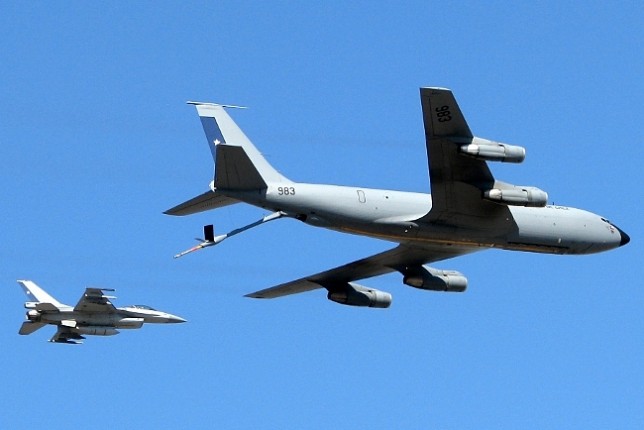
Most interesting, though, were the flying demonstrations over the air base. Lasting little more than two hours each, morning and afternoon programmes were initiated by a Group 10 Herk performing a short field take-off and tactical operations exhibition. Group 7 showed two concise F-16A Fighting Falcon display routines and Group 9 provided a Bell 412 search and rescue and an UH-1H Huey combat rescue operations. The Hercules also dropped several members of the Blue Berets (“Boinas Azules”) parachute demonstration team while a Group 10 KC-135E Stratotanker also made an individual display and later paired with one of the Group 7 Vipers for an in-flight refuelling fly past. Visiting from El Bosque, the Halcones aerobatic team deployed their Extra 300Ls for their last show under the aegis of Capt. Víctor Gallardo R., who handed command over to Cmdr. Cristián Bolton D. during the evening. Sadly enough, this was also the last show for Halcón #5, Lt. Eduardo Varas D., and maintenance supervisor, NCO Cristián García F., who died on Friday 15 when their aircraft crashed at Quintero air base.

Participating aircraft
Below is a list of all aircraft noted at the centennial celebrations. Aircraft marked with a plus sign (+) took part in the main air parade on 7 March (five additional Pillanes also formed the 100 figure at El Bosque). Aircraft marked with an asterisk (*) were noted in the static display at Pudahuel, while those marked with a cardinal sign (#) were noted flying or at the flight lines during the open day. Construction numbers, when shown, were actually checked on site.
| Operator | Type | Identities and remarks |
| Army | ||
|---|---|---|
| Helicopter Btn. | AS532AL Cougar | H282+ “Co. La Campana”, H286+ “Co. Caracol”, H287+ “Co. Puntiagudo” |
| Helicopter Btn. | SA-330L Puma | H263+ “Co. Sombrero” |
| Air Force | ||
| Aviation School | T-35 Pillán | 111+, 112+, 115, 118, 119+, 121+, 122+, 126+, 128, 130, 131+, 132+, 133, 135+, 136+, 139+, 142+, 145+, 149+, 151 (c/n 237)+* |
| Group 1 | EMB-314 Super Tucano | 451+*, 454+, 455+, 457+, 458+, 460+, 461+*, 462+ |
| Group 3 | F-16C Fighting Falcon | 851+, 852+, 853+, 855+ |
| Group 3 | F-16D Fighting Falcon | 857+, 858+, 859+, 860+ |
| Group 7 | F-16A Fighting Falcon | 741+#, 744+, 749+, 751+, 752+, 754+#, 755+, 758+ (underscored items carried no unit marks) |
| Group 7 | F-16B Fighting Falcon | 734+ (no unit marks) |
| Group 8 | F-16A Fighting Falcon | 721+, 722+, 723+, 728+, 729+ |
| Group 8 | F-16B Fighting Falcon | 736+, 738+* |
| Group 9 | UH-1H Huey | H-76+ (rescue configuration), H-80* (armed configuration), H-83?+, H-90+#, H-93* |
| Group 9 | Bell 206 JetRanger | Not noted x 2+; H-22*, H-24* (c/n 4025) |
| Group 9 | Bell 412 | Not noted x 3+; H-47#, H-49*, H-54#, H-55* |
| Group 10 | C-130 Hercules | 995+*, 996+#, 998* |
| Group 10 | Boeing 737-300 | 922* (grey c/s) |
| Group 10 | Boeing 737-500 | 921* (presidential c/s) |
| Group 10 | Boeing 767-300ER | 985* (grey c/s) |
| Group 10 | EB-707 Condor | 904+* (grey c/s) |
| Group 10 | Gulfstream IV | 911* (presidential c/s) |
| Group 10 | KC-135E Stratotanker | 981*, 982+*, 983+# (grey c/s) |
| Halcones | Extra 300L | 1, 2, 3, 4, 5 (all +#) |
| Photo Service | DHC-6-200 Twin Otter | 939*, 940* |
| Photo Service | Learjet 35A | 351* (grey c/s) |
| Photo Service | PA-28 Dakota | 223* |
| Sailplane Flight | Janus | V-16*, V-18*, V-23* |
| Sailplane Flight | Nimbus | V-25* |
| National Air and Space Museum | ||
| Halcones | Extra 300 | 1* |
| Halcones | Pitts S-2A | 4 (static at El Bosque) |
| Blériot XI (replica) | “Capitán Avalos” (ground parade at El Bosque) | |
| Bristol M1C (replica) | C-4987 (static at El Bosque and Pudahuel) | |
| PT-19A | 64/CC-DMF | |
| PT-23 | 40 | |
| T-35 Pillán | YBT (static at El Bosque) | |
| Navy | ||
| VP-1 Squadron | EADS C295 | Not noted x 2+ |
| VT-1 Squadron | PC-7 | Not noted x 2+ (one shark mouthed) |
Bibliography: World Air Forces Directory (Mach III, United Kingdom, 2000).
Internet sources: Brazilian Air Force (official), Chilean Air Force (official), Chile Defensa (blog), Colombian Air Force (official), Halcones (official), Modo Charlie, Paraguayan Air Force (official), Peruvian Air Force (official), Royal Canadian Air Force (official), Spanish Air Army (official), Scramble and Uruguayan Air Force (official).
Acknowledgments: Luis Quintana contributed to this report.

