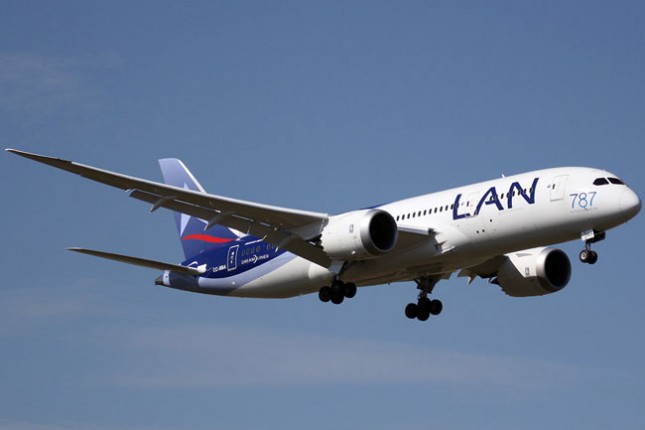

As it has been the case in a few other reports in the “Flight Critic” series, family affairs and the need to visit Buenos Aires before Christmas and New Year proposed me and my teenage son our first chance to experiment a flight in what Boeing defines as a plane that is “more than a dream”. Having followed the type’s first appearance at FIDAE 2012 and having failed to qualify for press flights with both the manufacturer and its first operator in the Americas, a fare-paying trip was the only way to get on board LAN Airlines’ ultimate bet to “deliver the best travel experience” for their passengers. As it will be remembered, the type was first exhibited in South America in FIDAE (March) and, after taking delivery of their first Dreamliner in late August, LAN started commercial services to Buenos Aires (Argentina) on 1 October, Lima (Peru) on 1 November and Los Angeles (USA) on 31 December 2012.

Trip planning and purchase commenced as soon as Dreamliner flights started being advertised by LAN in September. After scanning rates for several weeks, on 19 October I settled down on my lowest-rate/best-date combination. Having discarded more expensive alternatives in October and November, I chose to make this a three-day round trip departing Friday 30 November. After playing with different combinations in LAN’s amicable Internet pricing application, total cost was hammered out at US $ 279 (plus US $ 76 in taxes) and was paid in local currency with my Chilean credit card (three monthly instalments, interest-free). The only down side to the process was that I was unable to strike a “double Dreamliner” and only the return leg was purchased in Boeing’s ultimate creation. So, in addition to expecting an “ordinary” Airbus A320 outbound leg, I would spend the remaining 40 days praying that God and LAN would not change aircraft types on the return leg… and convincing the wife that my Dreamliner ticket was no more expensive than an “ordinary” one!

In spite of its “ordinary” character (this was my 24th flight on this type/route combination), the outbound ride was to feature some surprises. After an early morning check-in (we had to show up at the airport at about 3:30 am!) and sleepy wait for boarding time, we were driven to our plane by bus rather than the customary bridge embarkation. Once at the tarmac (parking position 8 or 9, if I am not mistaken), I was amazed that our plane was not a Chilean-registered aircraft but LV-BFO, LAN Argentina’s only A320s with special One World livery. Once on board, we were greeted by a distant all-Argentine cabin crew with an ear-hurting command of the English language and a good selection of newsprint options (El Mercurio and La Tercera from Santiago, La Nación from Buenos Aires). In-flight service included an acceptable snack (blueberry muffin, Juan Valdez coffee, beverages and juice) and a limited entertainment system (several audio channels were off and TV featured only a Southern Brazil wineries documentary and a “One and a Half Men” episode). The landing in Buenos Aires was a bit bumpy, but nothing serious at all.

My first Dreamliner!
After spending most of our Buenos Aires time visiting family and friends, we started the return leg with an early and uneventful Sunday midday check-in at Ezeiza (we arrived into the boarding area about two hours before departure!). At first impression, the boarding process realised several value propositions in Boeing marketing literature. Entering the passenger cabin was made easy by Dreamliner’s ample access door, while transiting to the Economy section was also straightforward and allowed us to take a quick glimpse of Premium Business class accommodations. Cabin illumination was superb, combining strong natural daylight entering through the type’s ample windows with selective violet, orange or white light on overhead bins and aisles and over passenger seats. Economy seats size was “just about right” in width (81.2 cm) and pitch (42.7 cm) for this 1.74 m tall passenger and his aviation photography back pack and proved to be marginally more comfortable than those in the outbound flight.

Once boarding was completed, the captain gave us a special welcome speech around the “First in the Americas” score attained by LAN after becoming the first airline to start Dreamliner scheduled service in the entire American continent (United Airlines came in second place three months later by flying from Los Angeles to Tokyo, Japan). Much to my satisfaction, my first Dreamliner flight also registered several records in my own log book. The aircraft itself was LAN’s first 787 (registration CC-BBA, construction number 38471, line number 68) and the plane that launched Dreamliner service in the Americas by linking two of the most relevant cities in my life (my hometown, Buenos Aires, and my residence for more than a decade, Santiago de Chile). The route was, naturally, the first LAN Dreamliner itinerary in history and, last but not the least, the captain was Jaime Quiroga, the pilot at the helm of CC-BBA on the historic 1 October 2012 flight to Buenos Aires!

Dreamliner’s in the details…
To fully understand the improved passenger experience proposed in Dreamliner and LAN marketing campaigns, the observer must be very attentive to small details, for it is a collection of fine points that make the experience come true. In my LAN 456, Economy seats were fitted with adjustable headrests and reclining positions providing 6-way regulation for passenger comfort. Dining tables were fitted with internal and external cup-holders releasing vital table space and providing secure support for glasses both during and after the meals (it would be a pity to spill some of the fine South American spirits served in LAN flights!). The overhead passenger service unit provided individual air flow and powerful reading lighting, while the overhead bins were as spacious and easy to use for carry-on luggage as advertised. The literature pocket under the dining table was built in semi-rigid material and was shaped to provide “more room to keep your things handy”, as described in this LAN Dreamliner interactive website.

A few even more daring innovations in the passenger comfort area were to be found and tested in this first Dreamliner expedition. Even though it was not very much evident in such a short flight (from break-release in Ezeiza to touch-down in Santiago, our total flight time was 1:47 hour), air conditioning systems are purportedly equipped with a variety of filters to remove ozone, bacteria, viruses, fungi, odours, irritants and gaseous contaminants that is said to result in a less sickening travel environment (fewer passenger dizziness, headache, eye irritation and dryness complains). In addition to their 40% larger size (a welcome feature for aircraft and airport photographers!), windows were built with polarized materials providing 5 degrees of external lighting, from totally clear to totally dark. Above and beyond their new design and larger dimensions, lavatory rooms were equipped with toilets that automatically closed the lids when the flush button was pressed… amazing detail!

Entertainment, LAN Dreamliner style…
The single most striking feature in LAN’s Dreamliner, however, was its comprehensive in-flight entertainment system (IFE). Hardware-wise, the passenger’s front panel featured a 9-inch touch screen and connections for headphones, Apple eXport systems and USB multimedia devices; while an electric outlet supporting several international formats was available under the seat. On-screen contents were supplied in three different languages (Spanish, English and Portuguese), with an equally tri-lingual simplified version for kids. Applications accessible through the screen were grouped in two neat menu bars; while an elegant passenger service unit control panel and flight time icon were always visible in the upper right corner. Most passengers spent their flight time browsing through a hefty list of multimedia contents, including a selection of 100+ movies, 40+ TV shows, 800+ music CDs and an unchecked number of games. Rounding up what I think was the most entertaining IFE I’ve ever used, miscellaneous information was also available through flight map, food offerings and duty free shop data, airline marketing videos and contacts, external devices integration functions and assorted options.

Inevitably, I made a few controversial annotations during the flight or while preparing this report. First, headphones handed over by the crew were fairly cheap (my first two broke all too easily!) and their audio quality and volume were unconvincing. Next, even though LAN promotional materials boast to provide “the best flavours of the region” at the passenger table, our meal service was again a basic snack (ham and cheese ciabatta sandwich, coffee, juice, beverages and peanut chocolate). Third and last, a few seats in the Economy cabin are to be used with caution… or not at all! Seats 28A and 28L are missing a window, while lines 18 through 20 are too close to the mid-cabin lavatories and galleys and may turn out to be bothersome in lengthy flights. And images provided by a fellow frequent flyer show that Premium Business seats in line 1 (particularly A, B, D and H) have been positioned excessively close to (not to say inside of!) the front galley and may happen to be intolerable to the average business traveller.

As it may have been noticed, my general passenger experience aboard this first LAN Dreamliner flight was definitively above average. The flight was smooth and entertaining and helped me attest that many of the innovative features advertised in Boeing and LAN marketing kits were indeed present under everyday operating conditions. Luckily, there was neither electrical fire nor smoke to report in my flight (nor in any other LAN 787 flight, as the airline asserted when announcing plans that will put the type back into service were under way in mid-April). So it is now up to the airline and Boeing technicians to apply the same Federal Aviation Administration-approved modification that put the Dreamliner back into commercial service on Friday 27 April, when an Ethiopian Airlines flight linked Addis Ababa to Nairobi (Kenya) safely.
Flight log: Airbus 320 & Boeing 787
| Parameter | Outbound leg | Inbound leg |
| Date | Friday 30 November 2012 | Sunday 2 December 2012 |
| Flight number | LA 4645 | LA 456 |
| Operated by | LAN Argentina | LAN Chile |
| Aircraft type | Airbus A320-200 | Boeing 787-8 |
| Registration | LV-BFO | CC-BBA |
| Captain | Gustavo Raglianti | Jaime Quiroga |
| Take off | SCEL 17R @ 1112Z | SAEZ 29 @ 1849Z |
| Landing | SAEZ 11 @ 1240Z | SCEL 17L @ 2036Z |
| Flight time | 1:28 hs | 1:47 hs |
| Route | Santiago – Rancagua (Chile) – San Rafael – General Pico – Ezeiza (Argentina) | Ezeiza – Junín – Laboulaye – Villa Reynolds – Mendoza (Argentina) – Los Andes – Santiago (Chile) |
| Cruise altitude | 35.000 ft | 40.000 ft. |
Internet sources: 24 horas, Airliners, Bibliotecas DUOC UC, Boeing’s New Airplane (official), Fox Business, LAN Airlines (official), ModoCharlie, NBC News, Nomadistas, RPP, Seat Guru and United Airlines (corporate).
Acknowledgements: A. Baranek and C. H. García contributed to this report.

