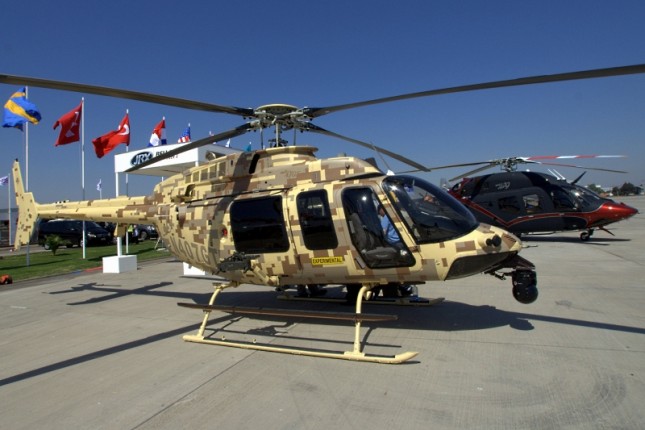


Furthering their long-standing relationship with Latin America, Bell Helicopter attended FIDAE with a potent team of executives and a variety of new offerings. The company entered the region’s market more than 60 years ago and nowadays claims 37% market share (1,670+ aircraft flying for 540+ operators in the area). Attesting to the regional market potential, more Bell helicopters were sold in Latin America than in any global region besides North America in 2012 and 2013. Powering that goal, the company was showcasing the Bell 407GT and Bell 429WLG (both introduced in 2013) in both static display and demonstration flights. The newly introduced Bell 505 Jet Ranger X was also displayed with a full-size mock-up illustrating its law enforcement configuration.
The newest member of Bell Helicopter’s family, the Bell 505 Jet Ranger X is a customer-driven design, blending proven systems with advanced technology and a sleek, modern design. The Bell 505 places safety, performance and affordability at its forefront. Fitted with Garmin G1000H Integrated Avionics Suite to maximize pilot situational awareness and powered by a Turbomeca Arrius 2R engine with dual channel Full Authority Digital Engine Control (FADEC), the model features a high inertia rotor system delivering superior auto rotation capabilities.
The Bell 407GT is the company’s armed version of the best-selling Bell 407GX, qualified for a range of weapons from light o advanced laser-guided munitions. The state-of-the-art tactical light commercial helicopter brings together the Garmin G1000HTM flight deck with precision weapons capability. Standard specifications include an infrared camera system, weapons management system, universal weapons pylon, tactical radio suite, target sight system, sliding doors for rapid egress and ingress on both sides and high-visibility windows and door for the cockpit.


The Bell 429WLG can land in a larger number of environments and conditions, providing operators of all mission profiles additional flexibility. Its taxiing capability is ideal for both repositioning in limited spaces and situations that require ground taxi, such as positioning closer to fixed-base operators. These benefits mean that both flight crews and passengers can save time and effort getting where they need to go. The Bell 429WLG also has reduced drag due to the loss of skids and an increased cruise speed. The Bell 429 is approved to operate at an increased gross weight of 7,500 pounds (3,402 kilograms) in several Latin American countries, including Argentina, Brazil, Chile, Ecuador, Mexico and Venezuela; while the Bell 429WLG is approved for gross weight increase in both Canada and Brazil, with other certifications currently in work.
Commercial fleet in Latin America to grow more than 70% in 20 years
Gaceta Aeronáutica was able to talk to Bell Helicopter officials at the show and submitted a list of questions to Jay Ortiz, Managing Director of Sales for Latin America, about their most recent appearance at FIDAE and their relationship with Latin America. Excerpts:
Gaceta Aeronáutica: Do you see any meaningful competitor in the region other than Airbus Helicopters, whom boasts to control 40% of the market? How do you expect to confront them and other competitors in Latin America?
Jay Ortiz: Bell Helicopter has the current largest installed fleet in the region for combined in-service, civil and turbine aircraft at 37 percent. We actually sell more aircraft in this region than anywhere in the world besides North America and also produce more commercial revenue in Latin America than anywhere else in the world. Our focus is to continue to modernize our product line with the latest technology so we can meet the current and future needs of customers in this region. In the past few years, we have introduced the Bell 429, Bell 407GX, Bell 407GT, Bell 412EPI, Bell 505 Jet Ranger X and Bell 525 Relentless, giving us a range of product to meet a diverse set of mission needs with some of the latest technology available in the market today. We expect to see the installed commercial fleet in Latin America grow more than 70 percent in the next 20 years, so we see a strong opportunity for the future.


Gaceta Aeronáutica: How is your sales and support network organized in the region? Do you feel this is adequate for your present market share and future forecasts? Do you plan any changes or improvements? Can we expect to see Bell subsidiaries or joint ventures coming out in the region in the near future?
Jay Ortiz: We currently have six sales managers in the region plus additional support personnel reporting directly into me as well as 19 Bell Helicopter-authorized independent representatives selling on our behalf. In addition, we have nearly 50 combined customer service engineers, product support engineers and regional service managers currently in Latin America. There are also a dozen Bell Helicopter-authorized customer service facilities in the region as well. We continue to be recognized for our industry leading global services and support, including our twentieth consecutive first place finish in Pro Pilot’s service and support rankings.
We continue to look for other opportunities to expand not only our personnel, but our overall presence in the market. This includes items such as training, parts distribution/storage, maintenance, repair and overhaul and assembly.
Bell 505, 407 and 407GX are options for the Chilean Navy
Gaceta Aeronáutica: Which are the Bell Helicopter’s product lines the you feel are more suited to Latin American military needs? Do you see your more sophisticated models (UH-1Y, AH-1Z, OH-56D, V-280) entering the region or focus will remain on upgraded legacy systems (Huey II) or militarized variants of your civil lines (Model 412, Model 505, Model 525)?


Jay Ortiz: We have historically supported the Latin American market with both our commercial and military products and will continue to discuss opportunities for both with current and potential customers. Last year, we introduced the Bell 407GT, the armed version of the upgraded Bell 407GX, and continue to have many positive conversations around that and other aircraft.
Gaceta Aeronáutica: Do you see any potential for the Jet Ranger X in “Project Seagull”, the Chilean Navy process to replace the Jet Ranger and Bo-105?
Jay Ortiz: Yes – we see the new Bell 505 Jet Ranger X, the Bell 407 and the upgraded Bell 407GX as options for the Chilean Navy. It depends on the capabilities the Navy will ultimately require of the aircraft in question.
Gaceta Aeronáutica: Which will be your approach to the Latin American civil sector for coming years? Do you see your entire line of products making new or further inroads into the region? Can you elaborate on individual key models?
Jay Ortiz: We are very excited to offer a full line of recently upgraded or entirely new products in the region. We not only see strong momentum for our current products, but have had a very positive response to both the Bell 505 and the Bell 525 as we get closer to first flight later this year. We see opportunities in every segment, but especially in the energy/deep off shore operations and VIP transport for the Bell 525 and in a variety of utility, parapublic, VIP and training segments for the Bell 505. The Bell 429WLG, recently introduced at NBAA 2013, also provides flexibility for customers in crowded areas such as Sao Paulo for corporate and EMS missions. It’s a very exciting time to be selling for Bell as our product line is arguably the deepest and most versatile it has ever been.


Gaceta Aeronáutica: Which are the sales strategy innovations you are incorporating with the Jet Ranger X? Do you expect to replicate your North American strategies in Latin America?
Jay Ortiz: One of the biggest sales features we have for the Bell 505 Jet Ranger X is offering customers the ability to configure their aircraft directly online from the comfort of their own home or business. Customers anywhere in the world can visit www.Bell505.com, select the “Build Yours” option and create their ideal aircraft. We are also supplementing the website with specific activities targeted to the region, but the idea is to meet our customer base wherever – and however – they prefer.
Gaceta Aeronáutica: Which of the market segments in your sales strategy (corporate, HEMS, oil & gas, parapublic) is the one with the greatest potential for Bell in the region?
Jay Ortiz: We see opportunities in each segment for us with our modernized product line. For example, we see a big opportunity for the Bell 412EPI and the Bell 525 Relentless for the continued deep water energy operations in and around the Gulf of Mexico. For the Bell 407 GX/Bell 407GT, we see our biggest opportunities to be in the corporate and parapublic sectors. For the Bell 412EP/412EPI, we see a great deal of demand in the offshore and military market segments. For the Bell 505 Jet Ranger X, we see opportunities for individual users, law enforcement and even training – especially with its affordable price point and safety and performance capabilities beyond other aircraft in the SLS market. For the Bell 429/Bell 429 WLG, the flexibility of the platform is ideal for EMS, VVIP/corporate, oil and gas and even law enforcement missions. Finally, in addition to the oil and gas segment, we also see the Bell 525 having a strong opportunity to support VVIP transport needs.
Working closely with customers “to chart the future of rotorcraft”
Gaceta Aeronáutica: Did you realize any sales or deliveries at the show? Can you elaborate on the types, sales volumes and customers involved?
Jay Ortiz: No, we continue to have productive conversations with customers and will announce sales throughout the year.


Gaceta Aeronáutica: Which was the main message you expected to convey to your Latin American customers at this show?
Jay Ortiz: Bell Helicopter is working closely with our customers to chart the future of rotorcraft. We have spent the past several years listening carefully to our customers and incorporating their feedback to create a product line that will not only meet their current mission needs, but also continue to advance the overall capabilities of rotorcraft in the years to come.
Sources: Bell Helicopter and Bell 505.

