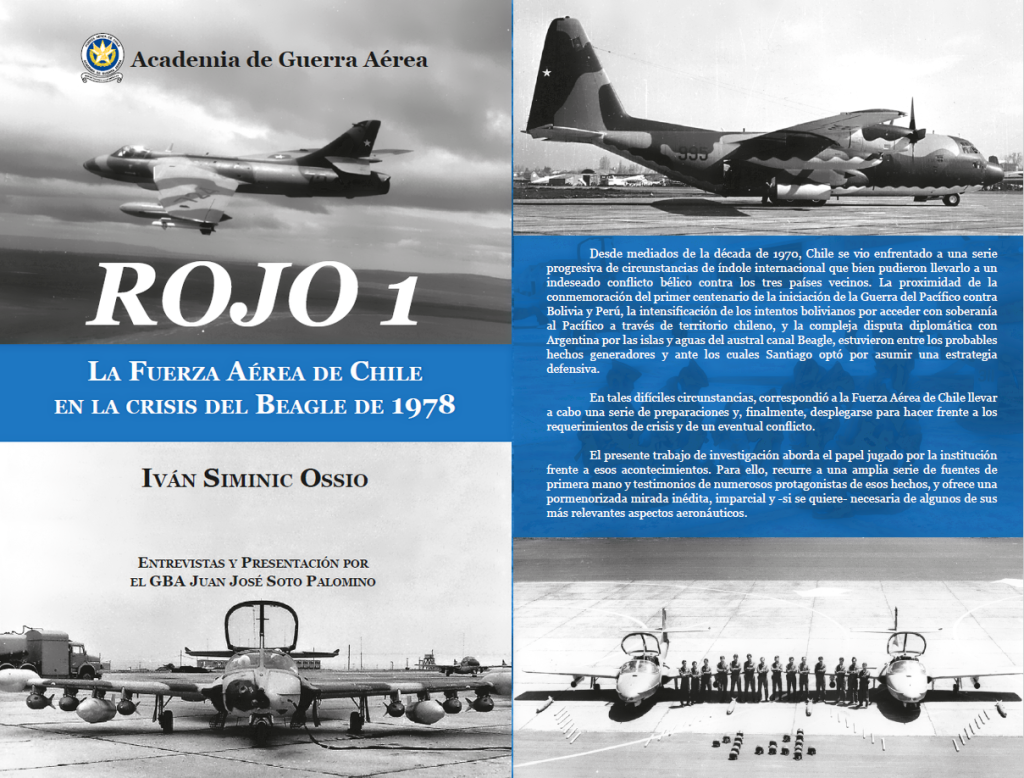
Largely unnoticed by mass media and most specialist outlets, Chile’s Air Force (Fuerza Aérea de Chile, or FACH) recently released the first edition of its official story about the air war that wouldn’t occur around the Beagle Channel dispute with Argentina in the late 1970s.
If you’re definitely interested in only learning about FACH moves to and from its Northern and Southern theaters in the second half of 1978, you can read chapter one to acquire a historical and diplomatic background to the Beagle Channel dispute and then skip directly to chapter five…
More than a campaign account
But the book goes well beyond the title proposition and half of its pages are devoted to render a detailed story of a maturity process which may as well explain the genesis of FACH’s present day amazing human and technological capabilities.

The book’s chronicle begins two decades before war nearly broke out on Christmas eve 1978 and it does so by reviewing the 1958 Snipe crisis, when both nations were involved in a minor diplomatic incident around lighthouses built and troops deployed to that Beagle Channel islet by both navies (chapter 2).
Even though the crisis was averted by diplomatic means, the authors mark the incident as the first of a series of border episodes which would increase tensions between Chile and its three neighbors and made it evident that their armed forces where definitely inferior when compared to those of Argentina, Bolivia and Perú (chapter 3).
“An air force is not to be improvised”
In the lengthy (115 pages) and juicy chapter 4, the author reviews FACH’s evolution from 100% US-influenced doctrines and equipment of the 1940s and early 1950s, through their first flirts with European suppliers during the 1950s and 1960s to the still US-dominated capability mix of the 1970s.

The chapter is also ripe with interesting details about US tutelage of FACH doctrine, equipment and rules of engagement, limited Chilean political interest and support to fund a more independent force structure beyond a few (but nonetheless meaningful) British Vampire and Hunter fighters acquisitions, and protracted or outright failed acquisitions of many different US aircraft types.
Most interesting, though, are the accounts of the failed acquisitions of F-86 Sabre (1960-1962) and A-4 Skyhawk (1965-1966) fighters, especially frustrating in light of their coincidential delivery to the neighboring Argentine Air Force, as well as the long and protracted courting with the Northrop T-38 and F-5… which started in 1961 and saw fruition only in 1973!
The last 170+ pages (chapter 5) provide a comprehensive account and testimonials of 1978 FACH redeployment plans, activation of reserves and civil resources, creation of ad-hoc flying and air defense squadrons alongside its Northern and Southern frontiers to counter the combined threat posed by Argentina, Perú and Bolivia activating Chilean militaries’ much feared triple-threat hypothesis…

The book is the result of a three-year research project led by general (retired) Juan José Soto Palomino, intelligence professor at FACH’s Air Warfare Academy, who conducted countless witness interviews and wrote the foreword, and was compiled by lawyer, aviation and defense academic, Iván Siminic, who is also known in our environment as the editor behind the blog, El Observador Aeronáutico.
Summary… recommended!
The book is particularly poor when it comes to illustrations (images and maps are scarce, poor quality and not necessarily correspond to the conflict’s time frame), information on Argentine air armed services comes completely from our fellow Argentine publishers, Avialatina and Australis | Núñez Padín, and it tends to abuse of excessive and repetititive witness testimonies.
But, beyond those “weak spots”, its inevitable nationalistic tone and one-sided points of view, the book is a worthwhile addition of knowledge to the little known air chapter of Chilean-Argentine border disputes in the second half of the 20th Century.

