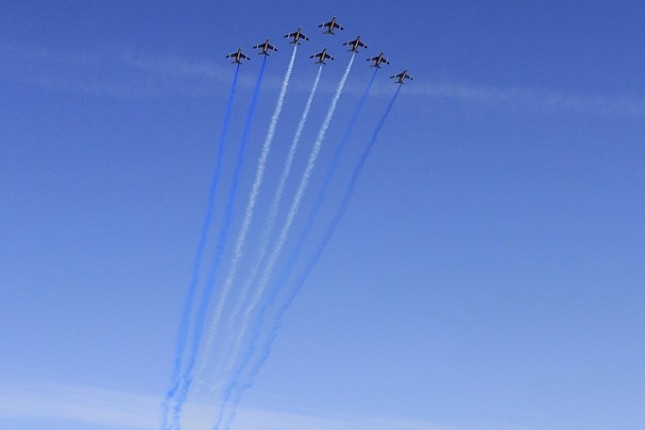

Air Force aircraft are scheduled to participate in the military parade that will mark the 200th anniversary of Argentina’s first “patriotic” (i.e. non-Spanish) government. The event is scheduled to start shortly after midday on Saturday 22 and will take place along “9 de Julio” Avenue in downtown Buenos Aires (C.F.).
A little more than 20 military aircraft will initiate the ceremony by flying over the parade ground from North to South at about 1:05pm (4:05pm UTC). The ground parade itself will march from South to North and will feature 3,000 Army, 800 Navy, 500 Air Force and about 200 security forces troops and an estimated 340 horses. Summing up the ceremony, a federal parade will see “urban and street bound” representations from several Argentine provinces marching down the “9 de Julio”.
The whole event is expected to last about two hours, although it will be conditioned by what appears as a non-too cooperative weather forecast. According to the National Weather Service, moderate North eastern winds are expected to maintain Buenos Aires under a cloud base which could lead to rain showers throughout the whole day.
Should ceiling and visibility conditions present themselves over minimum safety requirements (the flypast itself is projected at 1,300 ft. / 400 m), three VI Air Brigade Mirages, three V Air Brigade Fighting Hawks, three IV Air Brigade and one Flight Test Centre Pampas, two I Air Brigade F.28 Fellowships, four I Air Brigade Hercules, three III Air Brigade Pucaraés and three Military Aviation School Tucanoes could fly over the distinguishing downtown obelisk.
For those residing away from the parade venue, Argentine Public Television and news cable channel C5N will broadcast the ceremony live over Internet.
Santiago Cortelezzi, Ariel Haleblian, Martín Kubo, Gustavo Lepez, Julio Pérez Mugica and others whose names were withheld upon request contributed to this report, originally published by Aeromilitaria Argentina.

