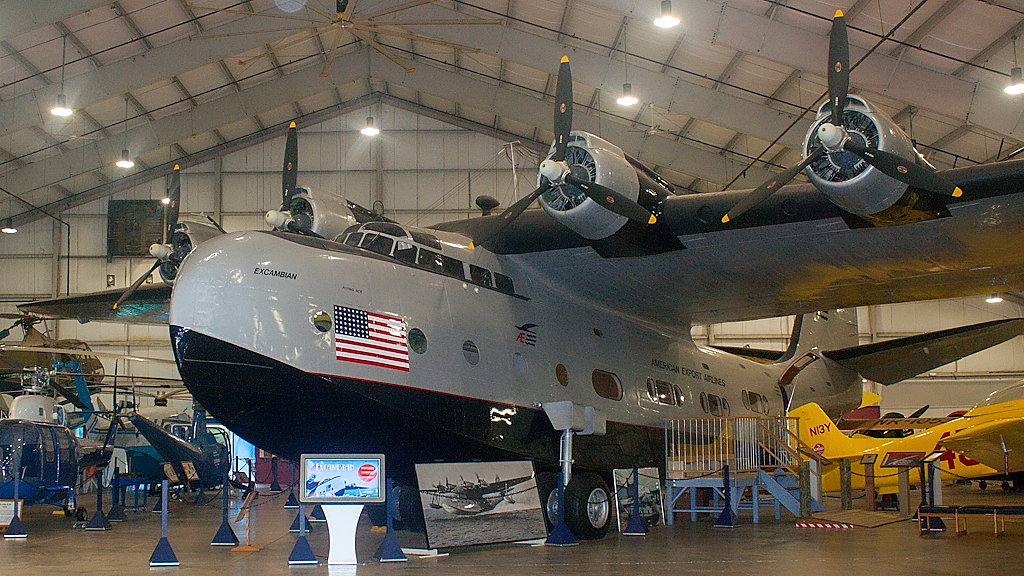
The third smallest state in the United States, yet the one with the largest average per-capita income, Connecticut possesses a rich aviation heritage curated by four different-sized museums located in the capital, Hartford, and New Haven areas.
Pioneering aviation state
Hot air balloons started flying from both those cities in the 1790s, America’s first controlled flight of a dirigible occurred in the state capital in 1878 and the first reliably documented flight of a heavier-than-air craft took place over New Britain in 1910.
Connecticut historians also boast that their state government was the creator of the world’s first piece of civil aviation legislation, the 1911 “Act Concerning the Registration, Numbering, and Use of Airships, and the Licensing of Operators Thereof”.


Growing public and business interest in aviation led to the appearance of pioneering enterprises building aircraft and dirigibles in the second half of the 1910s, the creation of aviation power plants giant, Pratt & Whitney, in Hartford and the Curtiss Flying School in Stratford during the 1920s.
In the early 1930s, Ukranian aircraft designer, Igor I. Sikorsky, selected Stratford for a seaplanes manufacturing plant, and Colonial Air Transport (now part of American Airlines), started providing regional passenger and cargo services between New York, Hartford and Boston.
Second World War brought about an unexpected bonanza for industrial production after the 1929 depression, with Pratt & Whitney manufacturing over 350,000 engines for military use, Hamilton Standard supplying countless aircraft propellers and Chance Vought producing F4U Corsair fighter aircraft for the US Navy.


Post war years continued to witness in-state aviation evolution: Commercial air transport development focused on Bradley International Airport (in Hartford’s suburban area), Sikorsky became the founding father of US helicopter industry, Pratt & Whitney entered the turboprop and jet ages in earnest (and even briefly played with the concept of nuclear energy for aviation power plants) and Sikorsky disciple, Charles Kaman, launched an independent business and turned into a wealthy reference in intermeshing rotor helicopter design.
Several of the firms listed above remain active and at the forefront of aviation technologies development and production to the present day, while Bradley International is a burgeoning facility supporting varied commercial, executive, general and military air operations.
Museum at Bradley International
The state’s #flagship museum is the New England Aviation Museum (NASM), located in Bradley International’s northeast corner in Windsor Locks, near Hartford.


At a modern and well maintained facility, the museum possesses four exhibition buildings, two maintenance/storage hangars, several outdoor exhibits and a deep storage sector dubbed “Area 51”, where access is naturally restricted…
Distinguishing features in the exhibition include a selection of World War II aircraft, including a fantastically preserved B-29 Super Fortress, several land and carrier-based fighters (including an impeccable P-47 Thunderbolt) and two medium bombers (a B-25 Mitchell and an A-26 Invader).
Cold War is also well represented, with several jets illustrating the era ranging from the Korean War in the 1950s to the fall of the Berlin wall in the 1990s and also showing a number of helicopters from the traumatic Vietnam War; several of them wearing markings from Connecticut or New England flying units.


The museum also pays tribute to the Airships era, propeller-drive commercial aviation and helicopters, with a variety of exclusive exhibits, including an awe-inspiring Sikorsky VS-44 seaplane, a beautifully restored Goodyear ZNPK dirigible cockpit, resplendent metal finished Douglas DC-3 and Electra 10 in Eastern and Northwest Airlines (respectively), exotic helicopter prototypes by Sikorsky and Doman and the ugly and recently restored Burnelli Loadmaster N17N.
Last, but definitely not the least, NEAM also illustrates aviation contributions to progress by helicopter pioneers, Igor Sikorsky and Charles Kaman, and involvement in aviation and US foreign wars by different social groups, such as New England’s women in aviation, the Tuskegee airmen or the Polish Kosciuzskko Squadron.
Twenty miles south of NEAM, Pratt & Whitney maintains a Hangar Museum (P&WHM), at its corporate headquarters in East Hartford, where company legacy, memorabilia and historial artifacts are on display for both employees and visitors alike.


The facility, which also fulfills a role as a huge two-hangar meeting hall for internal events, preserves a fascinating collection of Pratt & Whitney engines, scale models and displays curating company history since Faye Rentschler broke ground for their first engine-manufacturing plant on 07/16/1929.
New Haven entries
Closer to the Long Island Sound, at the northwest corner of Stratford’ Sikorsky Memorial Airport, lies the Connecticut Air & Space Center (CASC), an aspiring museum project housed just beside the historical Curtiss Flying School hangar.
In addition to preserving an interesting collection of aircraft and helicopters that are on display or storage, CASC’s goals contemplate restoring “the [Curtiss] hangar back to its original splendor and display it’s growing fleet of restored aircraft and displays [so as to] become a significant regional cultural educational location like no other in Southern Connecticut”.


Occupying two buildings at the former Stratford Army Engine Plant (one of a handful of surviving World War II aircraft factories in the USA), CASC displays only a small part of its aircraft and artifacts collection in a compact hangar and the surrounding tarmac.
Cramped, yet well illuminated and relatively easy to walk around, the hangar also displays a fascinating list of artifacts, collectibles and memorabilia from years gone by, including uniforms, flying garment, scale model aircraft and helicopters, manuals, posters and informative display commemorating state pioneers and veterans, ranging from humble Stratford test crews, Connecticut Pearl Harbor heroes to the state’s adopted son, Russian designer Sikorsky.
Center piece exhibitions include a former US Navy and Salvadorian Air Force FG-1D Corsair and an US Army LOH-6 Cayuse twice-downed during Vietnam War (both inside CASC’s main hangar) as well as several neatly restored relics exhibited outdoors.


The last stop in our Connecticut aviation museum tour is the National Helicopter Museum (NHM), established in 1983 in a former train building across the railways from Stratford Amtrak station, to try and “put the development of the helicopter in perspective with other aviation activities that occurred in Stratford”.
In addition to an S-76 Spirit cockpit section, NHM (inaccessible at the time of our visit) is said to feature a photo essay of helicopter development from nature’s own dragonfly and hummingbird to international developments in the twenty-first century, evokes Igor Sikorsky’s career and many helicopter pioneers are illustrated in varied forms.
Visiting the four museums requires a relaxed two to three-day schedule for ordinary tourists (inquisitive explorers should add more time try and access private areas): NASM definitively justifies a full day stay, CASC deserves at least a morning tour and P&WHM and NHM can be checked in just a couple hours each; while shuttling back and forth from New Haven to Hartford requires one and a half hour each way… but the list of 60 aircraft noted are well worth the effort!
Acknowledgements: Brothers Alfredo and Eduardo “Teddy” Di Poi contributed to this report in East and West Hartford, Stratford and Windsor Locks. Internet references: Airways Magazine, Avweekery, CASC, Connecticut History, Federal Aviation Agency, Joe Baugher, Mustangs Mustangs, National Helicopter Museum, Scramble and Wikipedia.


Interesting information but it’s time to acknowledge and correct your article, since many famous Ukrainian personalities in various professions among them “ Igor Sikorsky” ( in Ukrainian Ihor ) who was born in Kyiv, Ukraine studied at Kyiv Polytechnic Institute named after him is a legendary Ukrainian aviation pioneer.
It’s common knowledge that Moscow appropriates not only material objects , which is proven by current events in Ukraine, but also cultural assets and names of its best sons and daughters of Ukraine .
The fact that Ukraine was part of tsarist Russia and its successor the Soviet Union and now the Russian Federation does not mean that our world renown individuals are designated Russians by heredity. It’s time you avoid continuing promulgating Russia myths of greatness and return to Ukraine
the names of its famous sons and daughters.
“…he state’s adopted son, Russian designer Sikorsky” I look forward to your reply.
Dr.Orest Cap
Prof.Emeritus , University of Manitoba , Canada