

Between November 4-15 2013, the seventh edition of the Cruzeiro do Sul Exercise (Cruzex) took place in Natal, Brazil over areas known as Rio Grande del Norte and Pernambuco. Cruzex is a multinational flight exercise, organized by the Brazilian Air Force (FAB) aimed at effectively deploying airpower. The first edition was held in 2002 and since then has grown into a full-size air combat scenario. Cruzex is designed to train the participating pilots and commanders in the planning of combined operations with friendly countries, as well as training the military personnel of the FAB to operate in a modern structure of command and control. In this edition eight countries participated, including the host nation Brazil.
During the busy press conference in the opening hours of the 2013 exercise, eight commanding senior officers took to the table to answer questions from the international press reporting on the exercise. The Exercise Director, Major General Mário Jordão of the FAB explained that “due to the growing complexity of air war exercises, it was decided to prepare for the 2013 Cruzex Flight exercise by holding a (paper) Command and Control Cruzex (C2) exercise in 2012, where all countries in attendance gathered to exchange and optimize procedures and scenario’s”. This year’s year’s exercise, held once again at BA Natal, was the ‘Flight’ part of the exercise, as prepared in 2012.
Approximately 90 aircraft took part, with fighters, transports and helicopters based at Natal, while the tankers and electronic countermeasures aircraft were based at Recife. Countries which participated besides Brazil were: Chile, Venezuela, Uruguay, Ecuador, Colombia, U.S.A. and Canada. Argentina – which took part in all the preparations – cancelled their participation (they were to bring the A-4 Skyhawk) at the very last moment. Since no Argentinian officers were available, Gen. Jordão cited “internal reasons within the Argentinian context” as the reason for their cancellation; it is thought that imminent elections, financial difficulties and general difficulties between their politicians and military are amongst those reasons. The place of the Argentinian participants in the roster was filled by additional Brazilian aircraft, flown in over the weekend preceding the start of the exercise.


The Joint Force Air Component Command (JFACC) was also headquartered at Natal air base. Brazil as the organizing air force participated with the largest force, drawn from different squadrons. Operating from Natal were five Mirage F-2000’s in their last month of service – they were scheduled to be withdrawn from service by December 2013 – eighteen F-5EM Tiger IIs, twelve A-1A, A-1B, A-1M and A-1A reconnaissance AMX’s, four A-29 Super Tucano’s; two C-130 Hercules and two C-105 Amazonas (CASA 295). Operating from the Recife’s military apron was the tanker force including the Colombian KC-767, Chilean and American KC-135 Stratotankers, together with the Brazilian KC-130 Hercules and Embraer E-99 Airborne Early Warning & Control aircraft.
The exercise also included transport, control and CSAR missions. The helicopter force consisted of one H-34 Super Puma, one H-1H Iroquois and four UH-60L Blackhawks. New to the exercise were three recently acquired AH-2 ‘Sabre’ helicopters (aka Mi-35) acting in the Special Operations Combat Search and Rescue (CSAR) role. The transport missions included inserting special forces and first-timer Canada brought two CC-130J Hercules transports. The Canadian Detachment commander, Lt.Col. Mark Goulden, CO of 436 (Transport) Squadron based at Trenton, Ont., commented on Canada’s participation as “an excellent opportunity to operate in a very different environment and jointly operate transport aircraft in a tactical scenario”. He also hinted at the joint efforts of countries across the Americas in humanitarian support of the Haitian people in the aftermath of the 2010 earthquake, where Brazil and Canada had already worked side by side.


Neighbouring Chile brought five F-16AM’s and Colombia deployed six A-37 Dragonfly from Barranquilla in the north of Colombia. To reach Natal, more than 4.700 kilometres had to be flown. Their trip lasted two days, with one night spent in Manaus. In the two flight segments in a row, the KC-767 ‘Jupiter’ refuelled the Dragonflies five times. As Col. David Barrero of the Colombian Air Force told the audience: “we have been operating our KC-767 tanker since three years now, but this is the first time we bring the Jupiter to Cruzex, mainly to put our training on inter-operability into practice, so we can also improve internal procedures for our KC-767”. During the course of the exercise Brazilian tanker crews also boarded missions with their counterparts to exchange experiences. Brazil had withdrawn their KC-137 tankers in October 2013 before selecting a follow-on aircraft (note: Brazil ordered two IAI modified KC-767’s late December 2013).
Making their second appearance at Cruzex was Ecuador, bringing four Brazil-built A-29 Super Tucano’s. Brig.Gen. Esteban Benitez was lauded in their efforts to travel such a vast distance from Ecuador to Natal, but he commented “this is an effort we gladly undertake, since this is the only possibility to work alongside another A-29 user and in such a large exercise as well”. Of the other participants, Uruguay sent a three Cessna A-37B Dragonflies and three IA-58 Pucara’s, itself the most exotic type participating, since Uruguay is the only country besides Argentina who operates this aircraft.


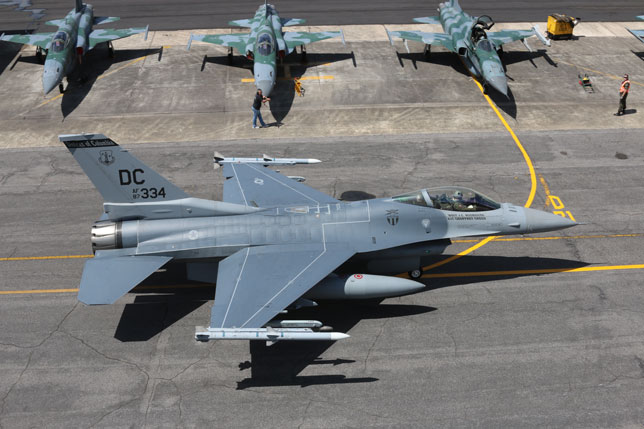
Two other countries -Venezuela and the United States- both brought a more common type, the F-16, but the story behind the these two countries participating in the same exercise seemed more interesting. Many of the questions posed to the detachment commanders (Col. Colmer 12AF ANG liaison and Brig.Gen. Mundaray of the Venezuela Air Force – AMBV) were aimed at the friction between the two countries in the very recent past, but as Col Colmer said: “we are military men and we are working together here professionally as pilots, doing our job”. Brig.Gen. Mundaray nodded and that was all there was to it. Maybe exercises like this confirm the more relaxed stance between the countries. Certainly the non-updated 30 year old Venezuelan F-16A’s could use some fresh spare parts and new avionics or will Venezuela bring their Su-30MK2’s? Referring to this question Brig.Gen. Mundaray answered: “there is no special reason not to bring our Sukhoi’s, but it could well be this is the last time we bring our F-16’s, so we will probably return to Cruzex with other aircraft”. It will be interesting to see how this pans out in the future.
The participating nations trained alongside each other in fictitious scenarios to prepare for potential events across the world. These internationally-sanctioned actions might include supporting peacekeeping and stability operations, supporting civilian authorities during humanitarian response operations and assisting coalition neighbours in the aftermath of a natural disaster. In the years the missions became more varied and now include combat search and rescue, aerial refuelling and combined air operations centre training opportunities. During the exercise no live weapons where used, only simulated attacks were carried out.


During the exercise, Caicó airfield served as a base for the H-34 Super Puma helicopter for possible search and rescue missions. Located 250 kilometres away from Natal, Caicó airfield is a strategic point. It is here that a three-dimensional radar (TPS-B34) together with command and control equipment was installed to control the exercise. The management of air traffic was performed by the Third Integrated Centre for Air Defence and Air Traffic Control (CINDACTA III) at Recife. With the use of new techniques and equipment it was possible to create three-dimensional pictures of the exercise, thereby greatly improving the debriefing capabilities.
The Exercise Director, Gen. Jordão asserted the changes applied to the last two editions of CRUZEX, especially the division between the real use of aircraft and the virtual environment of the exercise, previously operated at the same time. “CRUZEX evolves every edition and our experience has made us conclude what we should focus on. The intention is to excerpt the most of each operation and now I can say that, with these changes, our goals have been achieved”, he said.
The size and quality in participants, exchange of information and experience allows Cruzex to be ranked as one of the most important multinational exercises worldwide and the most important one in the context of Latin America. However this time there were no European participants, where earlier editions attracted French aircraft and Swedish and UK observers. Perhaps French aviation industry did not support a new trip of the Rafale overseas, a move justified by the selection by Brazil later in 2013 of the Swedish Saab Gripen as the successor to the French Mirage 2000 in the air defence role. It should therefore be no surprise to find Swedish Gripens participating in the next (2015) edition of Cruzex.


A brief history of Brazil’s Cruzex exercise
The idea of ‘Cruzex’ was born in 2000 when Brazilian Air Force (FAB) observers participate in the Odex exercise in France. During this exercise the following scenario was followed and became an inspiration for Cruzex. The exercise simulated an armed conflict between Border States that due to the international law, the intervention of a peacekeeping force was necessary for the ceasefire, the process of “peace enforcement”. As seen in the conflict in the Gulf region and the Balkan these scenarios are now more common than the old cold war scenarios and the Brazilian air force wanted to prepare itself for a possible commitment in such an event. From 2000 on preparation started for the first Cruzex exercise Brazil. Over the past exercises thirteen foreign countries participated and other countries joined as observers.
The first edition of Cruzex took place soon after in 2002, at Canoes air base, close to Brasilia. Argentina, Chili and France participated in the exercise that was based on an invasion like the one in Kuwait. That would test the command and control structure and joint planning of combat missions. It was the first time ever NATO procedures were used in a South American combined exercise and it was heralded a success. FAB concluded that the exercise results were very satisfactory and paved the way for Cruzex.


In 2004 the second edition was held at Natal air base, this edition included air forces from Argentina, France and Venezuela, as well as the host nation Brazil, while Peru, South Africa and Uruguay sent observers. The exercise was designed on a simulated low intensity air campaign scenario within the constraints imposed by peacetime regulations and safety issues. Two main Brazilian air bases, Natal and Fortalesa, where involved in the fictitious clash between two countries, Green and Yellow, fighting over an area rich in mineral resources.
The third edition was held at Anapolis air base in 2006. The Exercise a scenario as in the previous exercises, based on an UN controlled conflict featuring three fictitious nations: Red Land, which has invaded its ex-territory Yellow Land, and the Blue Land who supports the Yellow Land people. To push the Red Forces out of the invaded Yellow territory the Blue Land forms a coalition force with Argentina, Chile, and Uruguay, Venezuela and France and goes to war against the Red Land. The Peruvian Air Force had intended to participate also, but sadly one of its A-37B aircraft crashed while en route to Annapolis AB killing the crew.


Again placed at Natal Air base, the fourth edition was in 2008 and participants, next to the host nation, were Chile, France, Uruguay and Venezuela. Argentina was to have participated, but was forced to cancel shortly before the exercise began. The scenario for the exercise was compatible with previous years, as a simulated low intensity air campaign within the constraints imposed by peacetime regulations and safety issues.
In 2010, the fifth edition of Cruzex at Natal Air Base was heavily influenced by the knowledge gained in the Red Flag exercise 08-03 in which Brazil participated. In the fifth edition the air forces of Argentina, Brazil, Chile, the United States, France and Uruguay participated. Once again the number of countries that where participating as observers e grew, highlighting the importance given to this exercise in the region. For the United States Air Force it was the first participation with aircraft after being an observer in previous years. France, a member since the first Cruzex brought their Rafale and Mirage 2000, where the Rafale could be seen as a contender to replace the FAB Mirage F-2000.


Already the sixth edition of Cruzex at Natal air base, the 2012 event was a command and control exercise, in other words there was no actual flying during the exercise. With personnel from Brazil, Argentina, Canada, Chile, Ecuador, United States, France, United Kingdom, Peru, Sweden, Uruguay and Venezuela, that year’s edition of CRUZEX had the largest number of participants ever in the exercise. The 2012 C2 version of Cruzex was also a preparation for the 2013 ‘Cruzex Flight’ event.
Authors thank the Brazilian Air Force, the staff of CECOMSAER, BA Natal command and many others in accompanying us throughout the exercise and trying to meet our demands in covering the exercise.
A previous version of this article was published at KARO Aviation by the same authors.
Headline photo: USAF F-16C taxiing in front of brazilian F-5EM (photo: Rob Nispeling).

