
Several years ago I worked as a contractor in a five-star hotel in Buenos Aires, a undoubtedly tourist business. As a part of my function I had to do several training courses, reserved for to the company staff, in order to know the culture of the hotel. I remember one of the crucial points of this training was this statement: “We are the best hotel in Buenos Aires, and the most expensive. In the future we are still going to be more expensive, because we will be better”.
Nothing is furthest from aviation, another tourist business.
The price of tickets
A ticket Buenos Aires to New York by Aerolíneas Argentinas, in 1958, cost USD 632.20. The flight, an overall 24 hours journey, was made in DC-6, in what was then called economy class, which could be considered “Y” class today. In order to compare ticket price with other aeronautical costs, an oil barrel was close to three dollars each, with a downward trend, and a Douglas DC-7C cost about three million dollars.
Three years later, things had changed, so the ticket to New York in economy class was cheaper, USD 599, but the trip was made in Comet 4 jet, much faster than the DC-6. So the trip took just over half the time. The aircraft, however, were more expensive, a Comet 4 worth USD 4.87 million, and a Boeing 707 about six million. Oil was below two dollars.
Flying at these prices was usual. Reservation systems had not yet been invented and all tickets in serious airlines cost the same, a value established by IATA. Cheaper services could be found in companies outside IATA (TAN, APSA, Cinta, ALA). Generally started from Chile, so passengers from Argentina had to fly an additional leg using slow aircrafts (DC-4, C-46). But judging from the abundant advertising in the local media, these flights were successful. There were also some more expensive services, called First Class.
Thirty years after that, in 1988, the IATA passage cost USD 1,125; a year later dropped to USD 870, and in 1991 raise to USD 999.

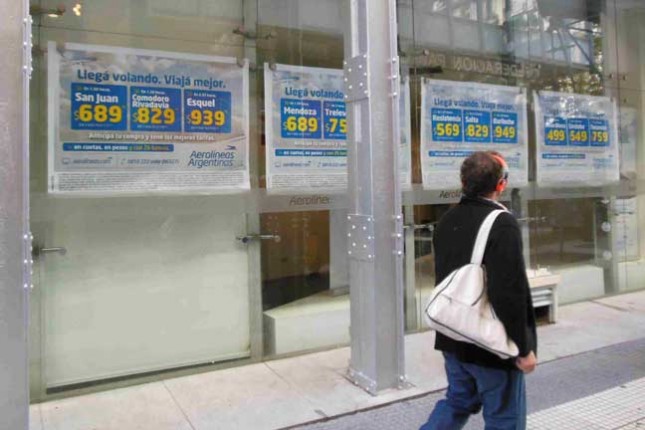
Aerolíneas Argentinas announced recently its services to New York will be resumed during December 2013. The launching price is AR$ 7,188 pesos, although at the time of booking aerolineas.com.ar attempt in August, you could get for AR$ 6,036 pesos plus taxes. At the time this article goes on-line, trying all combinations, this corresponds to a value that is, in round numbers, between 600 and 1,500 dollars.
The flights to New York will be on an Airbus A330/200, whose list price is USD 216 million. Today an oil barrel is in the USD 108 range.
Crazy numbers
From the all above, in little more than half a century:
- The air ticket Buenos Aires – New York by Aerolíneas Argentinas can cost the approximately the same price today. It may have risen something or maybe not. At present there is more uncertainty about the exchange rate AR$/USD than anything else.
- The plane (in fact was a DC-7, but is comparable) costs 72 times more.
- Fuel costs 36 times more.
But that’s not all, because you have to consider the fact that a today dollar is worth about eight times less than in 1956.
Nothing has sense, absolutely nothing. These tickets should cost:
- USD 5,000 to continue dollar inflation.
- USD 45.518, to keep the aircrafts prices.
- USD 22.759 in reference to oil prices.
Of course, I do not believe that all prices should always evolve at same level, but this dispersion does not seem rational. Over half a century, only with undeniable global inflation, air transport should doubled or tripled the price of their product. But has improved up to the point that the flight endurance is half than earlier times, you can choose your travel within a large variety of dates and times, the accident rate has dramatically shrunk and flights are more comfortable.[1]

The recent history of flight rates
Air fares were always a nasty invited to talks. They were unpopular, and nobody wanted to assume the political cost to fix them. In the Chicago Convention on International Civil Aviation, of 1944, the basis of modern civil aviation, does not say a word about it, and this nasty role was left to the companies. To do it, they met in La Havana, in 1945, and there formed the IATA, which among other things had the ugly feature to establish rates.
Of course IATA was something like a business chamber and, therefore, its resolutions, which were actually suggestions, were far from having the force of law, just a recommendation for its members, who were not bound by them, although they fulfill them.
It is difficult to know on what basis those fees were established. In the world of the forties, international airlines were usually state companies that were spending more than they earn, and covering their costs government aids. Then, air tickets prices did not respond to any economic mechanism, but to a political one. And in politics there was a strong compromise that it was necessary to promote air transport, and affordable rates were a part of that.
But not all countries subsidized their airlines in the same way. Some do not even supported at all, and not all companies were state-owned, leaving a wide place enough to tariff dispersion, although the reference value for many years would be those fares established by IATA.
Pan American was one of the forerunners of low rates. The official story says that in 1952 Pan Am reached an agreement with IATA allowing the development of tourist class on airplanes. But the truth is that long before that date already offered cheap fares.
But there were many companies since the late forties operated services outside IATA rates, some as charters, and other as regular services. In each country were accepted or rejected according to political convenience of the moment, but all these precursors demonstrated, with absolute clarity that the price, in the air business, operates as in absolutely all economic activity, when there is low demand it has a tendency to to rise.

The most efficient industry
The airline industry is more efficient every day. Since the introduction of jets, companies have pursued to reduce costs, and since the seventies, oil crisis and deregulation by, the work in this regard has been intense.
The increased efficiency of the aircraft was at the forefront of this process, but there are many things that contributed to this effect, from how to load the luggage up the navigation and landing systems that bypass the bad weather, from paperless electronic tickets until computer interaction to improve the distribution of capabilities… The industry has worked hard to move in this direction, and programs such as IATA’s Simplifying the Business have achieved remarkable results.
There are other issues, less obvious, but they are related to the equation. Today, planes fly more hours a day and can be amortized over periods of around twenty years. From a commercial standpoint, companies manage load factors besides ten or twenty points higher than the ages of the propellers.

Of course at the same time there were other stuff that did not please the passengers, who saw that air travel becames, lost glamour and looks like travel in suburban trains
But, of course, there was an answer for those who chose to continue making luxury travel. We can discuss it, because it lacks the charm that travel have in the past, but it exists and, of course, is more expensive.
One end of the air transport is the appearance of low cost companies. Beyond possible analysis, their philosophy is to argue that everything that makes an airline can be done with lower costs than traditional alike which results in better rates for passengers and good (maybe better) benefits for shareholders.
In the history of commerce and industry, in general, when someone found a way to do the same, but cheaper, succeeded. This case is no exception, and while we must recognize that low cost does not have displaced traditional companies, they have made life impossible, and forced to behave with patterns other than those to which they were comfortable.
The Peter Pan syndrome
Setting prices is a task for adults, independent adults. For someone who does not have to ask permission from the parents to make or break, and also is disposed to face the consequences.
Is that the attitude of the airlines? Sure not. First they tried that fees ware set by others, and invented the IATA, which basically was a cartel trying tariff fixation would have the least competition possible.
It worked on a large scale, but there was always some who wondered why not release the prices, and these few were actors as diverse as Pan American on one side and small companies of peripheral countries in the other. Sometimes it was difficult because it involved fighting a well sustained establishment by companies and governments, but always something worked.

Until the only argument for selling tickets was the price. Passengers, were very happy, but companies, not so much. In other words, the stock of airlines are not a good investment. Indeed they are the worst investment aeronautical circuit, which was organized for this to be so. Today airports produce more benefits than airlines, and is a curious fact that the investment on an airport kiosk, or a taxi, has better revenue than the one made in an airline.
Airlines are so afraid to raise prices that when oil rose disproportionately in the early, 2000s sought independent charge fuel surcharges instead of filing a full rate. With the low cost are similar phenomena, and to charge extra for carrying a suitcase is a very artificial to maintain low rates.
And so it is that today all prices related with travel services, suffer inflation and behave like normal tradables, while airfare not move. It is decidedly strange.
Note:
[1] This can be discussed. Today the seats are tighter, it is true, but aircraft are more silent and has less vibration, less influence of pressure differences, move less and are better heated.

