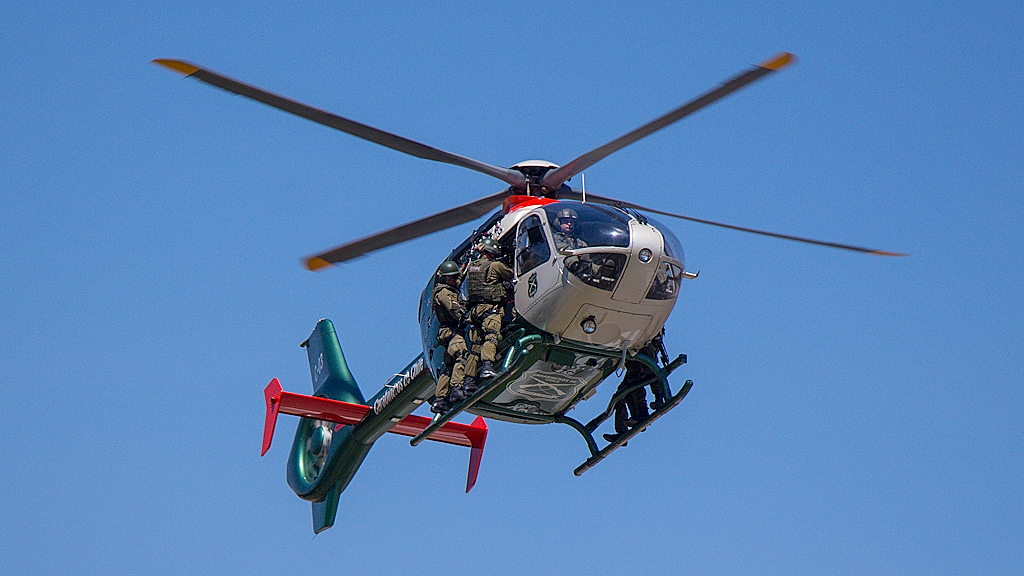
The pressing need to improve domestic security is prompting several Chilean government bodies to try and innovate to fund the acquisition of helicopters that will increase air support for their jurisdictions police forces, a trend that is visibly gaining nationwide (or rather “nationlong”, if you know what I mean!) momentum.
While investigating for an earlier story, details surfaced about several on-going funding initiatives for the acquisition of Chilean Carbineers (Carabineros de Chile) helicopters.
All of them follow a common pattern and are likely to expand elsewhere in the country, since decisions are being made to allocate up to five five new purchases to the ostensibly leading (and probably only) contender.
Five and counting…
Released in 05/2023, request for proposals (RFP) #5240-78-LR23 called for the provision of a twin-engined, multi-purpose helicopter with a 2.9+ tonne take-off weight for the Talca Police Air Unit (Sección Aeropolicial Talca) in Maule Region.
Two months later, RFP #5240-125-LR23 was released for the acquisition of a twin-engined, multi-purpose helicopter with a 3.7+ tonne take-off weight for the soon to be formed Arica Police Air Unit (Sección Aeropolicial Arica) in Arica and Parinacota Region.

Late last month, Santiago governor, Claudio Orrego, and Carabineros General Director, Ricardo Yáñez, announced an US $7.7 million investment project for the acquisition of armored personnel carriers, drones that also contemplates a multi-purpose helicopter for the services’s Police Air Wing (Prefectura Aeropolicial) based in Tobalaba airfield.
In mid 06/2023, Tarapacá governor, José Miguel Carvajal, announced that technical approval had been granted for the acquisition of a brand new helicopter destined to operate with the Iquique Police Air Unit (Sección Aeropolicial Iquique).
Lastly, and also in 06/2023, Coquimbo Region councillors revealed that work was under way to formulate a project that will fund the acquisition of a brand new police helicopter for the La Serena Police Air Unit (Sección Aeropolicial La Serena).
Better call the cops?
These acquisitions don’t come in a vacuum: According to a recent Seguridad Expo media release, Chile’s internal security outlook is gloomy: “In 2022, on average, two homicides, eight rapes, 35 car burglaries and 88 vehicle thefts were recorded per day” while “robbery [increased] by 53%, thefts by 46%, homicides by 42%, rapes by 12%, and finally conflicts with injuries by 25%”.
Different government bodies are running a frenzied race to propose legislation and action plans to curb ordinary crime, illegal immigration, rampaging drug trafficking and Mapuche terrorism; sponsoring initiatives ranging from a new public security ministry to strengthened intelligence, a renewed criminal legal code, new arms control regulations, improved police training and revisited rules of engagement for security forces.

While nationwide changes continue to be hotly debated in congress and mass media, the five regional governments above took a pragmatic approach and decided to funnel funding for the acquisition of multi-role helicopters to reinforce police units in their jurisdictions and had (or are in the process of having) their proposal approved by regional councils.
Following a 2017 constitutional reform, regional governors and councillors started being designated by people’s vote, took up several of the responsibilities previously held by central government branches in Santiago and gained authority to manage their region’s budget.
But, even though governors have control of regional resources and public service apparatus, they can’t delve into operational security matters because that’s territory where the central government’s Ministry of the Interior (Ministerio del Interior) rules unchallenged, so the Carabineros were requested to actively handle these helicopters acquisitions and operations.
Following approval from regional technical and political bodies, those regions ar making National Fund for Regional Development (Fondo Nacional de Desarrollo Regional) resources available to the domestic security service for them to purchase the helicopters and incorporate them to their fleet.
If every prospect above sees fruition, Carabineros will increase its nominal rotary wing fleet by an estimated 42% and augment their police, surveillance, search and rescue and transport capabilities in many areas previously unattended.

But, given that funding flows from separate jurisdictions and at different paces, the service has adopted an unsophisticated acquisition approach and is launching individual RFPs as resources are made available by regional authorities.
The overall process is seemingly creating an “exclusivity bonanza” for Airbus Helicopters, which was the only proponent in the two RFPs listed above as well as in an earlier competition (see “Airbus set to win Chilean Carbineers training helicopter contract with no competition?”) and proposed an US $8.26 million H135 for Maule and an US $11.59 million H145 for Arica.
The situation hasn’t escaped industry scrutiny and is generating reactions from competitors that are losing business opportunities that may result in up to US $50 million in sales for the next two years.
Hindustan Aircraft Limited (HAL) was ostensibly discouraged to submit a Dhruv Mk.III proposal for the Arica RFP when it was notified through a virtual questions and answers platform that Indian airworthiness certifications were not acceptable, while US Federal Aviation Agency or European Aviation Security Agency certification are mandatory.
Likewise, local representatives for Italy’s Leonardo and US Bell Helicopters decided not to submit proposals after concluding that several requirements were “specific to a single brand and model instead of listing operational needs that can be solved differently by another manufacturer”, as noted in the lengthy Maule RFP questions and answers log.

Carabineros replied that requirements are in line with their own operational needs and “can be evaluated without excluding conditions, brand or model”.
But Bell’s representative in Chile, Eagle Copters South America, didn’t seem to agree and filed an opposing demand against the Arica RFP at the Public Acquisitions Court, claiming that Airbus’ H145 had been selected from the outset, as publicly announced by the regional government when funding was approved in February.
Stay tuned!
Very much like a binge worthy streaming series, this story is bound to have several “episodes”: Number one “aired” early last week, when a 09/13 resolution allocating Maule’s buy to Airbus (H135) showed up in Chilean government acquisitions portal, Public Market (Mercado Público).
Coming close behind an 08/10 resolution allocating the training helicopter contract to Airbus (H125), these decisions have set the tone for a second episode which is likely to see the Arica y Parinacota’s purchase allocated also to Airbus (H145).
Reactions from Airbus’ competitors and the presidential proposal of increases in public security and national emergencies budgets for 2024 (5.7% and 28%, respectively) are likely to turn this saga into a multi-million and multi-season blockbuster…
Internet sources: Airbus, Aircraft Cost Calculator, Radio Bío Bío, Arica, Coquimbo, Maule, Santiago and Tarapacá regional governments, Bell Helicopter, Chilean Government, Diario Talca, Global Security, Hindustan Aeronautics, InfoDefensa, Leonardo, Mercado Público, PlaneSpotters, Pista 18, Public Contracts Court, Seguridad Expo and Wikipedia.

