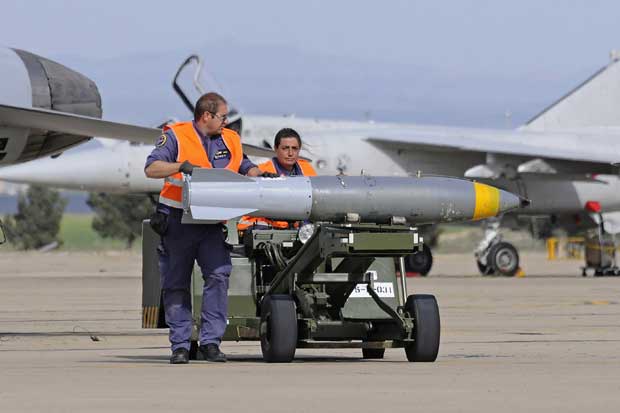

Once again the Ejercito del Aire de España (EDA) held between 6 and April 16, 2011 one of the exercises that score high on their annual training plan. This is the Sirio-Tormenta (Sirio – Tormenta) double exercise, whereby the EDA aims to increase and improve their skills.
The main overall objectives of these training tasks is to maintain and increase the level of training of the units, centers and agencies of the EDA, in the areas of leadership, planning and control, operational and tactical levels of command and control structure (and air Component Command and air Operations Center) and in the areas of planning and implementation at the level of air units, across the full spectrum of mission of a modern air force with a high capacity for deployment and operations.
No less important is another objective of the exercise Tormenta, which is to check the real status of air-surface weapons in the air force and the degree of accuracy of the different types of weapons used. For this purpose, certain lots of ammunition in the arsenal of EDA are selected and they will be used throughout the operating hours.
In short, the Sirio- Tormenta is planning at the operational and tactical missions that cover the entire spectrum of aerospace power that is capable of deploying a modern air force, and its implementation in a complex, realistic and challenging scenario for the Barracks Air general, participating crews and ground personnel. This exercise is the culmination of training that the Air Force units made in their daily instruction and has an annual basis.

Overall, within the Advanced Training Plans of the various units involved, the objectives are:
(1) Activate Air Defense System, integrating the control centers of the defenses in a coordinated and centralized operations for conducting the air battle from the Air Operations Center (AOC) Air Combat Command (MACOM ), gradually implementing the Air Operations directives generated in Air Component Command (ACC).
(2) Train the units in the planning and execution of offensive and defensive air operations.
(3) Conduct tactical air transport operations and special operations in the aviation sector.
(4) Integrate Security Operations, with particular attention to Force Protection, antiaircraft systems and Health Operations.
(5) Exercising various capacities in the field of air-ground missions, close air support and air reconnaissance.
(6) Carry out training FACs, which will participate in the next personal take over from the peacekeeping mission that is taking place in Afghanistan.
(7) Check the status of air-ground weapons assigned to different units.
(8) Train staff of the MACOM (ACC) in planning and monitoring of operational and logistical activities.
The exercise is divided into two main phases. In the first, Sirius, the objective is to achieve the air superiority needed to provide friendly forces the use of airspace, while it is denied to the enemy. Once this phase, essential to operate, is achieved the second phase begins: Tormenta. In this second part, air power is directed onto the surface to attack the objectives set by the Commander of the operation.

Staff: Air crews, technicians and more…
The concept of the Syrian-Tormenta exercise involves the participation of the units involved to their full potential in sustainable operations over time. Therefore, the staff has adjusted to the intensity of the operations at any time and demand for the missions ordered. This implies a degree of involvement varies depending on the phases and the tactical situation.
Still, as rough, you can encrypt the participation of 172 aircrew throughout the year. Since Sirius-Tormenta exercise is considered advanced training, participants require crews have a high level of fitness to participate in combat training missions. Naturally, the drivers were directly supported by a team of more than 180 mechanics, armorers and so on., Responsible for recruiting machines and weapons.
Parallel to the development of air missions Tormenta phase is executed close support missions (CAS) with the support of 4 forward air controller (FAC), which operated TACP divided into two teams. This was selected from among those who made the next over from those who fulfill their mission in the Afghan theater.
Given the scale of the exercise, the staff has been directly involved in the type flown on SAR and CSAR was 20 people. It also deployed to carry out missions of force protection 210 people.
Meanwhile, security of the units is entrusted to the Air Police Squadrons of the units themselves, reinforced with elements of force protection in those where it has been considered to fulfill the evaluation objectives. Air units also have been supported Firefighting personnel specific to each base.

Bases and airborne participants
The exercise involves all EdA units capable of being used in long lasting operations. This means almost all major units of Eden getting involved, in one way or another, in different phases of the exercise. Also personnel and resources of the other two Spanish armed forces participate. The Army provides antiaircraft artillery units. In the case of the Navy, aircraft and corresponding support staff from the 9th Squadron equipped with the EAV-8B Harrier II + is deployed to Zaragoza
All participating air units were operating from their usual air bases, making deployments at some point during the training. In Zaragoza Air Base (BAZ) 12, 14 and 46 wings were deployed. Wing 15 moved a detachment to the Air Base of Son San Juan (Palma de Mallorca). In contrast, the 46 wing based in Gran Canaria operated exclusively from the BAZ.
As for the logistical elements of the Air Force involved in the exercise, they have been provided by all units, both the participants and the support.
Moreover, during the Sirio-Tormenta exercise, all the elements that provide the EdA with the necessary operational intelligence participated.
In short, all the deployments and operations involved the participation in the exercise Sirio Tormenta of all the EdA bases. Mainly these Air Bases were remarkable for their activity: Torrejon, Zaragoza, Albacete, Son San Juan and Moron.
| UNIT | EQUIPMENT/MISSION | UNIT | EQUIPMENT/MISSION |
| MACOM | CUARTEL GENERAL DEL COMPONENTE AÉREO CENTRO DE OPERACIONES AÉREAS (AOC) | CECAF | U-22 (Beech C-90 King Air) |
| Ala 11 | C-16 (EF-2000 Eurofighter) | EZAPAC | EQUIPOS DE OPERACIONES ESPECIALES. EQUIPOS DE CONTROL AEROTÁCTICO |
| Ala 12 | C-15M (EF-18M Hornet) | EADA | SECCIÓN ANTIAÉREA, CONTROLADORES DE COMBATE, SECCIÓN UAV |
| Ala 14 | C-14M (Mirage F-1M) | SEADA | SECCIÓN DE PROTECCIÓN DE LA FUERZA |
| Ala 15 | C-15M (EF-18M Hornet) | ESLLA. PLUS ULTRA | SECCIÓN DE PROTECCIÓN DE LA FUERZA |
| Ala 46 | C-15CX (F-18A Hornet) | GRUSEG | SECCIÓN DE PROTECCIÓN DE LA FUERZA |
| Ala 23 | AE-9 (SF-AM Freedom Fighter) | GRUNOMAC | CENTROS DE CONTROL AÉREO |
| Ala 31 | T-10, TK-10 (KC/C-130H Hercules) | GRUCEMAC | CENTROS DE CONTROL AÉREO |
| Ala 35 | T-21 (C-295) | EVA 2 | SISTEMA DE VIGILANCIA AÉREO |
| Grupo 47 | TM-11 (Falcon 20), TM-17 & TK-17 (B-707) | EVA 2 | PROTECCIÓN DE LA FUERZA |
| Ala 48 | HD-21 (AS.332 Super Puma) | CAO | CONTROL DE LA CIRCULACIÓN AÉREA OPERATIVA |
| Ala 78 | HE-24 (Sikorsky S-76) | GRUCEMAC | ARS |
| GRUEMA | E-25 (C-101) | UMAAD MADRID UMAAD ZARAGOZA | EQUIPO MÉDICO DE APOYO AL DESPLIEGUE |
| AGA | E-25 (C-101) | UMAER | EQUIPO MÉDICO DE AEROEVACUACIÓN |
Hornet walk around |
||
 |
 |
|
|
The AIM-2000 IRIS-T (Infra Red Imaging System Tail / Thrust Vector-Controlled) is a substitute for the legendary AIM-9 Sidewinder, which is owned by some NATO member countries, including Spain (photo: José Luis Franco Laguna). |
Acquisition and target designation pod Rafael Litening Tecnobit. This equipment significantly increases the effectiveness of the attack surface in all weather conditions (photo: José Luis Franco Laguna) |
|
Operations
The series of exercises Sirius and Tormenta do not have a standard format, but adapted to the objectives sought by the Commander in each issue. Furthermore, given that the intention of the exercise is to resemble as closely as possible to reality, once established by the control objectives, they must meet in order. So you first need to establish air superiority over the target area, then beat the whites in the order established by the superiority.
The number of daily departures for the year of 2011 ranges from more than 30 in the first two days of operation (phase Sirius), and 90 outlets in the next three days (Tormenta). Coming thereby to some 275 outlets in the year in the course of this year.
For its part, the wide spectrum of missions that are conducted in both years, implies that there is no standardized mission, but the missions have to plan and implement to comply with the order of superiority as the year unfolds . Thus, as the days pass away missions occur simultaneously air defense (DCA), attack enemy defense systems (SEAD) air to surface attack (ASFA), close air support (CAS), offensive anti-aircraft (OCA ), rescue downed crews in non-permissive environment (CSAR), intrusion air bases (FP), air evacuation (MEDEVAC), special operations (RECCE and direct action), and others.
The weapons used during the year 2011 was the next Tormenta: MK-82: 60 units. Braking BRP-250: 25. BR-500: 35 units. Laser-guided GBU-10: 2 units. Missile A / S AGM-65 Maverick: 2 units.
|
Advertisement
|
Forward Air Controllers
Since Tormenta exercise involves attack surface, according to the targets and means to strike them, it may require the involvement of forward air controllers (FAC) operating on the ground.
The EDA FAC are selected among the staff who meet strict eligibility requirements for its functions, given the particularities of their own activities assigned to such personnel. Stop this requires member of air units as a pilot, or special operations units like the Airborne Sapper Squadron (EZAPAC).
Thus, not only gives a great contribution of knowledge from his previous experience to the course of FAC, but their daily work in the units easier to maintain your fitness levels of excellence required of these specialists, critical elements and always in short supply in any operation.
The FAC, as the last item in the chain of tactical air control party, received from the Land of Operation Command which is providing support, a request for aerial fire, once by itself can not beat the target.
This request is sent by air operational chain of command, which shall authorize and order a mission to the most suitable aircraft to beat assigned targets. These aircraft can be found in flight or take off and run the mission itself, depending on the urgency of the request.

The FAC made a study of the target to beat, providing this information to decision-makers and crews of aircraft designated for either a preliminary briefing on the base, once the aircraft in flight or in the vicinity the target.
After the allocation of air assets, and confirmed the need for support by ground commanders, the FAC is responsible for the crew of the aircraft purchase unequivocally the exact target to beat (can be as small as a particular vehicle in a parking lot car). The FAC must give special consideration to the collateral damage it may cause, not only our own forces but also to non-combatants who may be affected by aircraft operations.
Finally it should be noted that the EDA TACP teams (provided by EZAPAC) and led by the controller FAC, successes have been achieved and congratulations from his early interventions in the conflict in Bosnia in 1993.
At present, remain among the most prestigious teams in all operations involved in, and its indicative “Bullfighter”. Your participation in operations ordered by the absolute superiority is guarantee of a job well done for aircrew performing any CAS mission.

