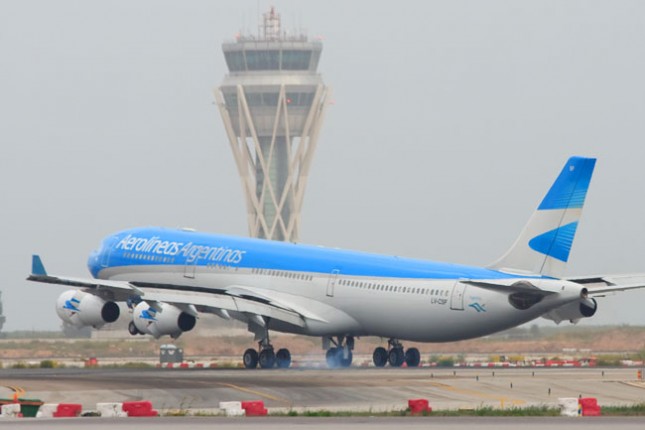

The issue of the Aerolineas Argentinas´ fleet age is in vogue. The size of the fleet too. Not just because society has a special interest in knowing the age or number of aircraft, but because the need or desire to advertise something by the airline management, whom has touched the subject publicly.
Argentines, sometimes likes to look for easy prides, and we fall into the lightness of pretension of having the longest avenue in the world, or the widest, and other things like that. In aeronautical terms: the youngest fleet or the largest of the region, may be an example of the same stuff.
Two issues to consider: aircraft maintenance and fuel consumption
The age of the fleet is a particularly sensitive issue. If the airlines followed all procedures, directives and bulletins of the aircraft manufacturer, everything is in order. If everything is technically and legally right, facing the passenger does not have to be any problem, and they will not notice of anything in reference to the aircraft age. There are old commercial aircraft still operating routinely, and there are some historical airliners which continue flying in exhibitions, or doing recreational flights.
The problems of operating a fleet of a certain age are for the company, especially for Accounting Department, since they has to deal with higher maintenance and operational costs. With increasing age of the fleet, cycles and flight hours of the aircrafts, they will be forced to pass complex revisions and therefore more expensive.
| Type of inspection | Frequency | Required time | Place |
| A-Check | 500 – 800 flying hours or 200 – 400 cycles. | 20 – 50 man/hours – (one night) | Gate or hangar |
| B-Check | 4 – 6 months. | 150 man/hours – (1 – 3 days) | Hangar |
| C-Check | 15 – 21 months or a number of flying hours determined by aircraft manufacturer. | 6000 man/hours (1 – 2 weeks) | Hangar |
| D-Check | Every 5 years. | 50.000 man/hours (2 months) | Hangar |
| Times and periods are approximate. They can vary as per aircraft type, manufacturer, flight hours and other factors. | |||
There is another variable that directly affects operating costs: the fuel. Earlier engines have higher consumption than today. Since the fuel is a key factor in the aviation, an aircraft with modern fuel efficient engines will have a more profitable operation.
As the years go on
Aerolineas Argentinas and Austral conform an airlines group with a somewhat fuzzy border between the two companies. Sometimes they are one company, sometimes two. If companies are considered separately could see that the average age of Austral´s fleet is 2.3 years and the Aerolineas just over 12. Officially, and as per subsequent reports presented by management, it is understood that both airlines form a single company, we can say that the average fleet age remains at 8.6 years.
For a better analysis, it is interesting to identify the different types of aircraft fleets in the Aerolineas Group. Thus, the ERJ-190 have an average life of 2.3 years, the B-737NG are on average 9.5 years and 17.7 years for the A340 fleet. The new additions to the long-haul fleet are “teenagers”: the A330 to incorporate enjoy an average age of about 14.4 years. The A340-300 (ex Iberia), whose rent has not confirmed yet, are 16 and 17 respectively. In summary, the regional fleet age enjoys a reasonable age of six years, but the long-haul fleet is over 16.

What about the other competitors in local market?
The comparison between fleets of different Argentina´s airlines gives disparate values, but not necessarily better than the country managed company. LAN Argentina’s fleet has two B-767 of 7 years and 11 A320 of 11.8. The MDs of Andes have an average of 23.8 years and 24.6 for Sol´s Saab 340.

On the other hand, if the average age of the fleets of other Latin American airlines is compared with Aerolíneas Group, there are ahead Azul with an overall age of just 1.9 years, 5.3 COPA, 6.4 LAN, AviancaTaca 7, TAM 7.1, and Gol 7.3 By the other side, it is interesting to know that any operator in the region who continue flying the B-737 200 series, surely is flying planes with more than 30 years.
Large U.S. airlines enjoy fleets with the following ages: 14.7 years American Airlines, United and Delta 13.6 and 16.8 respectively. If we look at traditional European companies, found that the average ages are 10.8 years for Air France, Alitalia 8.4, British Airways 13.4, Iberia 9.2, KLM 10, and Lufthansa 12.6. Instead, the well-known lowcost Raynair and Easyjet are 4.7 and 4.8 years old, respectively.

What if we talk about numbers?
In the segment of fleet size, we are also in an ambiguous position, since quantity does not implies efficiency, better services or more destinations served. In this area the most important thing is not the number of aircraft available, but the use made of each of them. An aircraft generates benefits by the number of passengers it carries. This should be flying a number of hours per day and the highest occupancy possible. A large fleet with a low load factor and low frequencies is wasteful.
Even so, there are numbers that scare and some examples are sufficient to see where we are. In the United States we find 701 United or American Airlines aircraft which has a fleet of 610 aircraft. In Europe, Lufthansa has 313 airplanes, Air France operates 246 aircraft and 259 British. Pretty far is Iberia, with 79 aircraft in its subsidiary Iberia Express with 15. Ryanair has 303 B-737NG (not operate any other model than that), and how could it be otherwise, Airbus is the only supplier of competence Easyjet, who is flying 192 A320 Family aircraft.
Focusing on Latin America, LAN has a fleet of 158 aircraft, TAM has 157 machines, AviancaTaca 155, Goal 130, Aeromexico 114, COPA 86 and Azul 73. Groupo Aerolíneas remains on 56 planes to which four A330 must be added soon.

Summarizing
Although from the direction of the state enterprise Argentina has emphasized the age and size of the fleet, can not be said to be particularly noteworthy data or regional level, or globally. Neither are bad. None of these factors is inherently determining when to provide good service to the passenger, and that is where the group should make their best efforts to achieve excellence.
If we analyze the current destinations Airlines Group calls attention to a key fact: There are more planes than cities served. Since it is the case that there are several daily flights to absolutely all destinations, the productivity of coastal aircraft park / regional might not be adequate. In the long-haul fleet, this issue seems to be more controlled.
It remains facing the Argentine taxpayer that their taxes solves the functioning of the group, operative achieve efficient and cost that will not cost anything to the public coffers. In this section, it is important to have a modern fleet and productivity especially well studied.
Sources: Airbus, Airfleets, Airliners, ATR, Aviation Corner, Boeing, IATA, OACI and Scramble.

