
“Nothing else”. Perhaps this phrase summarizes the present of third major airline of the nineties in Argentina. Far from to try to tell here of the history of Dinar Air lines, before facing completely this particular, will be interesting to make brief racconto of the birth, development and aim of one of the many private commercial companies that flown in Argentina and, in 2002 it finalized his operations because of bankruptcy.
We must come back to year 1992, when DINAR (a tourism agency from Salta province) decided to go further on in the market and to ask for authorizations to fly exclusive charters in the route Salta-Tucuman-Iquique (Chile). With happening of the time and the the market growing, the company began to provide the wished success; adding to the original route more destinies. This allowed great part of the population of the interior of the Argentina, that never before had travelled in airplane to holiday, to be able now to do it and, which is more important, without having to fulfil the forced and debilitating passage by the City of Buenos Aires. This panorama allowed Dinar to face a more ambitious project and to finalize with the expensive rent of airships to fulfil its flights, and to mount like an air line proper to put to give fight in a commercial air transport market extremely difficult to compete like the Argentinean.
It was in 1993 when Dinar Air lines was born and obtained the first permissions for non regular flights for passengers, mail and load. Later in 1994, the airline began with the regular operations. A period of great success began for the company, who showed differentiated quality characteristics from the other companies. A lot of details, not less important at the time of choosing an airline, beyond the value of the passage. For example a catering service with exclusive menu “a la carte” supervised by the famous Argentinean international level chef “Gato” Dumas. Also an outstanding punctuality, near 90%, and a special interest in demonstrating the security of its own operations were Dinar´s work horses.
Dinar was characterized by the use of different aircrafts types from of the main world manufacturers. The company flew charters and regular flights with airplanes such as Airbus A300 and A310, Boeing 727, 737, 757 and 767, Fokker F-28, Douglas DC-9 and McDonnell Douglas MD-80.
In 2002, Dinar was deeply affected by the economic crisis in Argentina. The company´s managers could not solve the growing financial problems and the market in recession with very low aircraft occupancy sealed the company fate. At last Dinar cancelled all flights and finally a request of bankruptcy close the company.
Glory and decline of Yankee November Alfa
During the golden years Dinar decided to leave to the purchase some airplanes and balance inclined in favour of the manufacturer of the American west coast: McDonnell Douglas. It was when these airliners began to arrive to Argentina. The first were DC-9 and then Super DC-9 (MD-80 Series). In April of 1998 arrived to the country the main protagonist of our history, McDonnell Douglas DC-9-41 with temporally serial LV-PNP. This plane was previously flying with French company TAT (Transport Aérien Transrégional), with Finnish serial OH-LNF.
|
||||||||||||||||||||
Once complimented all the proceedings of definitive matriculation in the national registry of aircrafts, she obtained her Argentine registration: LV-YNA.
The history of this aircraft began in 1974, when the Douglas received a purchase order from the Japanese company TDA (Toa Domestic Airlines) by a total of 25 airliners. This particular aircraft occupied position 747 of the line of production, received the serial number (MSN or manufacturer serial to number) 47.614, and Japanese serial JA8430. Later, in 1983, she was sold to the famous Nordic operator of Douglas airplanes, Finnair, having received Finnish matriculation OH-LNF, until his inscription under Argentine flag.
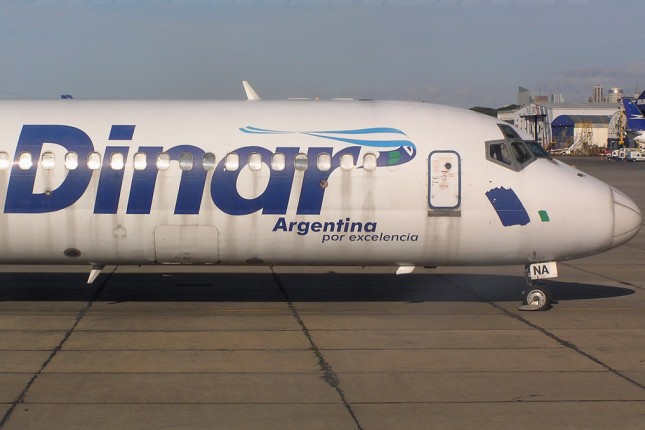
The airliner was destined to cover local and regional routes, operating regular and non regular flights. Throughout her service life in Dinar, she dressed two colours schemes. At the beginning, the aircraft was painted in white with blue and green of Crossair style: her vertical fin blue with the green Dinar logo and the great streamlined capital letters on both sides of the fuselage: “Dinar Líneas Aéreas”.
Later, it maintained a very similar scheme but the big letters that mentioned the company name were changed. Only was maintained the capital letter with company’s name, a small Argentine cheat lines were added together the phrase “Argentina por Excelencia” (“Argentinean par Excellence”), in a clear message of differentiation with the Argentine airlines group of Spanish capitals. This practice was not only used by Dinar, which also coloured its airplanes with the phrase “From the North of Argentine to the Mercosur”, but also by LAPA. This contemporary air line of Dinar was pioneering in this marketing strategy decorating his airplanes with a great Argentine insignia that claimed “Ser argentinos nos acerca” (“To be Argentinean gets us closer”).
After offering service during years, Dinar finalized its operations and consequently, the airplanes of their fleet that were hired returned to their owners. Those property of the company were, with the opening of bankruptcy, were scattered in different aerodromes all around the country.
For example, the case of the DC-9-34 registered as N927L (MSN 48123), still could be seen in Tucson, Arizona, dressing Dinar colours in 2006. By the other side, the airplanes that remained in Argentina, like the registered LV-YPA and LV-YOA, were preserved in the aerodrome El Palomar without their motors. The aircraft registered LV-YNA remained preserved at parking position 41 of the industrial platform of Metropolitan Airport Jorge Newbery years after the disappearance of the company. Parked together for private and corporate aircrafts, the LV-YNA was waiting for years in the hope of better luck.
Yankee November Alfa last hours (photos by Carlos Lefans)…

Wings cut off. |

First incisions in the fuselage. |
|
Clearing the upper fuselage section. |
Tail section scraped. |


As the legal process advanced, the bankruptcy of the company was imminent and clear. The uncertain end of its airplanes, too. When the bankruptcy took place and the company’s inventory was auctioned, there only was one way to sell the plane: to cut her in pieces and to commercialize like scrap.
The alternative, transfer the airplane to an aeronautical museum, hardly could be considered because of associated costs of transferring the aircraft to its new home, a difficult operation, still if the owners of the airplane, had decided to donate her.
The destiny played a macabre joke in the Day of the Innocents, December 28, 2007, when an enormous yellow machine began to cut the fuselage of the LV-YNA and load her parts on a great truck that left the airport with an unknown destination. The end of a golden decade of great Argentine airlines
Sebastián Acosta, Juan C. Rodríguez, Carlos Lefans and Carlos Ay contributed to this story originally published by Pista 18. Fernando Puppio produced this English version.

