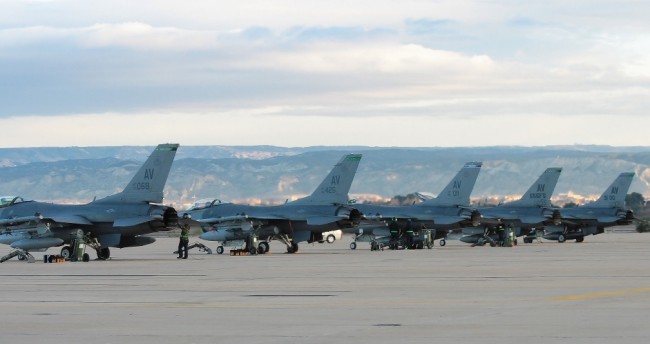

Once more time, the 31st Fighter Wing (FW) made a training deployment to Zaragoza’s city and, as usual, it was the first one of the year. Each fighter squadron from the USAFE (United States Air Force Europe) makes two Weapons Training Deployments (WTD) a year, taking advantage of the favourable weather conditions during winter months. The WTD 09-01, as this training is actually called, allowed American pilots to train in Spanish aerial space and maintain their operation abilities at top level. The Spanish northern sky is much less crowded than that of Northern Italia, where Aviano air base (Aviano AFB), home of the 31st FW, is placed.
The deployment of support material for the operation of the Vipers from Aviano began a week before the arrival of the fighters to Zaragoza. Thus, on January, the 9th, the load of the material that the C-130J-30 143rd Airlift Wing (AW) was to deliver the following day to the Aerial Base in Zaragoza (BAZ) began. Therefore, and for seven days, the necessary equipment for the deployment was transported to Zaragoza, not only from Aviano, but also from the Aerial Base in Ramstein (Germany) and Moron (Spain).

On the fourth week of 2009, the Fighting Falcons from the 31st FW were already flying in the BAZ, and 250 American personnel had deployed in Zaragoza. Among them, there were weapon specialists, maintenance technician and support personnel for the aerial operations, all of them belonging to the 555th Fighter Squadron (FS) “Triple Nickel”, though not all the F-16C that took part in the WTD 09-01 belonged to that squadron. The 510th FS “Buzzards” had to lend the “Triple Nickel” nine planes. A total number of 18 F-16C and just a F-16D, made the non-stop fly from Aviano to Zaragoza to operate from the “South Military Tarmac” of BAZ during the two weeks of fighter deployment.
Weapons Training

The training itself consisted basically on shoot and bomb training with training bombs BDU-33D, Mk-76 Model 5 and 20 mm ammunition PGU-28A/B. the training was carried out in the shooting range of Bardenas Reales in Navarra.
The typical mission involved the deployment of a flight of four planes headed for the shooting range. With an estimated fly of 10 minutes the shooting manoeuvres were carried out from North to South. The pilot was presented with different targets, duly indicated, which included a simulated airfield equipped with old and beaten-up F-4 Phantoms, a SAM site and several additional targets. The pilot is to attack according to the assigned mission and the appropriate weapon depending on the kind of target he has to blow down.
Once the air to surface mission is over, the planes had to head to an air civil traffic restricted area to carry out a different kind of aerial combat: DACT or Dissimilar Air Combat Training, against planes from the Ejército del Aire (EdA, Spanish Air Force) When this air to air mission is fulfilled, the Vipers went back to Zaragoza, having done all in all approximately one hour flight per plane.
Before the first ‘party’ had come back, the second one took off, with similar flight plans and combat training.
USAF training weapons (photos by author)
 The inert missiles Sidewinder and AMRAAM ready to be mounted on the F-16C. The inert missiles Sidewinder and AMRAAM ready to be mounted on the F-16C. |
 Missiles AIM-120C, AIM-9X, and exercise bombs MK-76 Mod. 5 mounted in TER. Missiles AIM-120C, AIM-9X, and exercise bombs MK-76 Mod. 5 mounted in TER. |
 Exercise bombs BDU-33D mounted in mixed dispenser of bombs and rockets BRD-4-dash. Exercise bombs BDU-33D mounted in mixed dispenser of bombs and rockets BRD-4-dash. |
Bardenas shooting range
The Shooting range of the barracks in Bardenas is a military training camp inaugurated as far as 58 years ago, and is the only one that the Spanish Air force has still in operation, it functions as an independent unit in that Air force. It depends on the Aerial Combat Command (Mando Aéreo de Combate, MACOM), and also on the General Aerial Command (Mando Aéreo General, MAGEN). There more than one hundred people work every day, among them there are 6 officers, 18 non-commissioned officers, 74 professional soldiers and 5 civilians.

These installations are also used for CSAR training missions with Super Puma helicopters from the 803 squadron of the Aerial Rescue Team. They are also used by the Sappers’ Squadron of Paratroopers from Alcantarrilla, who employ laser signals to show the targets to the combat planes, and by the Squadron for the Support to the Aerial Deployment (Escuadrón de Apoyo al Despliegue Aéreo, EADA) from the Zaragoza Air Base (BAZ), which deploy short range antiaircraft artillery to monitor with their radars the movements of the Spanish Army planes which fly over the zone.
The installations of the range include two targets for bombing training and a section for canyon shooting, whose targets are equipped with microphones that measure the amount of impacts that they get, transmitting this information to the computers on the control tower of the range, where the controllers who conduct these exercises are. Besides, inside the range there is a simulated airfield with several planes set around and it is defended by a SAM position. There are as well numerous and different additional installations where the material which is used as target is prepared.
|
Advertising
|
On December the 21st 2008 the Spanish Ministry of Defence and the Bardenas Reales Region, in Navarra, reached an agreement for the hiring of some land for the Military Aerial Training Camp of Bardenas Reales. This agreement extends the use of the mentioned shooting range until 2028.
Spanish contribution
The EdA had at their disposal an important quantity of means and personnel for the right fulfilment of the WTD 09-01. Among the personnel from the BAZ and the one from the army deployed for the occasion there were not only pilots, mechanics and armourers, but also support team for aerial deployment, for coordination and liaison, aerial control, security and fire-fighting units.
Regarding the aerial equipment that was used, the EdA took part on the WTD 09-01 with their front line units. The Ala 15 (15th wing) with its EF-18 played as local, and the Ala 12 (12th wing) from Torrejón also sent their Hornets, while the Ala 11 and 14 sent Eurofighters and Mirages F-1M respectively, these last ones went back to their bases after training routines. Such routines were similar to those carried out by the Americans, though the Spanish planes eventually took off in the first place.
Hornets! (photos by author)
 Ala 12 flight ready for take off. |
 Formation take off |
 Ala 15 EF-18BM taking off. |
On the other hand, taking into account the necessity of air refuelling, the Ala 31 (31st wing) (also from Zaragoza) made good use of their KC-130H from the 311 squadron.
Finally, after 3 weeks of stay in Zaragoza, on February the 13th, the withdrawal of the 555 FS took place, beginning with the return of the F-16C to Aviano. Logistic flights extended for 3 days more, allowing the returning of personnel and equipment to their usual settlements.
USAF participating aircraft
| Unit | Model | Serials | Remarks |
|---|---|---|---|
| 31st FW | F-16CG-40-CF | 89-2137. | Special marks for 31st FW commanding officer. |
| 37th AS | C-130E | 64-18240. | Based at Ramstein AFB. |
| 143rd AS | C-130J-30 | 06-1437. | Based at Rhode Island ANG, but deployed to Ramstein AFB. |
| 510th FS | F-16CG-40-CF | 87-0355, 88-0443, 88-0525, 89-2011, 89-2046, 89-2057, 90-0709, 90-0773. | 87-0355 only on 12 Feb. |
| 555th FS | F-16DG-40-CF | 90-0796. | Only D model deployed to Zaragoza. |
| F-16CG-40-CF | 88-0425, 88-0446, 89-2035, 89-2041, 89-2044, 89-2068, 89-2096. | 89-2035 had special marks for 555th FS commanding officer. |
Guillermo Acerbi, Pablo Blanco and Néstor La Orden contributed to this report. Air Forces Monthly, Aviation Corner, NestorLaOrden.net, Sramble, Sigpac, Ejército del Aire and USAF were also checked for background information.

