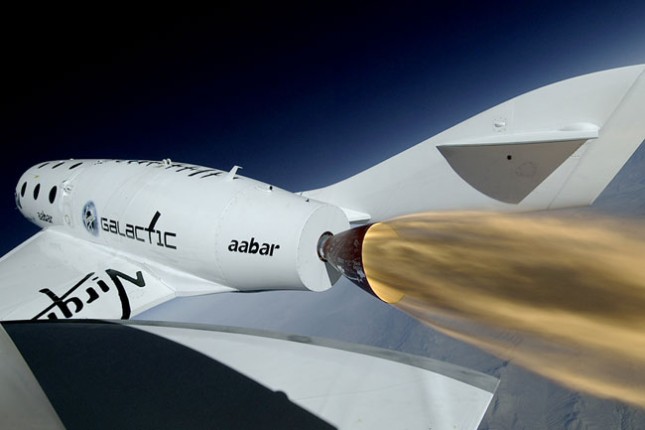

The last few years have seen significant changes regarding flights to space. One of them is of course the flight of Space Ship one that become the first civilian mission to fly to space in a flight comparable to the first flight of Mercury when Freedom 7 blasted astronaut Alan Shepard to an altitude of 188 km. The flight of Shepard used a Redstone rocket to blast of, lasted 15 minutes and finished with a splash down in the ocean and recovery by an aircraft carrier.
42 years latter Space Ship One took of under the wings of White Knight one, soaring to 43.000 ft. of altitude and there it was dropped, igniting its own rocket. The pilot Brian Binnie reached an apogee of 111 km before falling back to earth and gliding to a landing at the Mojave Spaceport from which he had taken off and hour and a half before.
There are many similarities as well as differences between these flights to count but the fact is civilian space flight is finally lunching. Ingenuity is replacing big pockets (the systems in Space Ship 2 will be a lot simpler than those in the Mercury Capsules and even on the late Space Shuttle) and the advances we will see will be guided by the profit that can be obtained.
Today there is a small ecosystem of companies that have the ability to fly into near space. Arianespace is the oldest commercial enterprise and has been flying payloads to space since 1984. However it has never targeted the civilian market and has mostly picked payloads that the government agencies such as NASA and the Russian endeavors (that were never placed under a single agency) couldn’t or wouldn’t lunch.
Space X which builds and operates its own space ships and that has so far focused on gaining government contracts, essentially filling the niche left vacant by the retirement of the Space Shuttle fleet that served to put small commercial or military payloads in orbit and also to resupply the International Space Station.

Orbital Sciences Corporation has been flying suborbital flights and has gained several contracts to deliver payloads to orbit for the US Air Force. Its Cygnus spacecraft successfully completed the first mission last January 11, 2014 when delivery cargo to the International Space Station under a contract with NASA.
There are several more civilian companies working to achieve the capability to go to space. As in the nineteen twenties with commercial aviation (see first part) the US government is helping these companies to grow by awarding them contracts. But once these companies reach a certain level of reliability they will be able to look elsewhere for new business opportunities.
Finally there is another company focusing on a totally different market in space. The partnership between Virgin Galactic and Scaled Composites or, if want to personalize it, between Sir Richard Branson, entrepreneur, showman and hiper achiever and Burt Rutan, airplane designer, dreamer and builder of some of the most exotic airplanes to every fly.
Richard Branson has set the goal of his company in creating a new market. By making space flight affordable he intends to create a new industry. Initially by flying civilian passengers in suborbital flights that will allow them to float free for a few minutes as well joining and elite of space flyers that today numbers less than 500 in the whole history of space flight. Neither of the other civilian companies has flown with humans to space, relying instead on unmanned space ships.
The first commercial flights are scheduled to lunch during 2014. Richard Branson himself and his children will be the first passengers and the flight will be transmitted live by NBC television network.

Branson is not saying much about his plans after the flights begin but we can expect to see the number of astronauts soaring. Once flights become routine, prices will go down and the number of people signing up for a ride will increase. Among the more than 600 hundred that have signed up already there are celebrities like Ashton Crusher, and others less known but who could afford the U$S 250 000 ticket. Among them is flight attendant that paid for her ticket with Bitcoins.
Bitcoins, like space flight for civilians are a concept that only existed in the minds of a few Science fiction writers until a few years ago. They represent the first global currency. One that is not ruled by any state but by a set of rules that will not be changed. Bitcoins as a concept represents another revolution, something that will change the world as we know it.
Conclusions
The fact is that something most people have only dreamed about will be possible in just a few years. As space flight becomes routine, prices will be more affordable and new companies will appear, both to build new space ships and to take passengers and cargo into space. Suborbital flights are just the first step. Once that is achieved it will be affordable to build space stations. Our sons may decide among the possible destinations for their honeymoon spending a week in space or maybe even a quick trip to the Moon to see the famous Earthrise.
It sounds crazy but we live in a world of changes. You are reading this on the Internet, something that just didn´t exist forty years ago. Twenty years ago you needed a dial up connection and at least a desktop computer to use it. Ten years ago you could have read this in a Laptop, maybe moving around a bit. Today you can read it in your phone, on your way to work. 5 years from now you may just see a video of the first civilian space station being inaugurated while you walk on the street. Who can say what will happen in twenty years? Science fiction has become fact. Welcome to the future.
Parece una locura, pero vivimos en un mundo de cambios. Usted está leyendo esto en Internet, algo que simplemente no existía hace cuarenta años. Hace veinte años necesitaba una conexión dial-up, y al menos una computadora de escritorio para acceder a la web. Hace diez años se podría haber leído esto en un ordenador portátil, tal vez moviéndose un poco. Hoy en día lo puede estar leyendo en su teléfono de camino al trabajo. Dentro de cinco años, quizás pueda ver un video de la inauguración de la primera estación espacial civil inaugurándose mientras camina por la calle. ¿Quién puede decir lo que va a pasar dentro de veinte años? La ciencia ficción se ha convertido en realidad. Bienvenidos al futuro.
Sources: Xprize, Scaled Composites, SpaceX, NASA, Virging & Virgin Galactic, CNBC, MTGox and Orbital.
Headline photo: First supersonic flight of the SpaceShipTwo (photo: Virgin Galactic).

