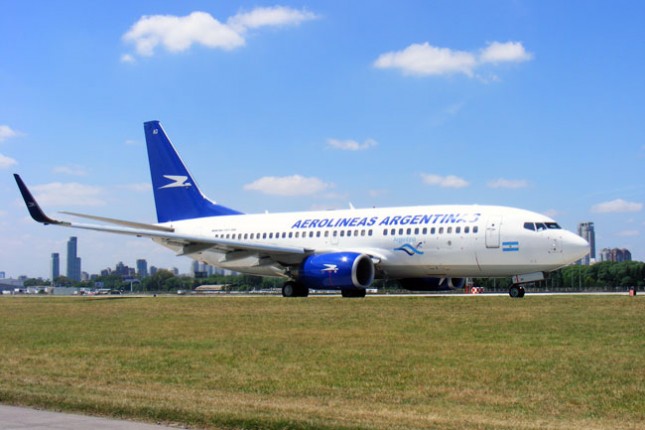

On Monday October 21 Aerolíneas Argentinas unexpectedly announced the closing of an agreement with Boeing for an order of twenty new Boeing 737/800.
The news was not entirely unexpected, because they knew there known to be negotiations. But the decision was clearly unexpected, because the Boeing official that had to be in the announcement (Van Rex Gallard, vice president for Latin America) had to urgently fly to Buenos Aires. These operations are not usually closed this suddenly, but insider sources related the fact to the upcoming elections. Who knows…
More difficult was to understand is what kind of operation we are talking about. The press release of the company said that participants “agreed to a purchase order”. What does that mean? According to the kirchnerist blog aviacionenargentina.com.ar, the President of the company said “Aerolineas will make a down payment and then seek financing that can come from banks or lessors”. This is far from a purchase order and sounds more like an intent to purchase letter.
The Aerolíneas Argentinas’ fleet
When the government made the controversial expropriation of Aerolíneas Argentinas and Austral, in December 2008, he took over a company that had a messy fleet and one of its first missions was to start streamlining the fleet. It is unclear whether there was a fleet plan or if decisions were made guided by the needs of the moment, but the fact is that it was decided to structure a fleet of Embraer ERJ-190, Boeing 737NG and Airbus A-340/200/300 that beyond any comment benevolent or malevolent, served well to the requirements.

Sure it’s not easy to get fifty planes overnight, and so the new fleet shows some inevitable discontinuities.
The Embraer were all new and of the same sub variant, manufactured according to the particular specifications of Austral.
The Boeing 737/700 are what Aerolineas managed to obtaing at that time. Two of them are new, which were purchased in 2009, and the rest of them are leased aircraft from multiple batches of different characteristics and ages. Those who came from Sky Europe were manufactured between 2006 and 2007, from EasyJet are the 2000/2001 and from Virgin of 2001/2002. The 737/800 fleet includes two new purchased of 2012 and two made in 2001/2002.
Airbus fleet is generally older and heterogeneous.
The glass half full
The CEO who operates Aerolíneas Argentinas on behalf of Argentina, Dr Mariano Recalde, said from day one that they aspired to have a very young fleet. It is a healthy political decision. The experiences of Iberia and Marsans we had shown the drawbacks of old and heterogeneous fleets.
A young fleet is a fleet in which no machine has had a “D check” or equivalent. If we look at Aerolíneas Argentinas Boeing NG fleet, there are several aircraft close to this so they would need replacement. At the same time, because traffic is growing well, it is also the time to think about that growth. The only answer to these questions is to incorporate new aircraft. So, what has been announced sound like a good idea.
It also seems logical to continue operating with Boeing products which the company has successfully operated for many decades.

The half-empty glass
But there are some aspects of this announcement that call for further analysis. The first, already mentioned above, is its credibility: This announcements were made by a government that has already announced the Bullet Train and that they would put an important suburban train, the Sarmiento line, underground. These works were never even started by lack of funding.
Thinking further about this, it is legitimate to wonder how decisions are made at the state run airline. The announcement did not state whether it was a buy or a lease or how the operation would be funded.
To complicate matters further, the reality suggests that no financial institution would loan money to a company that for several years has shown no duly audited balance sheets, and this is the case of Aerolíneas Argentinas. So, the only possible explanation is that these aircraft will arrive, if they come at all, thanks to the generous sovereign guarantee of the Argentine Republic, a reality that has worked before.
Moreover, there is a kind of paranoia in the country on any asset seizures of Argentine state owned assets abroad as a result of lawsuits filed by unpaid debts. These have resulted in the seizure of the frigate Libertad in Ghana, and resulted in the curious fact that the presidential airplane (best known per her callsign Tango-01) is not been used to fly the president abroad except to clearly friendly countries. It is somewhat ironic that one of the litigants in these trials is Marsans.
I was struck by the rush to make the announcement. It was convenient for both, Argentina as the government used the announcement to further its political agenda, but also for Boeing, which is involved in an adolescent sporty bid with Airbus in the media world. This operation gives the American builder some welcome news to dispute headlines to this competitor who simultaneously announced a sale of 52 aircraft to the Mexican VivaAerobus.

The glass
According to the statement of Aerolíneas Argentinas, the operation has a list price of 1,800 million dollars, which means ninety million per aircraft. According to the price list published by Boeing on its website the unit price is 90.5 million, so we can think that they obtained a little discount of just under 1%. We will never know the real price, because that information is rarely published, here or anywhere in the world.
I have nothing against NG model but, because it is an operation intended for the long term, I would have liked best the MAX model, despite its price being about 15% higher (103.7 million), because it has much lower fuel consumption and will surely become the standard of modernity in the years to come. This may have delayed delivery dates, but with the first new airplanes supposed to arrive in 2016 this wouldn´t be such a big issue.
Translation: Aníbal Baranek.

