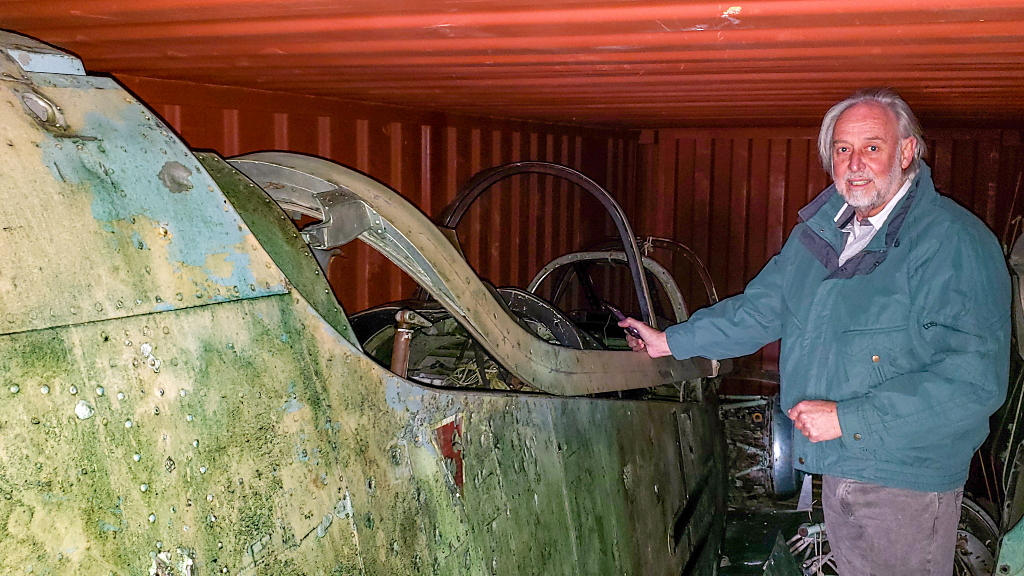
According to his official biography, Rodney John Halsey Butterfield was born in Rhodesia in 1950 and demonstrated an early fascination with sports & racing cars by restoring a 1946 MG TC from the ground up… at the age of 15! His automotive enthusiasm brought him to Britain in 1972, where he initiated a career in Formula One as a fabricator and race mechanic and later earned a Degree in Automotive Design from Loughborough University.
He then turned his passion into a respected (yet demanding!) business which he run initially in England and ultimately in the USA. As noted in an earlier post [see Fifth and last “British Pucará” rediscovered in North Carolina (USA)], he bought A-517 in 1989 and has kept it throughout his intercontinental journey. In February last year we spent well over three hours talking to him about his life, his career and his 30+ years with the last and lesser known British Pucará. Excerpts:
Q: Your biography says you were born in Rhodesia, spent an interesting professional and entrepreneurial career in Great Britain and then moved to the USA. What made you such a globe trotter?
Butterfield: I was actually born in South Africa in Johannesburg but when I was three my parents moved with the family to Salisbury Rhodesia and in those days, it was Southern Rhodesia and that’s where I went to school and grew up. After graduating from school, I studied geology in South Africa because my father’s career was in the mining industry and we had a small family mining exploration company which I planned to work with and help manage.

However, I had always had a huge passion for cars and automobile racing, and at the age of 22 I decided to follow my primary dream and leave for Europe to get involved in racing and car design. I was lucky to find a job at McLaren in 1972 as a fabricator helping to build the F1 and Indy cars, and of course those cars all had monocoque aluminum construction, so I found myself working beside several master technicians for British Aerospace who honed my skills with forming and riveting aluminum panels.
This was exactly the same technology as used in the aircraft industry so becoming co ride to in that later gave me the interest to take on Warbird aircraft restoration. I also at this time decided if I wanted to advance in Formula 1 I had to have a university degree in automotive and aero design, so I enrolled at Loughborough University (which was then the only place in the English speaking world other than General Motors Institute in Michigan to offer an Engineering Degree in Automotive Design).
Accordingly, the next five years were spent working for various F1 teams to earn a living at the same time studying to complete the Degree. I spent time with Shadow, March, Lyncar and Surtees in the later years through 1976 traveling to races as a race mechanic.
After the last year at university I decided in 1978 to start my own business to focus on my love of sports and racing car restoration. That was based in Oxfordshire and known as Thoroughbred Sports Cars Ltd. At the peak I had 16 workers and also built an adjacent 100 car showroom for classic car sales.

In 1990 the premises were sold to make way for a housing development, and I moved to live in the Isle of Man. Two years later I set out on my third continental adventure and moved to North America where I still live and continue to operate a world class restoration shop (www.blueridge-sportscars.com) and sell classic cars around the world (www.sportscarsinc.com).
Q: You were also a Formula 1 professional for six years in the 1970s. Did you get the chance to participate in races taking place in South America (Argentina and Brazil grand prixes) or meet regional credits such as Carlos Reutemann or Nelson Fittipaldi? Do you keep any good, annoying or amusing recollections from that era?
Butterfield: Being mostly based at the factory in construction, I did not ever attend the South American F1 races in person. However, I have fond memories of my last day at McLaren near the end of 1973, when I painted the very first M23 F1 car in the red and white colors of Marlborough for Emerson Fittipaldi to drive in 1974. Iconic times! I do well remember Carlos Reutemann, but I never knew him. One amusing memory from later years when in the early 1980’s I had my restoration shop in Witney Oxfordshire right across the yard from the Toleman F1 Team, and often saw a young kid arriving in sneakers to visit them. It was a youth called Ayrton Senna just trying to break into F1! LOL.

Q: How come a proven sports car enthusiast/professional like you developed an interest in combat aircraft?
Butterfield: I am and always have been in awe of the great achievements of engineering, and while race cars are one sector, the aeronautical marvels of the 20th century are fantastic examples of power and precision and I always wanted to experience something like a P-51 Mustang or a Spitfire. The idea of finding one to restore was always thrilling to me.
Q: Did you own any other aircraft before deciding to get yourself involved in the Pucará acquisition? Are you a flying pilot? When (and how) did your first learn about the commercial availability of A-517? What influenced your decision to purchase Pucará A-517? Did you find anything particularly attractive in that plane? Is there any emotional relationship between you and this model or aircraft?
Butterfield: I had intermittently started to learn to fly over many decades but had never actually owned an aircraft. I was hoping to find a Warbird project throughout the 1980’s to progress as a hobby using our extensive engineering facilities. I was focused on a P-51 Mustang when out of the blue I was offered the chance to buy the Pucará A-517 which was being recovered from the Falklands/Malvinas. Like most people my first reaction was “what on earth is a Pucará?”

As I began to research the answer, I became more and more impressed with the story of A-517, and the remarkable flying characteristics of the Pucará design. The history of the war was current and real and well documented, along with the exact role of each participating aircraft on both sides. As I researched there were more and more reasons why I decided to favor the Pucará over a P-51 or similar project. These included:
- It was going to be the only example in private hands anywhere (there are a lot of 51’s flying). As a result, I felt it would be very interesting and attract a lot of air show work which I had hoped might help to pay for the flying costs if we got it restored. The poorest P-51 owner is hardly going to be noticed beside all the others at a big air show! And I am not rich! LOL.
- The two-seat full dual control cockpit design was very attractive as I am not likely to be an experienced enough pilot in my lifetime to competently and safely fly a high-performance warbird. I figured that a military pilot could fly the Pucará and I could enjoy a limited copilot experience from the second seat before I ran out of abilities. This would be a good way of flying at this level without killing myself. I’ve watched several aircraft enthusiasts with limited hours come to a sad end in Spitfires and other single seat warbirds so I felt the Pucará would be a wise choice.
- The short field and rough ground take off performance, along with the very low stall speed was also particularly attractive as it could be flown into small fields and used a lot more often for fun.

- The visibility from the second seat was also super attractive. Staring at the back of a co-pilots head is not much fun, as is most often the experience.
- Further the Pucará has a terrific range, even up to 2,200 nautical miles with drop tanks, so I felt that it would be way more usable for long trips than a P-51, which is hard to ferry anywhere. Can you imagine a flight across the Atlantic to Britain for example? Or across the continental Americas! That would be one of the most awesome private aviation experiences known to man!
- On the same thought the final attraction was twin turbine safety, and the Pucará’s fantastic aerobatic performance. Rolls into the wrong engine on one engine?? Wow. So many ways to stay alive in extreme flying circumstances. By comparison a P-51 Mustang has a fairly fragile Merlin engine, with no back up in the event of failure.
All of which caused me to make a huge effort to fund the purchase of A-517 in the late 1980’s…
To be continued..

Opening image:
IA-58A Pucará A-517 and the man who has curated it for well over three decades and over a trans Atlantic journey from England to the United States: Rodney John Halsey Butterfield (photo: Mitchell Enríquez, Forest City, North Carolina, 02/2020).


I have a pic of me stood on the wing of this aircraft back in 1982
Ahh, I remember those days in Witney, using hot water to get the frozen tools of the workbench, trying not to be last to the bank to cash in your Friday pay check , hoping it did not bounce. Those were the days…… not.