Taking on where we left in the first half of our interview (see Rodney Butterfield and Pucará A-517 (1/2): “My first reaction was ‘what on earth is a Pucará?’”), we accompany Rodney Butterfield in the last part of his bicontinental journey with Pucará A-517.
Q: Would you share with us the price you paid for it?
Butterfield: No… I am keeping the price confidential, but lord alone knows how much that initial money would have accumulated to by now if it had been otherwise invested. Further, beyond the initial purchase, the invested funding cost is now much higher as I have dragged the containers all over England and then across the Atlantic to the USA, where it has already been moved three more times!
Q: Which were your initial plans after purchasing the aircraft? Did you plan or expect to get it fully restored to flying condition or just saw it as an exotic garden ornament? What made you postpone those plans and get the aircraft preserved in Cosmolene? What compelled you to move the aircraft to the USA when you left the United Kingdom? Have you always held it into storage in its present location in the USA? Or did it get here after other intermediate locations?
Butterfield: I was always set on setting up a Warbird Restoration shop. In fact, after I closed the Oxfordshire auto restoration company I thought I would turn all the equipment to airplane restoration. I explored all the wartime remnant airfields in southern Britain in the late 1980’s seeking a chance to build or restore a hangar. Unfortunately, I did not succeed and left the U.K. in 1990 seeking a kinder tax environment. I tried hard to see if we could purchase the wartime airfield remaining at Jurby in the Isle of Man in the early 1990’s, but one partner refused to sell his part.

At the same time the UK restricted aircraft restoration to one of 13 licensed companies approved by the FAA. That made me think of moving the project to a more flexible and hopefully cheaper environment and contributed to my plan to relocate in the USA which I did in 1994.
From 1992 to 1996 I looked at almost every sky park in the southern USA with my plan in mind, ending up with some land with rights to a small grass airstrip here in western North Carolina, so moved the plane here in 1996. Sadly, the owner of the airport was not a man of his word and the promised use of the airstrip and the land to build a hanger never transpired.
Various occasional efforts since then, to find the right airfield and aviation partner somewhere in the USA have all been frustrated for one reason or another. It has been very disappointing, but one negative aspect of this experience has been that almost no one knows what a Pucará is!
Even serious pilots have lost bets to me that I have a plane they’ve never heard of. The first guess has often been “is that a microlight”? It has been frustrating, and I’m sure if I had indeed ended up with a P-51 I’d have found several partners with funding to complete the project by now!

Q: Have you had any contacts with other aircraft restorers throughout all these years? Which were their reactions to your project? Did you ever approach or were approached by Argentine individuals interested in your project or the aircraft itself? Did you ever consider, or decided, to put the aircraft up for sale? Did any interested parties show up? What caused the sale to fall through? Which are your present expectations for this aircraft? Would you accept an Argentine partner to get the aircraft restored? Would you eventually choose to donate it to an aviation museum? Could it be an Argentina-based or Argentine-related institution?
Butterfield: I would certainly be pleased to negotiate with any interested partner from any nation, if together we can get this wonderful plane airworthy. However, it may have to remain domiciled in the USA or Britain as I have signed contracts with the British and American governments restricting what A-517 can be used for if eventually airworthy and where it can be displayed. Perhaps with the passage of time since the war, important changes could be negotiated if necessary, but we are not there yet.
In short, I would like to stay involved in seeing this project through and perhaps even getting to fly in it before its final fate is settled. I am open to sharing A-517 with other airplane owners, maybe trading even for a reciprocal share in a more usual everyday plane that I can actually co-own and fly! I am ready to listen to all serious suggestions.

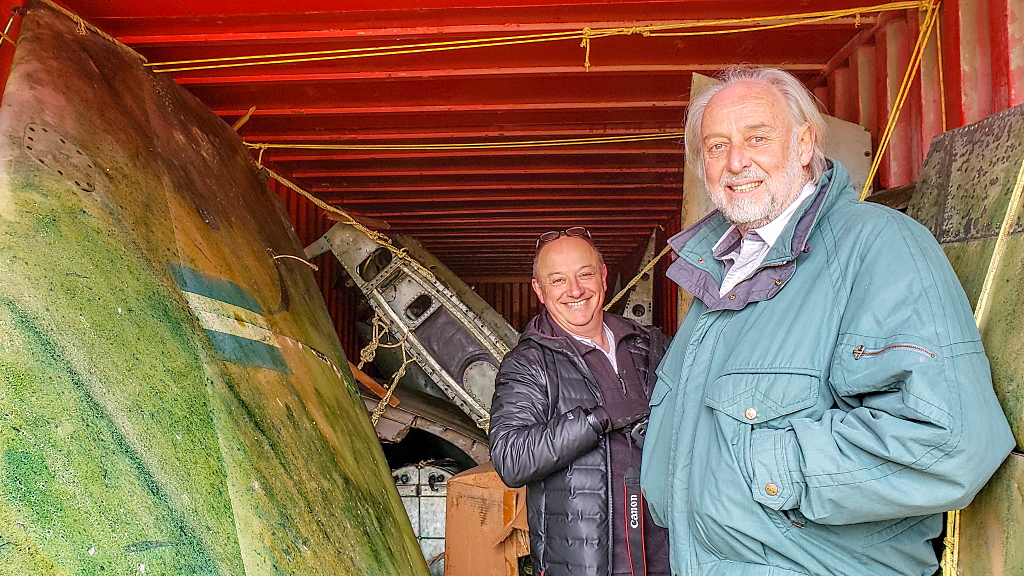
Opening image:
Roderick Butterfield and Carlos Ay posing inside one of A-517’s two containers (photo: Mitchell Enríquez, Forest City, North Carolina, 02/2020).

