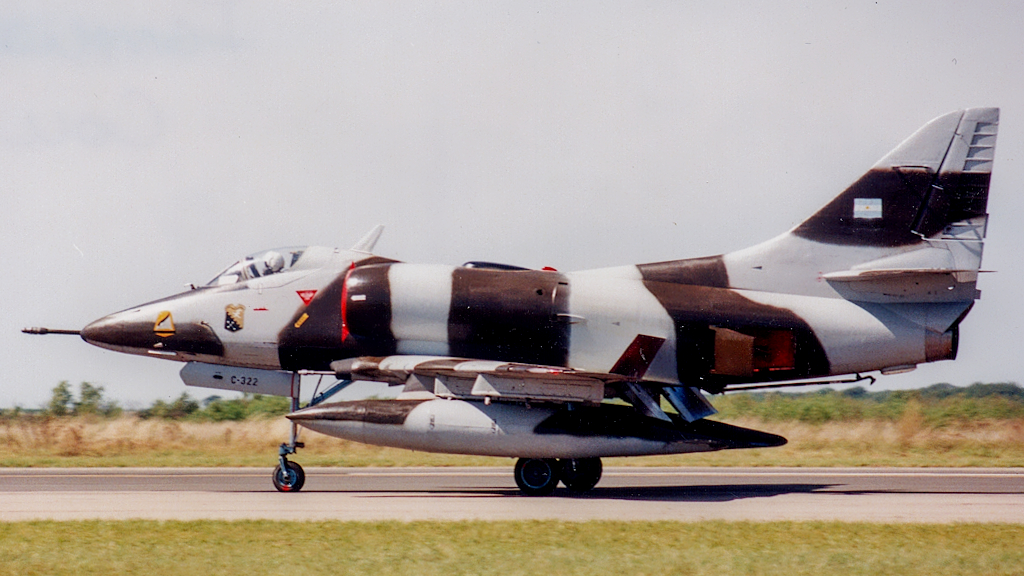
Today we will know the history of Skyhawk c/n 12839, which after a varied activity in the United States ended its days in Argentina.
There, it participated in the conflict with the Republic of Chile over the Beagle Channel (1978) and carried out several combat sorties during the South Atlantic Conflict against the United Kingdom (1982).
Manufactured at the Douglas plant in Long Beach (California) on 01/30/1962, it had an active service record.

Registered with US Naval Bureau of Aeronautics Number 149514, it was initially delivered to the USMC (United States Marine Corps) and began its service with VMA-242 squadron on 02/06/1962, in routine exercises with rockets and bombs of different types, as well as night training flights.
Its last operational service record with a North American squadron was registered with VMA-214 (El Toro, California) and there is no evidence that it was ever deployed to Vietnam or sent to Florida during the 1962 “Cuban Missile Crisis”.
In 1970, it was reallocated to training missions with the reserve: Last destined to Naval Air Station Glenview (Illinois), it was finally discharged and sent to the MASDC (Military Aircraft Storage and Disposition Center) at Davis-Monthan AFB (Air Force Base), Tucson, Arizona on 07/14/1971.

It remained that way until the Argentine Air Force bought it in “as is condition” on 12/12/1974, with 3,639 flight hours behind it.
Serving the Argentine Air Force
At Lockheed Aircraft Services facilities in Ontario (California), it was reconditioned for shipment by sea to Argentina, arriving in 1975 and delaying its commissioning due to lack of documentation and maintenance manuals plus the absence of test benches.
Arriving in our country, it did not have any technical documentation and it retained USN colors and insignia, very much like the entire Argentine A-4C fleet.

On 06/19/1978, performed it first flight from Río Cuarto.
Rio Cuarto Material Area (Área de Material Río Cuarto, ARMACUAR) was responsible for installing new NAV/COM equipment and fixed underwing supports and spoilers copied from the A-4E and A-4F variants.
The AN/APG-53A radar was very difficult to put into operation due to lack of technical information and spare parts, so it was discontinued.
Relocated to El Plumerillo (Mendoza), home base for Operations Group 4, on 07/27/1978 and participated in its first deployment to Puerto San Julián (with a stopover in Comandante Espora Naval Air Station) that was being established as a forward operating base on 09/05/1978, returning to Mendoza on 09/07/1978.
On 11/19/1978, it deployed towards Rio Gallegos for five days.
On 12/13/1978, it was again deployed as part of one of the A-4C air mobile squadrons to Comodoro Rivadavia due to the Beagle Channel conflict, which almost led to an armed confrontation with Chile later that month.
Withdrawn to Rio Cuarto on 12/27/1978 as a precaution against a possible Chilean attack, it finally returned to base on 01/10/1979.
In 1982, Litton LTN-211 VLF Omega equipment (navigation), Cossor 2720 (IFF) and Thomson-CSF AHV-611 radio altimeter were installed, following a process initiated in 1980.
Puerto Argentino/Port Stanley’s recovery on 04/02/1982 found C-322 stationed at Mendoza, completing three hours of local flight.
On 04/1982, crewed by captain Jorge García, it relocated from IV Air Brigade to Puerto San Julián (Santa Cruz), from where it would carry out all of its combat missions into the South Atlantic Ocean.

For the remainder of the month, it completed four training flights from San Julián (on 17, 18, 21 and 23) and bombing practices (on the 25).
At war over Malvinas
As of 05/01/1982, once military actions began in the theater of operations, and in compliance of “fragmentary order” OF1095 to attack naval targets, it took off from San Julián at 11:00 am using callsign “Oso 1” (captain Fernando Castellano), refueling in flight (2,000 pounds of fuel), yet finding no target and landed back in San Julián at 1:30 pm.
That same day in the afternoon, it carried out another offensive reconnaissance sortie over Malvinas as “Pampa 1” (captain Eduardo Almoño), later suspending the mission and returning to base due to communication and fuel transfer problems.
Its next mission took place on 05/09/1982 (OF 1174) crewed by lieutenant junior graduation Gerardo Isaac (“Trueno 4”), but it was cancelled due to replenishment failures.

On 05/11/1982, it launched two sorties from San Julián, crewed by first lieutenants Normando Costantino and Omar Castillo, respectively.
Got airborne again on 05/13/1982 (lieutenant Jorge Bono) and 05/14/1982 (lieutenant junior graduation Guillermo Martínez) on low-altitude navigation training flights.
On 05/20/1982, it withdrew to Mendoza, most likely for maintenance purposes, flown by first lieutenant Daniel Vázquez, returning to San Julián on 05/22/1982.
Continued its operational activity wit missions launched on 05/22/1982 (first lieutenant Oscar Cuello) and 05/24/1982 (lieutenant Daniel Méndez), fulfilling OF1228 as “Halcón 3” to attack ships in San Carlos Bay with three 250 kg bombs; but that attack was canceled while in flight.

On 05/25/1982, made a local flight (first lieutenant Costantino) and on 05/27/1982 fulfilled OF1249 as “Tanque 4” (lieutenant Daniel Méndez) tasked with attacking surface vessels near Darwin; but it returned to the mainland after refuelling and failing to make contact with the enemy, landing at 12:45 pm.
On 05/28/1982, lieutenant Daniel Paredi flew it as “Chispa 3” attending OF1259 to attack ships in the Pradera del Ganso area, but it was unable to locate them due to very marginal weather conditions; recording unspecified issues with the Omega navigation system upon arriving in San Julián.
On 05/29/1982, lieutenant Paredi performed yet another local flight, making C-322 the most flown A-4C for the month of May, totalling 27 hours.
War continued the next month and our protagonist continued to carry out missions.

On 06/08/1982, fulfilling OF1298, he led the flight as “Yunque” under the command of Captain Jorge Caffaratti and, after refueling, he went on to attack the RFA “Sir Galahad” armed with three 250 kg bombs in the area of Pleasant Bay unable to achieve it. Confirming the results of the attack and having a strong and dense anti-aircraft defense, landed in San Julián at 6:00 pm.
On 06/09/1982, as a wing in “Cobra” flight (lieutenant junior graduation Gerardo Isaac) and fulfilling OF1303, launched its last wartime combat sortie attempting to strike again in the Pleasant Bay area; but returned due to refueling problems.
On 06/18/1982 he made a local flight of 01:30 hours (captain Atilio Zattara) and finally withdrew to Mendoza with the rest of the squadron on 06/21/1982 (lieutenant junior graduation Carlos Codrington), resupplying in the air over Neuquén.

With C-322 accounted, only four of the initial group of ten A-4C Skyhawks (and 15 of 23 pilots) originally deployed to San Julián returned the their home base…
Post-war time
In 1983, its flying activity at IV Brigade was strenuous, to say the least, after funding, technical and logistic limitations started becoming became common place.
But, in addition to routine training flights, our protagonist was deployed to the exercise “Galaxia II” between 09/15/1983 and 10/15/1983 in Río Gallegos (Santa Cruz).

On 12/20/1983, it was transferred to V Air Brigade alongside all other surviving A-4Cs, integrating Fighter Group 5’s III Squadron at their new home base in Villa Reynolds (San Luis).
Budget shortages notwithstanding, it was again involved in exercises “Galaxia III” (Río Gallegos, 02/15 to 03/15/1984) and “Orión” (Comodoro Rivadavia, 09/15/1988).
On 06/14/1985 it went back to ARMACUAR for a major overhaul which was to be completed two years later, when project “Halcon I” replaced its two Colt 20mm with DEFA 553A-4 30mm cannons, increasing its firepower and reliability.

“Charlie Three Two Two” and the entire A-4C fleet was grounded due to structural fatigue issues twice (04/1988 and 04/1993) and again in 1995 following the C-321 accident where first lieutenant Mario Bordagaray died (see Skyhawks Illustrated #12505: A veteran of the controversial attack on HMS “Invincible”), and 1997, time due to the C-324 accident.
C-322 itself had wing structural problems in 1991 and technical analysis was carried out and lost its IFF and radio altimeter systems due to lack of spare parts in 1997.
Even though no evidence has been found of its participation in the many exercises carried out between 1989 and 1995, our aircraft and four more Skyhawks participated in the 85th Air Force Anniversary air parade over El Palomar (Buenos Aires) on 08/12/1997.
Anticipating a well deserved retirement, flying activity dwindled and came to an end on 12/15/1998, when it performed its last operational flight.
After participating in the A-4P and A-4C farewell ceremony at Villa Reynolds on 03/15/1999, two weeks later made its last and final flight between Villa Reynolds and Morón (Buenos Aires), its ultimate resting place at the National Aeronautics Museum (MNA, Museo Nacional de Aeronáutica).
Variants:
- A4D-2N (1962), A-4C (redesignated 1962), A-4C (initial Argentine configuration, 1978) and A-4C Halcón I (final Argentine configuration, 1987)
Identities:
- BuNo 149514 (1962), #3A343 Monthan Davis Air Force Base, AZ (07/14/1971) and C-322 Argentine Air Force.

Owners and Operators:
- USN & USMC: VMA-242 “Bats” MCAS (Marine Corps Air Station) Cherry Point, North Carolina (02/06/1962); H&MS-14 MCAS Cherry Point, North Carolina (08/01/1963); VMA-224 “Bengals” NAS (Naval Air Station) Roosevelt Roads, Puerto Rico (10/04/1963); H&MS-14 MCAS Cherry Point, North Carolina (08/12/1965); VMA-225 “Vagabonds” MCAS Cherry Point, North Carolina (11/05/1965); VA-125 “Rough Raiders” NAS Lemoore, California (03/13/1966); VMA-214 “Black Sheep” MCAS El Toro, California (04/11/1968); MARTD (Marine Air Reserve Training Detachment) NAS Glenview, Illinois (04/08/1970); MARTD (Marine Air Reserve Training Detachment) NAS Memphis, Tennessee (07/02/1970); MARTD NAS Glenview, Illinois (08/06/1970); MASDC (Military Aircraft Storage and Disposition Center) “3A343” Davis-Monthan AFB, Tucson, Arizona (07/14/1971).
- FAA: Acquired 12/1974, Rio Cuarto Material Area (ARMACUAR) 1975, first flight (ARMACUAR) 06/19/1978, IV Air Brigade (Mendoza) 07/27/1978, V Air Brigade (Villa Reynolds) 12/20/1983, National Aeronautics Museum 03/29/1999.
Fate:
- Preserved at the Argentine National Aeronautics Museum in Morón since 03/29/1999.

Bibliography: Jorge A. Núñez Padín: Air Force Series #30 “A-4C Skyhawk” (Ed. 2023) and National Aeronautics Museum Historical Research Department. Internet sources: Forgotten Jets, Skyhawk Association and AMARC Experience. Javier Ruberto, Carlos Ay, Jorge Nuñez Padin, Sgt. Thomas M. Dunne (USMC), Todd Frommelt, Fernando Benedetto, eLaReF, Atilio Marino, Ignacio Collia and Walter Marcelo Bentancor made fundamental contributions to this story.

