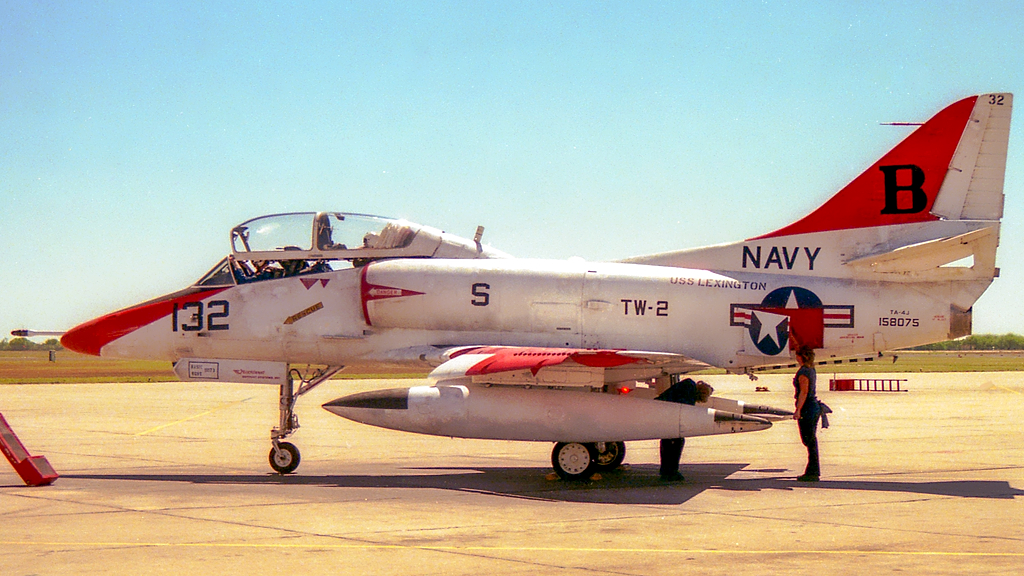
The two-seater version of this remarkable aircraft rose from the need for training and operational conversion duties back in the early 1960s.
Several generations of pilots were trained in variants raging from the original TA-4E to the final TA-4J, and most of them fought in the Vietnam War.

In the early 1970s, several Argentine Navy pilots were students in US Navy training squadrons and this gave rise to interesting anecdotes, one of them starring the aircraft in our story, BuNo 158075.
The original two-seater prototype was built from the union of two incomplete A-4E fuselages (BuNos 152102 and 152103), later deriving into the TA-4E/F models.

Unlike its two-seater predecessors, he final TA-4J had all weapon systems removed, was fitted with Escapac 1C-3 ejection seats, was powered by a J52-P6 and in mid-1969 entered operational service with VT-17 at Kingsville, Texas.
Our protagonist was built at the Long Beach (California) plant, was part of the first batch of factory-new TA-4Js and was delivered to the US Navy on 01/28/1971 wearing Bureau Number 158075, spending its entire operational career at Kingsville.
The Argentines arrive…

At the beginning of the 1970s, A-4Q Skyhawks were already operational in the Argentine Navy and, after three accidents, it was determined that they could have been avoided if their pilots had had an instructor pilot or two-seater aircraft training time.
As it was impossible at that time to acquire them, it was decided to send Argentine pilots to US Navy VT-21 and VT-22 training squadrons so that they undergo the adaptation course on TA-4J Skyhawk two-seaters.
In 1975, several naval pilots, who years later would stand out in the actions of the 1982 Malvinas War, were commissioned to the exchange program: Lieutenants Rodolfo Castro Fox, Jorge Colombo, Roberto Curilovic and Carlos Sánchez Alvarado, received initial instruction at the VT-21 and VT-22 squadrons.
They highlighted that experience was very important due to the possibility of carrying out maneuvers considered critical with an instructor in the rear position.
Obviously, the Argentine pilots stood out.
And here comes something that I think is rarely seen and exceptional: After 270 flight hours and about 20 hook landings, at the end of the instructor course, the VT-21 “Fighting Red Hawks” commander officer had the name of Lt. Roberto “Toro” Curilovic painted by the cockpit of our TA-4J.
A gesture rarely seen and that evidences the performance of the Argentine pilot in flight practices, training in tactics and operations on aircraft carriers that took place in that distant 1975, in addition to evidencing personal appreciation from the VT-21 commander, Captain David Dungan.

Years later, Lieutenant Commander Roberto Curilovic and Lieutenant Julio Héctor Barraza, manning two Super Etendards, would sink logistics ship “Atlantic Conveyor” on May 25, 1982 using AM-39 Exocet missiles… but that is another story!
Variants:
- TA-4J (1971).

Identities:
- BuNo 158075 (1971).
- #3A0818 Monthan Davis AFB, AZ (25/08/1994).
Owners and operators:
- VT-22 “Golden Eagles” NAS Kingsville, TX (01/28/1971).
- VT-21 “Fighting Red Hawks” “B-128” NAS Kingsville, TX (09/29/1972).
- TW-2 (COMTRAWING-2) “B-132” NAS Kingsville, TX (07/01/1986).
- AMARC (Aerospace Maintenance and Regeneration Center) “3A0818” Davis Monthan AFB, AZ (08/25/1994).

Fate:
Sold to HVF WEST, of Tucson, AZ, and then scrapped 11/16/2022.
Cover photo: 158075 on the apron at NAS Kingsville, in engine start up sequence (photo: Trevor Bartlet, 03/31/1989).
Bibliography: “Mc Donnell Douglas A-4Q & A-4E Skyhawk Aeronaval Series #41” by Jorge Félix Nuñez Padín. Internet sources: Roberto Curilovic, Forgotten Jets, Air Britain, Skyhawk Association, Phil Kovaric, Javier Ruberto, Juan C. Cicalesi, Trevor Bartlet and The Aviation Photo Company. Gary Verver, Javier Ruberto and Jorge Nuñez Padín made valuable contributions to this story.

