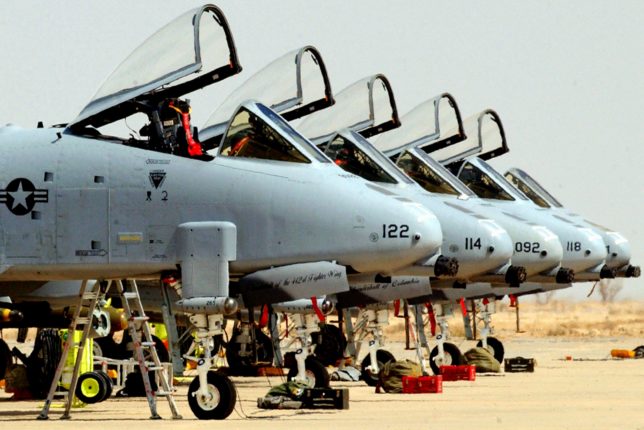


The United States Air Force A-10 Thunderbolt II (more often known as the “Warthog”) is the most unique aircraft in US service. The aircraft has been in service since 1974 and will continue to serve the US Air Force well into the 2020s. The aircraft if the only military aircraft that is dedicated strictly to the role of close air support (CAS) and it has several unusual features that help it meet that role.
The experiences of the Vietnam War pointed out the need for aircraft that was dedicated to the CAS mission. Although aircraft like the A-1 Skyraider, the F-4 Phantom and the A-7D Corsair were used in this role, they were not originally designed for this purpose. Thus in March of 1967, the US Air Force issued a request for proposal (RFP) to 21 companies for design studies involving a low-cost attack aircraft designated as the A-X proposal. A final RFP was issued in May of 1970 with specific requirements as well as having a head-on flying competition that would be conducted for the first time in several years between prototypes build by the two finalists chosen by the Air Force.
In August of 1970, six companies submitted formal proposals for the A-X development contract. The Fairchild Republic Company was one of the six companies and it was in the most precarious situation. The Fairchild Republic Company finished production of the F-105 Thunderchief in 1964, a workhorse during the Vietnam War and the company had no major aircraft programs in house.


In December of 1970, Fairchild Republic and the Northrop Company were chosen as the two finalists by the Air Force with each company building two prototype aircraft each that would participate in a competitive flyoff to win the A-X contract. Fairchild took the approach that their aircraft (designated the A-10) was more representative of a production aircraft whereas Northrop’s approach (the A-9) was that of a conventional prototype that would have required several changes before coming into production.
The A-9 was conventional in appearance with shoulder-mounted wings and engines located neatly in the fuselage under the wing, along with a single vertical tail fin. The A-10 was more radical in appearance as it had the two engines mounted high on the rear portion of the fuselage, along with the use of a dual cantilever tail section. The reason for the high engine location by Fairchild was to increase survivability of the engines by keeping away from runway debris and ground fire, as well as a shield against ground infrared radar. The unique tail section design provided stability as well as shielding the engine exhaust from ground infrared radar.


The A-10 wings are long and perpendicular to the fuselage in order to give the maximum amount of lift possible to the aircraft during takeoffs from short runways. Survival features for the A-10 aircraft included the use of a one-inch thick titanium “bathtub” that would enclose the cockpit, providing protection for the pilot against ground fire as well as protection for some of the critical flight control cables that were located in the cockpit area. Other survival features included the lining of the fuel cells in the wings with ballistic foam pieces that would soak fuel and not allow a fire to break out if the cells received a direct hit from enemy ground fire. The primary flight controls had triple redundancy with a dual redundant hydraulic system that was backed by a cable system that could be used in the manual reversion mode if hydraulic power was lost (This particular feature would be demonstrated vividly years later during war action).
The A-10 was essentially a plane that was built around a gun. The gun assembly consisted of seven long barrels and was almost twenty feet long along which attached to a very large ammo drum that had to be fitted inside the fuselage. Fairchild Republic engineers took a novel approach with regards to the nose landing gear of the aircraft by locating it off-center of the middle of the fuselage in order to accommodate the long barrels of the gun and to allow the landing gear to fit when retracted. The gun could fire at a slow or high rate of speed, with the maximum rate of speed being 4000 rounds per minute with the ammo drum holding 1350 rounds.
In January of 1973, Fairchild Republic was announced as the winner of the flyoff competition. A major reason for picking the A-10 was that the A-10 prototype was made to be much more representative of a production aircraft by Fairchild Republic and there would be less transitional difficulties in starting the production line. However, there were some political hurdles that had to be resolved first as the congressional delegation from Texas was pushing for the older A-7D Corsair II aircraft built by Vought in Texas to perform the CAS mission. This resulted in a subsequent flyoff between the A-10 and the A7 in April of 1974 and it was determined that the A-10 was the better aircraft for meeting the CAS mission, particularly in the areas of target spotting in less than ideal conditions as well as having better survivability features.


The A-10 began production in 1975 with initial bases set up throughout the US and one in Europe in Bentwaters of the United Kingdom. The presence of the A-10 in Europe would be a counterbalance against the massive amount of tanks in the Warsaw Pact led by the Soviet Union. Pilots would nickname the aircraft the Warthog, due to its odd appearance and a few years later, it was officially designated as the Thunderbolt II, in honor of the original P-47 Thunderbolt built by Republic during World War II.
A total of 713 aircraft were built with the last one delivered to the US Air Force in 1984. However, changes in the political climate in Europe saw the end of the Iron Curtain in 1988 and the need for the A-10 appeared to be diminished. The aircraft was destined to be scrapped by the Air Force when in 2001, the A-10 was sent over to the Middle East as part of Operation Desert Storm to liberate Kuwait from Iraq. During the 43-day war, the A-10 conducted hundreds of missions that included downed-pilot rescue, SCUD missile hunting and most important of all, the destruction of almost 1000 Iraqi tanks.


With this new lease on life, the A-10 would successfully support various US operations overseas over the next 20 years in Bosnia, Serbia, Afghanistan, Iraq (again) and Libya. While the A-10 has been accruing flying hours, efforts have been taken to upgrade its wings and avionics to extend its service life.
In recent years, there have been many debates in US Congress about keeping the A-10 in service, primarily because of budget concerns. However, with many ground personnel testifying the effectiveness of the aircraft, the retirement of the A-10 has been put off indefinitely. Currently, there are approximately 283 A-10 are still in service.
About the author
Ken Neubeck is an aerospace reliability engineer and a former employee of the Fairchild Republic Company that worked on the A-10 program, who has written several aviation books and articles, including books on the A-10 Warthog.

