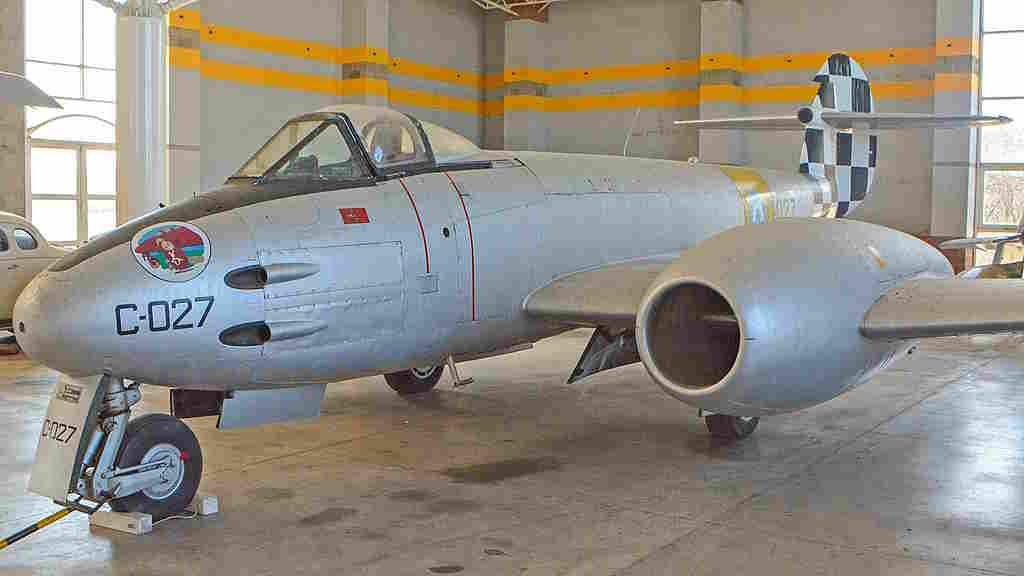
Oddly enough, the oldest Meteor F.Mk.IV built in Gloucestershire (UK) survives to the present day in private hands after a negligible stint with the British Air Speed Record Team and a quarter century career with the Fuerza Aérea Argentina (Argentine Air Force, FAA).
Although a couple earlier cockpits reportedly survive in the United Kingdom, our subject aircraft is definitively the oldest complete Meteor F.4 survivor and can be identified by its Gloster’s construction number G/5/127 and initial Royal Air Force (RAF) serial number EE527.

Built in 1946, it spent one year in the United Kingdom until it was sold to Argentine and never served with an operational unit within the RAF, although several sources report it as loaned as a training or backup airframe for the British High Speed Flight that broke the world’s absolute air speed record on 09/07/1946 (Group Captain E. M. Donaldson and “Star Meteor” EE549).
Once sold to Argentina, it was shipped to Buenos Aires, where it arrived and flew for the first time on 07/02/1948.

Accepted by FAA on 07/23/1948, it spent some time based in Ezeiza International airport until it entered operational service with VI Brigada Aérea (VI Air Brigade, VI Br Aé) at Tandil (Buenos Aires) on 08/02/1949, moving on to VII Br Aé at Morón (Buenos Aires) 12/1951.
Even though no actual combat records are known for this particular aircraft, it participated in large-scale training exercises in Pampa de Olaén (Province of Córdoba) in 1953 and 1961, operation Tritón (1959) and air-to-air gunnery training in the Mar Chiquita gunnery range, near Mar del Plata (1964).

Last flown by FAA first lieutenant Aldo Tomás on 12/29/1970, it was withdrawn from use on 12/30/1970 and struck off charge on 02/21/1972.
Stored for some time at a Morón air base hangar, in early 1971 it was installed as a ground instructional airframe to Universidad Nacional de Córdoba (Córdoba National University, UNC), where we noted it for the last time in the summer of 2001.

Even though it retained its ultimate operational colour scheme, the aircraft was eventually repossessed by FAA and relocated to Las Higueras, where it was restored to its early 1960s livery and fitted with cockpit instruments from sistership C-057.
Variants:
Meteor F.Mk.IV (built 1946).

Identities:
EE527 (1946), I-027 (1948) and C-027 (06/17/1959).
Owners or operators:
Royal Air Force (ntu), RAF High Speed Flight (1946, on loan), Gloster (1948), Argentine Air Force (1948), Córdoba National University (1971) and Estancia Santa Romana (circa 11/2004).

Accidents & incidents:
- 10/23/1953: Emergency landing at Morón after expansion chambers burn out. Pilot: Ensign Rodolfo Guerra.
- 05/11/1954: Emergency landing at Morón with right landing gear retracted, 20% damage repaired and returned to operational condition on 04/19/1956. Pilot: Lieutentant César de la Colina.
- 07/25/1957: Run off the runway at Morón during a take off simulation. Pilot: Captain Aldo Barbuy.
- 03/02/1961: Mid-air collision with sistership C-048 while on aerobatic maneuvers over Reconquista (Santa Fé). Pilot: Lieutentant Alexis de Nogaetz.

- 04/27/1964: Hit a towed target while on gunnery training over Mar Chiquita (Buenos Aires). Pilot: First lieutenant Knud E. Andreasen.
- 08/01/1966: Emergency landing at Morón with landing gear retracted. Pilot: First lieutenant Juan Ferreyra.
- 08/25/1966: In-flight bombs dispenser loss while operating out of Tandil (Buenos Aires).
- 04/21/1969: Emergency landing at Morón with nose landing gear retracted.

Fate:
Preserved in Santa Romana museum, Province of San Luis (last noted 09/2016).
Acknowledgements: Alberto O. Domínguez, Andy Marden, Atilio Marino, Daniel Relvas and Fernando Benedetto contributed to this story. Bibliography: Lucas C. y José L. Giani: “Gloster F Mk.4 – Atlas de Preservados” (Argentina, 2016), Atilio Marino: “Gloster Meteor F.4 en Argentina” (Argentina, 1998). Other sources: Grupo de Usuarios Pista 18 (Facebook), Key Aero, Tangmere Museum and Top Foto.

