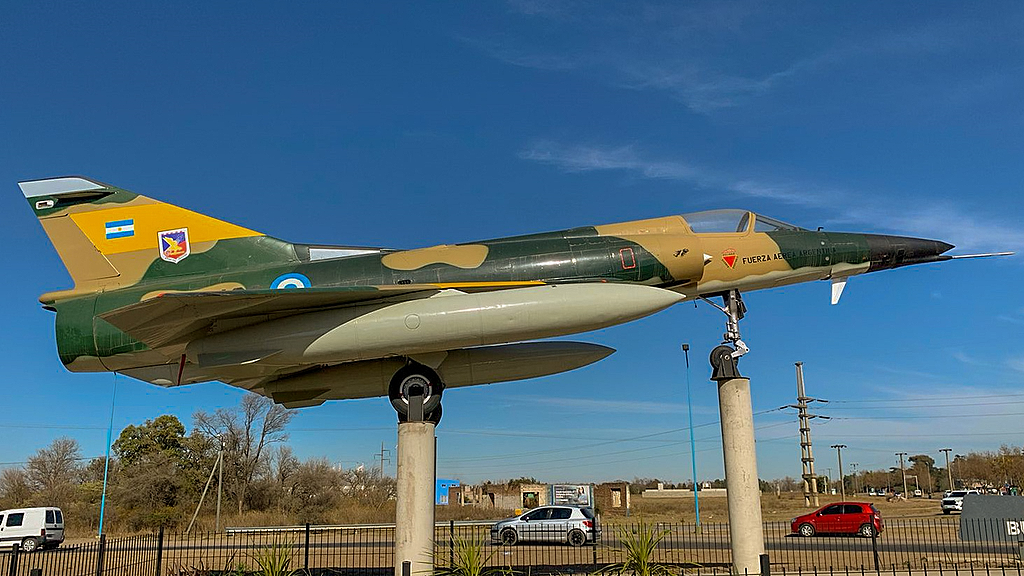
Either built in France or Israel, Delta fighters represent the peak of Argentine Air Force (Fuerza Aérea Argentina, FAA) air combat capabilities.
Even though the last few members of the fleet were definitively withdrawn from use almost a decade ago and haven’t yet been replaced by a more modern “weapons system”, the so-called “Delta Dynasty” remains a source of pride both among its former pilots and technicians as well as with many local and foreign aviation enthusiasts.

While FAA top brass and Ministry of Defense officials continue to explore ways to select, finance and purchase a fourth generation multi-role fighter type that may restore some of the “Argentine Deltas” supersonic capability and splendor, let’s explore the many locations where Argentine Mirage and Dagger wrecks and relics can be found throughout the nation and abroad.
Sonic boom veterans census
After consulting a wide range of physical and on-line resources and testimonies, our research concluded that well over 60 airframes, large airframe components or wreckages from the 93 aircraft purchased since the early 1970s do (or may) remain in existence to the present day.

Naturally, most of them concentrate in the Moist Pampa, Cuyo and Patagonia regions in Argentine continental territory, several wreckages are believed to remain in place following their loss in combat during the 1982 Malvinas war and one is exhibited in dual markings at the Israeli Air Force Museum in Hatzerim (Be’er Sheva).
Central Argentina locations include former “Argentine Deltas” operating and maintenance air bases such as Las Higueras (Córdoba), El Plumerillo (Mendoza) and their last home base at Tandil (Buenos Aires), training and museum facilities as well as locations in war veterans and former pilot’s home towns.

The South Atlantic Theater of Operations (Teatro de Operaciones del Atlántico Sur, TOAS), where the 1982 war was fought, is another source of Delta fighter wreckages and monuments that keep memories alive.
Even though most surviving examples and wrecks are geo-referenced on the satellite image below and listed elsewhere, let us synthetize more than four decades of Argentine supersonic air combat history, the four “generations” that brought these sleek French and Israeli fighters into FAA’s fleet and their present whereabouts.

French originals
Ironically enough, the first generation was the only one purchased new from the manufacturer and consisted of four Mirage IIIDA two-seat trainers (including two converted from French-surplus Mirage IIIBEs) and 17 Mirage IIIEA single-seat fighters delivered between 1972 and 1982.
Allocated to air superiority duties during the 1982 Malvinas War, two of them were lost to British air-to-air missiles and a further seven were destroyed in peace time accidents; having operated with both the VIII (Mariano Moreno) and VI (Tandil) air brigades without major improvements to their avionics and weapons configurations (beyond early portable GPS navigation receivers).

Two thirds of this generation are believed to survive to the present day in varying conditions, since seven are preserved as gate guardians, monuments or museum pieces throughout the nation.
Several other airframes are believed to remain stored or dumped in varying preservation conditions at the air bases where they reached the end of their flying careers: Tandil or Las Higueras.

Israeli copycats?
The second generation was purchased between 1978 and 1981 and consisted of 35 single-seat Dagger and four two-seat Dagger T, the Argentine designation for the Israeli Aircraft Industries Nesher multirole fighter, which at the time was a little known purported copy of Dassault’s Israeli-inspired variant, the Mirage 5.
Even though the first six Daggers were readied for war with Chile at the peak of the Beagle Channel Crisis in December 1978, their first battle actually took place four years later during the Malvinas War, where they were involved in both air-to-air, air-to-ground and anti-shipping missions.

Alongside the initial acquisition contract, a deal was struck with Israeli, French and British firms to upgrade Argentine Daggers with an advanced integrated navigation and attack system that would increase their multirole capabilities with state-of-the-art combat avionics.
Between 1985 and 1989, After the Malvinas Air War forced a project reconfiguration, Israeli and French equipment filled the void left by British vendors and 21 of the surviving single-seat aircraft were converted to the new operational variant, Finger III.

Eleven aircraft were downed in combat during the 1982 war and a further ten were lost in peace time accidents until the type’s almost three decades of operational service ended in late 2015.
Nearly 20 examples (or parts of them) are understood to survive in a diversity of locations in continental Argentina, while the wreckages of six aircraft downed during the 1982 war are believed to remain in place at their crash sites on Malvinas soil.

Post-war additions
The third generation arrived in Argentina in 1982 after the Peruvian Air Force sold ten of its Mirage 5P single seaters as a means of helping FAA cover most of the Daggers lost in the Malvinas War.
Believing they were equivalent to their “Israeli cousins”, the Peruvian fighters were initially allotted to Tandil’s air brigade and re-used ten of the Malvinas-downed Daggers serial numbers.

Once differences between both models became evident, the entire fleet relocated to Río Gallegos’ X Air Brigade to form the first Patagonia (permanently) based fighter-bomber group in FAA history, its members were upgraded to the Mara standard wearing distinctive radar warning receivers and other improvements and their serial numbers migrated from the C-400 to the C-600 range.
Following three fatal accidents and retirement from active duty late in 2015, at least five of this variant’s airframes (and parts from at least another one) live-on as monuments or instructional airframes, either in their original markings or representing Malvinas war veterans.

The fourth generation was ironically integrated by the oldest and most battered Mirage variant in Argentine hands: Comprising four former Israeli Air Force two seat Mirage IIIBJ and 18 single seat Mirage IIICJ, it was incorporated in 1983 via a moot arrangement to disguise it as a deal with the Peruvian Air Force.
Initially allocated to X Br Aé in Río Gallegos and IV Air Brigade in El Plumerillo, aircraft from this generation eventually concentrated in Mendoza and later relocated to VI Br Aé in Tandil to be withdrawn from use in the late 1980s.

Even though the type was short-lived in Argentina and its local career was inconsequential, 19 airframes survived retirement and failed to find a new operator willing to purchase them… the author being shortly involved in at least one failed campaign to re-sell them abroad in the mid-1980s!
Once grounded for good, the surviving examples became monuments, museum pieces and gate guardians at a variety of locations throughout the nation, either in their original liveries or representing Mirage and Dagger airframes lost during the 1982 war.

Their greatest historical value, however, belongs with the Israeli Air Force, which already got hold of one of them for preservation at the institutional museum in Hatzerim and may be setting their sights on their last surviving photo reconnaissance example, presently posing as an IAI Dagger in a Tandil neighborhood (see “The Israeli spy that retired in Argentina: Mirage CJ.34”).
Sorting out the details
Even though Pista 18’s data base presently lists nearly 70 records for our research subject, several actually correspond to incomplete airframes (wings or tail sections) and six are Daggers lost in combat over the Malvinas Islands in 1982.

The remaining entries, meanwhile, may include repetitions for airframes that were last noted in storage at Tandil or Las Higueras and later appeared redressed with other type’s color schemes or individual serial numbers and haven’t yet been tied-up to their previous identities.
In fact, reusing old aircraft serial numbers is common place because many of the surviving airframes have been repainted to represent aircraft (and pay tribute to pilots) lost during the 1982 conflict.

The two most popular are Mirage IIIEA I-019 and Dagger C-433, which have been re-utilized up to four times to honor the memories of major (post-mortem) Gustavo García Cuerva and first lieutenant (post-mortem) Juan L. Ardiles, who were brought down on 05/01/1982, the day when hostilities broke out.
Even though the last dynasty members retired wearing a dull two-tone gray low-visibility livery, more than half of the surviving examples reverted to the South East Asia tactical cammo dominating the fleet in 1982, while several other wear special commemorative or distinctive schemes such as Argentine Flag Mirage IIIDA I-002 or “Pepsi Cola” Mirage IIICJ C-717.

If you can provide information to update this story or the Pista 18 Data Base, feel free to contact the author by leaving a comment (and a legitime contact e-mail) below.
Bibliography: Burden, Rodney et al: “Falklands the Air War” (BARG, UK, 1985); Clariá, Horacio et al: “Dagger & Finger en Argentina 1978-2004” (Avialatina, Argentina, 2004). Internet sources: Avialatina, ABC Hoy, Falklands Conservation, Grupo Spotter Córdoba, Mediática Digital, Pista 18, Prensa Presidencia Argentina and Scramble. Most important, though, A. Coppari, A. Drigani, A. Szejner, C. Díaz, F. Rodríguez, F. Rovira, G. Salas, I. Howat, J. Grau, L. Satini, M. Chiófalo, M. Suárez, P. Barrios, R. Domandl, R. Reca, S. Cáceres, S. Rota and V. Cettolo contributed useful data to this report.

