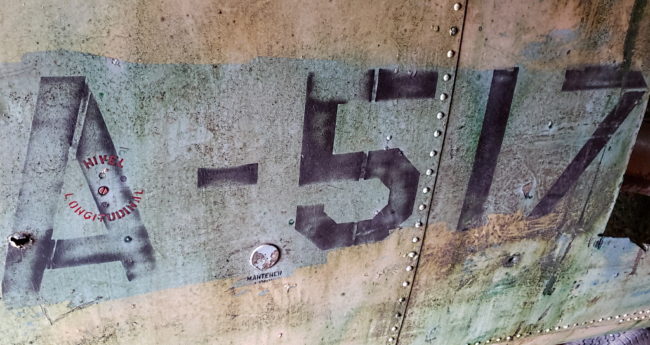
At times, we found nothing but dead ends: Most of our references, warbirds publications, industry sources and spotting colleagues appeared to have lost track of it. Every now and then, however, the mysterious and elusive “Alpha Five One Seven” insisted in reappearing into our “research radar”, re-lighting and strengthening our interest in trying to get to what we generally referred to as “the sixth and most elusive British Pucará”…
Our subject aircraft’s life dates back to 1977, when it started being built at AMC (Área de Material Córdoba, or Córdoba Material Area), the ubiquitous aircraft manufacturer best known for its historical designation, FMA (Fábrica Militar de Aviones, or Military Aircraft Factory). Allotted manufacturer serial number 14, it was initially destined for what became a failed sale of three IA-58A aircraft to Mauritania´s Air Force.

Once the African deal fell through and it flew for the first time in early 1978, Argentina´s Air Force (FAA) pressed it into service with its first Pucará squadron, activated at Reconquista air base in Northern Santa Fé Province three years earlier. Allocated FAA serial number A-517 (second use), it was taken on charge in September 1978, just in time to be deployed south to General Roca (Río Negro Province) for the conflict between Chile and Argentina over a Beagle Channel territorial dispute in December that year.
Five days in Malvinas…
The most relevant segment of its brief operational career, however, would take place in April 1982, when it was selected for deployment South to Malvinas. Flown by the late lieutenant Miguel Giménez (who would get killed on board Pucará A-537 on May 28), the aircraft landed at Malvinas air base in Puerto Argentino (Port Stanley) late in April and, flown by Lt. Héctor Furios, relocated to Cóndor air base at Prado del Ganso (Goose Green) two days before hostilities broke out.


The plane’s 4 plus-year career would come to a sudden end shortly before 07:30 hs. (local time) of May 1, 1982 as Lt. Giménez tried to fly it out of harm’s way because British air bombings were expected at the Prado del Ganso garrison imminently. However, the soggy and irregular Goose Green soil got in the way and A-517’s nose wheel stuck into a hole and the gear collapsed as Giménez sped up for take-off.
After the bombing materialized (killing eight and wounding nine Argentine airmen and destroying Pucará sistership A-527), the damaged A-517 was inspected and deemed a write off. This notwithstanding, a decision was made to recycle it as decoy for future British air attacks. The nose landing gear was hastily re-erected in order to move the aircraft out of the runway and into a position where it would propose an inviting target for incoming British Harrier bombings.
The long and winding road to Oxfordshire
Four weeks after its fateful incident at Cóndor air base, the aircraft fell into British hands when the Argentine Army and Air Force garrison at Prado del Ganso surrendered to “2 Para” (2nd Battalion, Parachute Regiment), British Army, on May 28. The aircraft then spent little more than two years abandoned at probably the same location where it was positioned at the outbreak of war.


This turned it into an easy prey to the islands’ inclement and highly corrosive weather, resentful islanders or military bounty hunters who cut out one fuselage roundel (right side), a tail flag (left side), one ejection seat warning sign (right side) and its unit badge (left side), shot at it for fun or removed whatever parts and components suited them for souvenirs. Before the airframe became a pile of rubble, however, the British Ministry of Defense decided to donate it the people of Goose Green in October 1984.
Lacking the least of interest in preserving a symbol of the “Argentine occupation”, Goose Green immediately sold the aircraft to one Mr. Harrison, from Grampian Helicopters international Ltd., who had the wreck stowed into two 40 feet and one 20 feet containers and shipped them to Port Stanley on board cargo vessel “Monsunen” early in 1985. Alongside an ex Argentine Army UH-1H Huey, A-517 is believed to have arrived by sea in the United Kingdom before the fourth quarter of 1987.
Interestingly and strangely enough, Grampian managed to have the wreck accepted into the British civil aircraft register after an incredibly fast registration process. Less than two months after being purchased, A-517 got British Civil Aviation Authority (BCAA) marks G-BLRP on December 3, 1984… long before it could leave the South Atlantic!
Chasing the “ghost Pucará” into the 21st Century
Once it reached English shores, A-517 nearly disappeared into that nation’s gloomy fog. Some sources say it was first noted at the Lashenden Air Warfare Museum at Headcorn (Kent) in September 1987, still inside its three containers and awaiting restoration to static exhibition or flying condition. Two years later, a firm by the name Dopatm Limited started advertising it in aviation media inviting the potential buyer to “possess a piece of history with this two-seat, twin turboprop recovered from Goose Green after the Falklands conflict”.


Its paper trail demonstrates that the aircraft was attractive enough for one customer, who bought it and got it re-registered to his name in September 1989. Yet the aircraft continued to remain invisible with rumors indicating it had been abandoned or stored in varying locations such as Jersey Island or Bicester (80 km. away from Witney). Our last hopes of getting through to it died when its civilian registration was cancelled by BCAA in November 1995.
But now we know that the aircraft has remained stowed in two (consolidated from the original three) containers for little over 30 years and returned to the Americas in the mid-1990s. Its owner since 1989 is Rodney Butterfield, a Rhodesian automotive design engineer, who consolidated his acquisition into the two 40 feet containers at the vintage sports and racing cars restoration firm he owned in Witney (Oxfordshire). But, after selling that business for a real estate project in 1990, Butterfield moved to North Carolina to start yet another car restoration facility and brought A-517/G-BLRP along feeling “it would perhaps be easier and more economical to undertake the restoration in America”, as he told to our webmaster in his first contact back in 2008.
In his interaction with Fernando Puppio, Butterfield said his plans had been to build a local hangar to house the project to “be able to undertake a full survey of the condition and evaluate the possibility and costs of restoration”. Regrettably, the demands of his car business prevented him “from making progress as fast as I had hoped” and the aircraft remains stowed inside its two containers at the owner’s facility in Forest City, central North Carolina, to the present day.
Meet and greet A-517
The aircraft is partly dismantled and still covered in dry Cosmolene to hold corrosion. When inspected, the containers revealed the presence not only of A-517 but also parts coming from several other airframes, including the left wing nose wheel door cover and an outer wing panel from A-529 (see this aircraft’s history here), a cockpit frame coming presumably from A-509, at least four internal fuel cells, three ejection seats (only two apparently complete), two engines (but only one propeller) and an extra windshield panel.


Butterfield is confident that “the plane is complete with original engines and instruments (and indeed all hard parts I believe except propellers) but all are in unknown condition, and currently are not usable without restoration”, but he is well aware that restoring it to flying condition (even under an experimental registration) could just as well require a little fortune… 1.5 million dollars and maybe more!
From our point of view, getting it to a static display condition is also a possibility and could cost a lot less, but it would require at least 5% to 10% of the figure above to have it re-assembled, ideally inside a building where it could be exhibited to the public and corrosion will be held at bay for good.
We had an extraordinary chance to talk to Rodney Butterfield in early February 2020. His ideas, ideals and frustrations with this 40-year old piece of history will be revealed in an interview we will be publishing in a forthcoming post.

Mitchell Enríquez, Carlos Brito, Javier “Javo” Ruberto and Martin Schofield contributed with data, fieldwork, photographs and proofreading for this report. Bibliography: Burden, R. et al: “Falklands The Air War” (British Aviation Research Group, England, 1985); Moro, Rubén O.: “La Guerra Inaudita” (Editorial Pleamar, Argentina, 1985).


Look forward to your book, Anonymous on 9 Jan. It’s always good to learn a bit more about colonial aviation in Malvinas… please contact me privately when the book is published!
I made the trailer which transported A-517 from the site in Goose Green to the coast for shipment to UK. I’m writing a book about my RAF time in the Falklands in 1984 and will be published later this year.
Brian Lloyd RSM deceased & 3 colleagues of 2 para gave me the piece of painted fuselage off the Pucara A-157 on there return from the falklands in 1982 …
The Royal Army backed the wrong side in the English Civil War, and had their ‘Royal’ title removed for all time.
Text corrected… again! And your proofreading is now recognized at the bottom Martin. English-centric culture isn’t easy to understand!
There isn’t any such organisation as the Royal Army either. We have the Royal Navy, the Royal Marines, the Royal Air Force and even the Royal Horticultural Society, but only a British Army. No, I don’t understand either.
Interesting article, however.
Text corrected… thank you Anonymous for the correction.
2nd Para Brigade, Royal Marines – No such thing exists or has existed…….