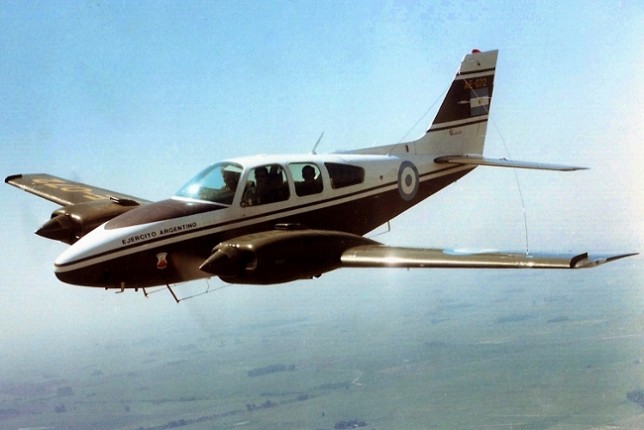

Little known to the average aviation buff, is the fact that Beechcraft’s top-of-the-line product in the non-turbine segment, the Baron, saw short-term duty in Argentine presidential, military and security service. Although research has produced no results yet, it may have also seen pre-war service during the 1977-1978 Beagle Channel escalade.
Chronologically, the first service to operate the type was the Army. Ostensibly following United States Army doctrine, which in 1965 adopted a military version of the Baron designated the T-42A Cochise for multi-engine and instrument flight training and liaison purposes, Argentina’s land force purchased two aircraft in the mid-1970s.
Both were flown into the country from Beechcraft’s Wichita factory and remained operational for close to eight years, both being discharged in 1983. The first one was delivered in November 1975 and belonged to the larger variant, the Baron 58. The second was a smaller Baron E55 and was purportedly taken on charge coinciding with the coup d’etat on 24 March 1976.

Allocated to the Army Flight Instruction Division (División Instrucción de Vuelos, or DIV) at Campo de Mayo (Buenos Aires), both aircraft were essentially tasked with training and liaison duties. The Baron E55 was struck-off charge from Army inventories on 17 May 1983 and the Baron 58 was written-off after catching fire while undergoing maintenance on the ground at Campo de Mayo.
In a hunch which we haven’t yet been able to confirm, Argentine civil-registered Barons could also have been pressed into military service due to the 1977-1978 Beagle Channel crisis. The fact that the type was extensively used in country since the early 1960s (40+ Barons were registered in Argentina between 1961 and 1978), its acquaintance with Army flyers and the fact that several competing types (Navajos, Aero Commanders, etc.) were indeed impounded and given military serials are food for speculation…
Prisoners federal air transport
When struck-off charge by the Army in May 1983, their sole Baron E55 found itself a new lease of life as an inmate transport and liaison aircraft for the Federal Penitentiary Service (Servicio Penitenciario Federal, or SPF). Re-registered LQ-ASY to that service on 10 August 1983, the aircraft has remained in operation to the present day. The aircraft, in fact, is known to have operated regularly through 2008, initially from Buenos Aires/Jorge Newbery and then from San Fernando (Buenos Aires), when lack of maintenance funding got the aircraft grounded.

By 2010, a decision was made to have the aircraft restored to flying condition. Accordingly, competitive bids were requested by the Ministry of Justice and Human Rights among national certified maintenance firms. Official papers called for a 100 hours overhaul, covering airframe, engines, propellers and undercarriage, adoption of manufacturer service bulletins and the complete replacement of the communications and navigation suite. The winning offer, valued at about US $ 130,000, came from Bombardier’s Argentine technical representative, Aviación Atlántico Sur.
Even though work was scheduled to last four months after a purchase order was issued on 29 December 2010, the aircraft was ready only in October 2011. According to media reports, technical issues not previously envisaged were raised during the overhaul process, increasing costs in an estimated US $ 70,000. While all additional items were authorized on the technical field, funding was not readily available to pay for them until mid-2013.
After financial resources were sorted out, LQ-ASY was formally handed-over back to the SPF by President Cristina Fernández in a ceremony held in mid-July 2013. After a three-year hiatus, the service was able to re-activate its flying department with an aircraft featuring “a range of 750 nautic miles, accomodations for 6 passengers, a cruise speed of 180 knots and a state of the art navigation system” that will help “reduce costs and special transfer times to the nation’s most distant facilities”, as stated in an official press release.

A presidential Baron
The most exotic individual in this peculiar history was a civilian Baron which saw temporary duty with the Presidential Aviation Group (Agrupación Aérea Presidencial, or AAP). The aircraft was a 1968 Model B55 registered to the National Meat Board (Junta Nacional de Carnes, or JNC) and was tasked with flying officials in this government organization regulating meat market prices, standards and exports.
Apparently under a proposal by JNC Chairman, Alfredo Bigatti, the aircraft was re-allocated presidential duties under the Raúl Alfonsín Administration (1983-1989) in the late 1980s. Both Alfonsín and Bigatti were politically-related natives from Chascomús (Buenos Aires) and the move coincided with a presidential decree to dispose of surplus “vehicles and [other] state-owned assets”, as former presidential pilot, Air Force Colonel Rodolfo Muñoz (retired) recalls.
Taken on charge circa January 1989, the aircraft was scheduled to be flown by lieutenant colonels Rodolfo Muñoz and Jorge Chevallier (later known for his 10 years tenure as Chairman of the Joint Chiefs of Staff), who converted to the type under the guidance of JNC instructor pilot, Manuel Cusi. According to Muñoz, the “aircraft was used twice to fly President Alfonsín to his home town in Chascomús (Buenos Aires)” and also “flew Minister of Foreign Affairs, Dante Caputo, to [the beach-side resort of] Villa Gesell [Buenos Aires]”.

Even though the type seemed ideal for the 115 Km. hop between Buenos Aires/Jorge Newbery and Alfonsín’s birth place, this Baron’s career was ephemeral and the aircraft was back into JNC hands “before President Alfonsín quit office in July 1989”, as the former presidential crewmember remembers. By the time the JNC was dissolved by President Carlos Menem in 1991, the aircraft was most likely unserviceable and was not able to find a new owner. Ironically enough, Muñoz would notice it years later at Don Torcuato airport, abandoned and with several key components missing…
The fleet
All things said, below is an illustrated (at least partially!) list of all Argentine military and federal government Beech Barons providing synthetic individual details.
| AE-071 | ||
|---|---|---|
| Model | Baron 58 | |
| Serial number (c/n) | TH-654 | |
| Destino | w/o 1983 | |
| Remarks | Destroyed by fire while under maintenance. | |
| AE-072 (ultimately LQ-ASY) | ||
 |
Model | Baron E58 |
| Serial number (c/n) | TE-1077 | |
| Destino | wfu May 1983 | |
| Remarks | Transferred to the Federal Penitentiary Service and re-registered LQ-ASY in August 1983. |
|
| LV-JIN | ||
 |
Model | Baron B55 |
| Serial number (c/n) | TC-1146 | |
| Destino | wfu 1989 | |
| Remarks | Short term loan to Presidential Air Group by National Meat Board. |
Bibliography: E. Martín & O. L. Rodríguez: “La Aviación en el Ejército Argentino – Crónica histórica y catálogo – 1867-1991” (author’s edition, Argentina, 1991), M. Magnusson & G. Pavlovcic: “Registro Completo de Aeronaves Civiles de Argentina 1938-2011” (Tomo 1, Ediciones Argentinidad, Argentina, 2012), R. W. Simpson: “Airlife’s General Aviation” (Airlife Publishing, England, 1995). Magazines: Pista 18 (Argentina, 1997). Internet sources: Argentina Compra, Aviación Atlántico Sur, Beechcraft, Clarín, Ministerio de Justicia y Derechos Humanos, Prensa Argentina and Wikipedia. Acknowledgements: Ignacio Collia, Michael Magnusson and Javier Mosquera contributed to this report.

