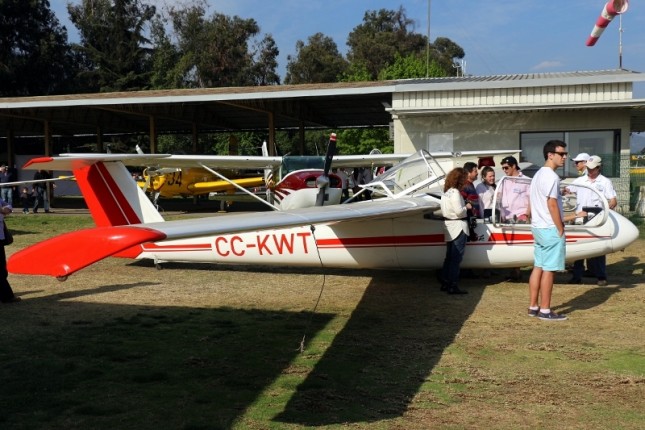


For the second consecutive year, Vitacura Gliders Club (Club de Planeadores de Vitacura, or CPV) opened up their doors to residents in the affluent neighborhoods surrounding Lo Castillo airfield (SCLC) in Northeast Santiago. Aimed at a demanding and wealthy public, the show was held on Saturday 19 October 2013 and featured a variety of flying activities, static exhibitions by both the hosts and several guest institutions and fast food carts contracted with by renowned Chilean soda fountain, Dominó (their powerful tomato-mayonnaise-avocado pork tenderloin sandwiches met a welcome demand and stock were depleted by 5:30pm!).
Advertised on a door-to-door basis with missives and catchy flyers, the event was “a club and its members investment into the community” destined to “raise simpathies among Vitacura residents”, as stated by CPV general manager, Arturo Diez Voigt. Friendly community relations are essential for this well-located club, which defines itself as a prime soaring centre for the Andes Cordillera, provides training on gliders and fixed-wing aircraft and hosts a number of regular glider competitions, including Chilean nationals and Sailplane Grand Prix events.


Guest exhibitors included the three armed forces, Chile’s aircraft modellers club (CACh, or Club de Aeromodelos de Chile) and a couple general aviation firms promoting their wares. The armed services were both recruiting candidates for their officer academies and showing their community-oriented services. Air Force put up the largest number of stands, featuring their “Halcones” (aircraft) and “Boinas Azules” (paratroops) display teams, search and rescue and aerophotogrammetric services and officers school. Navy and Army were also looking for prospective high-society officer candidates, with Navy also advertising their sea rescue service (“Dial 137”). Interestingly enough, the National Aeronautics and Space Museum was showing a “Women in Chilean aviation” exhibition highlighting past and present feminine contributions to national aeronautics.
Military aircraft on display included Air Force T-35 Pillán 114 (c/n 163 checked), Army MD-530Fs H-189 “Cerro Colorado” and H-197 “Cerro El Roble” and National Aviation Museum Extra 300 “Halcones #1”. Approximately twenty aircraft and helicopters were involved in the flying programme, which featured helicopter and glider displays as well as glider, biplane, helicopter and light plane demonstration flights for the attending public. Involved in these chores were Aero Boero 180 CC-KWD, AS-350 Ecureuil CC-ETE (Investigations Police, tactical demonstration), Bell 206 CC-APP, Bell 407 CC-ADA, Cessna 172 CC-KWG, Cessna 182s CC-KWJ, CC-PGL and CC-PVY, Cessna 206 CC-PSM, Let Blanik CC-K11W, Let Super Blaniks CC-KWM, CC-KWV and CC-KWW, PA-18 Super Cubs CC-KWC, CC-KWQ and CC-PRW, Pilatus B4 CC-K14W (aerobatic displays), Robinson 44s CC-PCS and CC-PUY, Schempp-Hirth Janus CC-LWA and Stearman A75 CC-KWZ/140.


Civil aircraft on static display included Beech Baron CC-PGN, Cessna 150 CC-KWO, Cessna 180 CC-PIO, Cessna 182 CC-PNP, Cirrus SR22s CC-ABL and CC-PRB (c/n 2497 checked), LET Super Blanik CC-KWT, PA-18 Super Cub CC-PGK, PA-28 Cherokee CC-AGM, Pipistrel Virus CC-AHU, Robinson R44 CC-AHZ, Scheibe L-Spatz CC-KWU, Schemp-Hirth Duo Discut CC-AAW/2, Schemp-Hirth Ventus CC-LWD and CC-PQZ, Socata TBM N771AM (c/n 464 checked, previously OE-EEE, carried “Loma Larga Vineyards” titles) and T-34 Mentors CC-KST and CC-PNV (c/n CG25 checked). Interesting sightings noted elsewhere on or over the field included Bell 407 CC-PBJ, Cessna 150 CC-KWR, Cessna 172 CC-PWN, Cessna 337 CC-PET (derelict), Eurocopter EC-130 CC-CSG, Let L-33 CC-KWP, Pilatus B4s CC-K1W, CC-K15W and CC-K16W and Robinson 44 CC-ABO.
Even though no massive advertising was made before the show, the event attracted a respectable crowd. According to CPV figures, 2,032 individual visitors (including 210 club member relatives) were logged entering the premises (free of charge). Airfield operations for the day totalled 455 movements, with 422 controlled by the tower after the airshow started at 10am. Most of those movements were naturally converted into demonstration flights for the public, including 99 monoplane, 62 helicopter, 59 glider and 5 biplane flight rides purchased by visitors.


Bibliography: I. P. Burnett: “Civil Aircraft Registers of Chile” (Air Britain, England, 1985) and R. W. Simpson: “Airlife’s General Aviation” (Airlife Publishing, England, 1995). Internet sources: Club de Planeadores de Vitacura (official), DGAC Chile (official), ModoCharlie, Rego Search and Shocman (Antonio Segovia foto blog).

