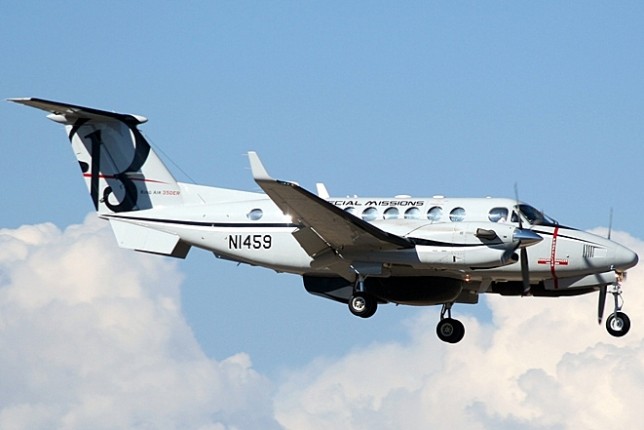

Rounding up the Beechcraft offerings described in an previous report (see “Live long, King Air?”), the King Air family display at FIDAE 2012 included special missions demonstrator, King Air 350ER N1459. The aircraft was on the last leg of a worldwide tour staging through 14 countries (England, Bahrain, the United Arab Emirates, India, Singapore, Indonesia, Philippines, Malaysia, Ethiopia, Tanzania, South Africa, Peru, Chile and the United States) and at least four trade shows (Aeromed Africa, Bahrain and Singapore Air Shows and FIDAE). This was part of a major Hawker Beechcraft effort to promote their special missions concept, integrating Hawker Beechcraft airframes with a variety of mission packages for pilot and crew coordination training, military liaison, priority transportation, medical evacuation, surveillance, maritime patrol, cargo hauling, flight inspection and other critical missions for military, government or commercial applications. To that purpose, the Wichita manufacturer had developed a number of standard configurations for missionized aircraft; while also promoting their “capability to design, certify, and install custom special mission modifications”.

Building on its extensive experience with special mission applications by earlier models (more than 500 Model 90/100/200/300 aircraft have flown in such a role), the King Air 350ER special mission value proposition integrated a 12 hour-endurance, certified and tested airframe featuring state of the art aerodynamic, automation and in-flight comfort technologies comparable to those in the 250 and 350i versions with equally up-to-date mission-specific packages. The demonstrator was in fact fitted with a search radar radome and electro-optic/infrared lift for surveillance missions, airline-style seating for military transport missions and two medical sleds and a medical storage cabinet for evacuation missions. All of these installations were certified by the U.S. Federal Aviation Administration and the European Aviation Safety Agency, were available for immediate delivery on new aircraft from the factory and would be supported by a global network of more than 100 authorized service centres worldwide, including fully-owned facilities in the United States, the United Kingdom and Mexico. As stated by Jay Gibson, vice president Special Missions for Hawker Beechcraft, “the King Air 350ER, along with our entire line-up of products, represents our commitment to the worldwide special mission market.”

Implementing a long-range value proposition the Texan way
While sharing most of the features in its executive siblings, the 350ER most relevant differences included two 447 litre fuel tanks and changes to the main landing gear to incorporate a stronger wheel/tire/brake assembly; with smaller changes altering the rudder assembly, fuel monitoring system and glass cockpit avionics software. When configured with a “slick” interior (flight crew chairs, interior sidewalls but no cabin seats nor furniture and the lavatory installed at the back of the airplane), the model’s maximum take-off weight increased to 7.530 kg and its maximum useful load to 3.240 kg. At the cost of a longer take off run (1.363 m at sea level, under international standard air conditions) and lower top speed (560 km/h), the aircraft could sustain the 12 hour-endurance in its value proposition and its maximum range exceeded 4.630 km. While the manufacturer maintained that most surveillance missions take up a maximum of seven hours, they felt confident that “the aircraft operators can take comfort in knowing the airplane is capable of far more”. All things said, the model had been welcomed by an interested customer base resulting in 90 aircraft being sold between 2007 and 2011, with a peak of 34 shipped in 2009.

The King Air 350ER value proposition came in extremely handy at a time when the United States government need for airborne sensor platforms had overwhelmed the unmanned aerial vehicle industry. Late in 2006, USAF was looking for a solution to fill certain combat-support roles in Iraq’s recently-reborn air force, so two contracts for 10 Griffin Eye-fitted (system details below) King Air350ERs plus 2 transport/training King Air 350s were laid out to Beech in 2007 and 2008. Deliveries started in December 2007 and by, October 2008, Al-Muthana-based 87 Squadron was flying the first all-Iraqi crew intelligence, surveillance and reconnaissance (ISR) mission since the fall of Saddam Hussein. As the Iraqi program was getting off the ground, USAF again contracted Hawker Beechcraft to start supplying more than 30 King Air 350ERs for its own use. Dubbed “Project Liberty”, the acquisition was aimed at rapidly disseminating full motion video and signals intelligence to joint forces on the ground with King Air 350ER aircraft re-designated UC-12W Liberty. Within months of initial deliveries in March 2009, the type was flying its first combat mission in Iraq in June and was landing in Afghanistan in December 2009. The model and its complete flying organization (two 15-aircraft expeditionary squadrons flying abroad plus one 7-aircraft training unit at home) had accumulated over 2,000 sorties by March 2010.

One platform, many solutions
Taking advantage of the proven airborne platform provided by the King Air 350/350ER, other companies in the intelligence, surveillance, target acquisition and reconnaissance (ISTAR) business have long been offering special mission packages for installation into those airframes. Three such companies, in fact, were showing their wares in scale model, banner or brochure form during FIDAE 2012: Braunschweig (Germany) based Aerodata, San Diego (US) based General Atomics and Ashdod (Israel) based ELTA Systems, acting under its Israel Aircraft Industries (IAI) corporate umbrella. Aerodata was marking its FIDAE appearance with a new regional contract, as it arrived in the fair shortly after being subcontracted by Hawker Beechcraft to provide a maritime surveillance mission package for a King Air 350ER that will be delivered to the Argentine Coast Guard. General Atomics was attempting to expand its customer base into the region by furthering previous sales in the United States, Europe and the Middle East, while ELTA was probably looking for additional sales in the region, where at least one customer already operated several of its products.

Aerodata was partnering with manufacturer Hawker Beechcraft and its Argentine representative, Aero BAIRES, to install an AeroMISSION software solution integrating search radar, infra-red sensor, broadband direction finder and identification transponder into a brand new King Air 350ER. When installed, AeroMISSION software will provide integrated mission management functionalities (moving map with tactical data overlay, full sensor control, flight deck and FMS integration and powerful data link, reporting, recording and storage capabilities) with a long range airframe also fitted with a drop hatch (for SAR applications) and bubble windows (for visual searches). The radar component will consist of a Telephonics RDR-1700B unit, an X-Band search radar with the ability to search, detect, and track multiple targets during over water surveillance with a maximum range of over 200 km. Imagery functions will be provided by a FLIR Systems Star Safire III system recording infra-red images with optional colour zoom, spotter scope, low-light camera and laser rangefinder/illuminator/pointer. Tracking and identifying vessels while on search and rescue and surveillance duties will be a Rockwell Collins SAR-126 direction finder and SAAB R4A automatic identification system transponder.

Many details remained to be confirmed at the time of writing, since both the customer and its main suppliers declined to comment. Nonetheless, the Argentine King Air AeroMISSION software was expected to run on commercially-available Microsoft Windows operating systems with dual hard disk for recording and use 19” LCD screens (one for primary situational awareness control, one for radar and camera images and control) plus keyboard and trackball for system operation. The typical crew was expected to be composed by two pilots, one or two operators and two observers/drop masters. Once the aircraft gets rolled-out of the Wichita factory, it will be fitted with bubble windows in the US and will fly to Germany for conversion work before delivery takes place late in the second half of 2013.When completed, the project will mark the second successful King Air/AeroMISSION sale for Aerodata, following closely on the heels of two King Air 200s converted similarly for the Armed Forces of Malta. The deal could also strengthen Aerodata’s position in the intricate Argentine defence and government market, where they sold a flight inspection system for installation on Air Force Learjet 35As in 2006 and was working to make it interchangeable between two existing aircraft since 2011.

All roads lead to… the Middle East!
As anticipated in one of our show previews (see “FIDAE 2012 “on short final!”), FIDAE newcomer and renowned unmanned air vehicle (UAV) manufacturer, General Atomics, was promoting its first manned airborne ISR solution, marketed under the suggestive name Griffin Eye, a mythological beast ruling both air and ground thanks to its lion body and eagle head and wings. Derived from the successful Predator UAV flown by USAF since 1995, General Atomics’ Griffin Eye consisted of an integrated mission sensor package suite flown aboard a King Air 350ER airframe. It packed a Lynx Multi-mode radar, an electro-optical/infrared camera turret, a high-bandwidth tactical data link, a sensor operator console with dual flat panel monitors and Claw integrated control and analysis software. Optional sensor systems can be integrated as well, thus providing maximum situational awareness for troop protection, border monitoring and vital infrastructure protection. Suggestively, General Atomics boasts that “the combat-proven ISR systems utilized on Griffin Eye have been exported and are deployed throughout the world” (namely, in the United States, the United Kingdom, Italy, Turkey and Iraq, the latest being the launch customer for Griffin Eye).

A veteran in the ISTAR marketplace, IAI’s subsidiary ELTA Systems was also promoting a King Air mission package. Dubbed ELI-3120, it was described as suited for both “hard” military missions (battlefield situation awareness and electronic order of battle mapping by signal intelligence) and “soft” government applications (maritime patrol, search and rescue and border surveillance, enforcement of terrorism, piracy, contraband and anti-narcotics legislation and environmental protection against pollution, illegal fishing and forest fires). ELI-3120’s basic configuration comprises an impressive array of sensors: Radar (medium power or synthetic aperture), communications intelligence (HF/VHF/UHF) and direction finding (VHF/UHF) tools, multi-mission optical stabilized payloads (incorporating tracking devices and laser pointer), line-of-sight data and satellite communications links, independent navigation systems, high resolution vertical camera and imagery recording equipment. The airborne side of the product is complemented on the ground by a number of stations for pre-flight mission planning, post-mission analysis and audio and video replay processes.

Optionally, the system can incorporate cellular communications intercept capabilities (for GSM band), electronic intelligence and support measures (for detection, location, identification, classification and monitoring of ground, naval and airborne radars), active communication jamming (VHF/UHF) and self-protection (against air-to-air and ground-to-air missiles) tools. Even though the system was initially launched on a King Air Catpass 250 (a Commuter Air Technology King Air 200 improvement package increasing payload and performance through aerodynamic, structural and systems changes), ELI-3120 was being advertised as suitable for other airborne platforms, including IAI Astra and Galaxy bizjets, Fokker F-70s commuters and medium altitude long endurance UAVs such as IAI’s own Heron Multipayload, also on the FIDAE 2012 static display (ostensibly with ELI-3120 radomes). The scale model on display inside the IAI booth, however, clearly illustrated a King Air 350 (not 350ER) aircraft fitted with the distinctive upper and lower fuselage radomes required by the Israeli supplier, as delivered to their first and so far sole Latin American customer, the Colombian Air Force.
Sources: Aerodata (official site), Air Force Magazine, Airport Data, Defense Industry Daily, Flight International, FLIR Systems (official site), General Atomics (official site), Grifovunque, Hawker Beechcraft (official site), Israel Aircraft Industries (official site), Rockwell Collins (official site), Saab (official site), Tactical ISR Technology, Telephonics (official site), USAF (official site) y Webinfomil.

