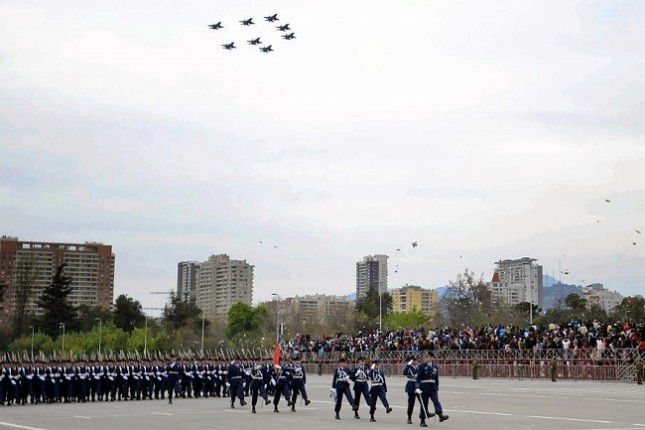

Nearly 8,500 troops, 100 aircraft, 35 motorcycles and 20 armoured personnel carriers (APCs), including 655 Chilean service women and about 100 foreign military and police troops, were featured in a new edition of Chile’s traditional Great Military Parade (Gran Parada Militar). As it will be remembered, the event is part of a lengthy national holiday celebrating both the first Chilean government (formed 18 September 1810) and Chile’s military glories (instituted on 19 September 1915 by President Ramón Barros Luco). Even though the ceremony is supposed to centre on Army feats, the parade has usually featured forces from all armed and security services (Army, Navy, Air Force and Carabineers) as well as civilian representatives from different Chilean ethnic and social groups. Just like it did in the 2007 edition, Army focused this exhibition on national identity, diversity, tradition and human capital, and left most of its advanced weaponry stored in unit stores and barracks. Apart from the motorcycles, APCs and carry-on man-portable weapons, only the aviation components exhibited larger military systems.

For the fourth and last time in his administration, the event was headed by President Sebastián Piñera Echenique, seconded by Defence Minister Rodrigo Hinzpeter Kirberg and Army Commander-in-Chief General Juan Miguel Fuente-Alba Poblete. Special foreign guests included Canadian Land Force Chief of Staff, Lieutenant General Peter J. Devlin, Ecuadorean Army Commander-in-Chief, Division General Jorge Peña Cobeña, Spanish Army Chief of Staff, General Jaime Domínguez Buj, United States Southern Command Commanding Officer, Major General Joseph P. Di Salvo and Spanish Army Chief of Staff cabinet leader, Brigadier General Luis Ruiz de Gordoa Pérez de Leceta. Heading the parading forces for the second consecutive time was Army Metropolitan Region Garrison Commander, Division General José Manuel Cichero Santos; accompanied by echelon commanders from the Navy, Rear Admiral Harald Sievers Zimmerling, the Air Force, Brigadier General Ludwig Gronemeyer Crestto, the Carabineers, General José Miguel Abarca Latorre, and the Army, Brigadier General Iván González López.
Patriotic meeting at O’Higgins Park’s

The ceremony followed a more or less traditional schedule starting at about 3pm and lasting close to two hours. After President Piñera and Minister Hinzpeter arrived at O’Higgins Park’s ellipse, they reviewed officer school troops formed at the parade ground and were saluted by representatives from Chilean rodeo and traditions association Gil Letelier (an unchangeable tradition for Chile’s Great Military Parade). As soon as General Cichero was authorized by President Piñera, the military display got under way in earnest with formations from all four officer schools (Army, Navy, Air Force and Carabineers) parading in front of the presidential stand. All four institutions marched to a particular soundtrack provided by their own music bands, with cadets arranged in 20 to 30 line-abreast formations. Peculiar only to the Carabineers element, it included by an 8-women and 16-men platoon formed by officer candidates from Costa Rica, Ecuador, Guatemala, Honduras, Mexico, Panamá, Paraguay and the Dominican Republic, all of them participating in Chilean-government international police forces training programme.

Active-force troops were next on the parade ground, starting with the Navy echelon. Totalling 1,298 men and 101 women (including the school element at the beginning of the display), the echelon was formed by troops from the Naval Polytechnic Academy, led by Captain Pablo Lubascher Correa, the Naval Reserve Company, headed by First Lieutenant Hernán Rivera Sariego, and the Amphibious Expeditionary Brigade, commanded by Marines Captain Luis Vargas Heinrich. Next on the ground was the Air Force echelon, contributing 1,344 men and 120 women (including officer cadets and flying crews), arranged in three distinct sub-echelons: Non-Commissioned Officers School, headed by Colonel Raúl Jorquera Conrads, Units (Air Force base personnel from El Bosque, Cerrillos and Pudahuel), led by Colonel Alfredo Castillo Dinamarca, and Land-Based Combat Units (Anti-aircraft and Special Forces Regiment and an Aviation Infantry Battalion), commanded by Colonel Luis Valdivia Concha.

Next came the Carabineers echelon, totalling 1,095 men and 367 women (the largest feminine contingent in the ceremony). The militarised police force started by marching flags from a variety of and units and a squadron of police officers from Argentina, Bolivia, Brazil, Colombia, Costa Rica, Ecuador, Guatemala, Haiti, Honduras, Panamá, Paraguay, Perú and Uruguay presently undergoing advanced training in Chile. Next came the Carabineer Officer Training School, led by Colonel Fernando Vega Oetiker, the Carabineer NCO School, headed by Colonel Omar Gutiérrez Gambaro, and a formation of specialist units (canine, frontier guard, transit-control and cavalry), led by Colonel Luis Salazar Cancino. Closing the event, the Army echelon contributed 4,072 men and 167 women. Behind the echelon commander and a squadron of reserve officers, Chilean/Argentine Joint Combined Force “Southern Cross”, paraded its United Nations white APCs under command of Argentine Army Colonel Ubaldo Juárez and Chilean Army Colonel Luis Hernández Loyola.

Next came a 49 flags formation representing Army units from the entire country and a historical display formation from Reinforced Regiment No.7 “Chacabuco”, representing its 4th Company (exterminated in combat in the La Concepción battle in July 1882). Lastly, elements from four different land forces segments strode along O’Higgins Park ellipse. A foot units sub-echelon comprised formations from the Army Non-Commissioned Officers School, the II Motorised Division, the Infantry School, Infantry Regiment No.1 “Buin”, Infantry Regiment No.2 “Maipo”, and Artillery Regiment No.1 “Tacna”. Next came the Andean sub-echelon, with troops from Andean Company No.20 “Cochrane” and Reinforced Regiment No.3 “Yungay”. Third was a paratrooper sub-echelon with specialists from the Special Operations Brigade “Lautaro” and fourth were two more historical units demonstration by Armoured Cavalry Regiment No.1 “Granaderos” and Artillery Regiment No.1 “Tacna”.
Centennial air power on display… again!

The fact that only aviation elements were showing complex weapons systems at this year’s parade was ostensibly related to Chilean military aviation’s centennial. But unlike the ceremony covered by Gaceta Aeronáutica earlier this year (see “Chilean military aviation centennial”), the 2013 Great Military Parade was missing certain key air participants, including Air Force aerobatics team “Halcones” and Naval Aviation units. Compensating for those losses, Air Force made a major effort to put 70% of their F-16 Fighting Falcon inventory in the air (32 aircraft), surpassing the 20 and 24-aircraft formations recorded in the 2012 parade and April 2013 military aviation centennial ceremonies. All things said, the air side of the parade was divided in three segments. The first comprised one element and flew-by as the Air Force officers school marched on the ground. The second and largest one comprised nine elements and provided air cover to the Air Force echelon. The third and last comprised two elements and flew overhead the Army echelon.

Element #1 was formed by Air Force T-35 Pillán trainers 111, 114, 115, 121, 122, 126, 127, 128, 129*, 131, 132, 133, 138*, 142 and 145 (those marked with an asterisk are unconfirmed). Element #2 flew eight A-29 Super Tucano advanced trainers from Aviation Group No.1 (only 457 was identified). Element #3 comprised F-16Cs 851, 852, 855 and 856 and F-16Ds 857, 858, 859 and 860 from Group 3. Element #4 was formed by F-16As 741, 742, 743, 748, 749, 753 and 755 and F-16B 734 from Group 7. Element #5 was constituted by F-16As 721, 722, 729, 730, 731, 745 and 750 and F-16B 736 from Group 8. Element #6 included F-16As 723, 724, 744, 746, 747, 751, 752 and 754, flown by mixed crews from Groups 7 and 8. Element #7 was led by Learjet 35A 352 from the Photogrammetric Service, followed by three CitationJet 1s from Group No.5. Group No.10 contributed elements #8, formed by Boeing EB-707 904 and KC-135 Stratotanker 982 and 983, and #9, with C-130 Hercules 995, 996 and 998. Group No.9 equipped element #10 with Bell 412s H-47, H-51 (Group No.8 markings), H-53, H-54, H-55 plus one not noted, UH-1H Hueys H-81, H-90 and H-93 and Bell 206s H-22, H-24 and H-25.

Army Aviation Battalion contributed the two elements forming the third and last air display segment. Element #11 was apparently integrated by MD-530 Defenders H-132, H-134, H-136 “Co. Imán”, H-189 “Co. Color” and H-197 “Co. El Roble“ (data was obtained from a pre-flight briefing aired by CNN Chile), while element #12 was formed by AS-532 Cougars H281 “Co. Aconcagua”, H282 “Co. La Campana”, H283 “Co. Fitz Roy”, H286 “Co. Caracol” plus two not noted and SA-330 Pumas H263 “Co. Sombrero” and H264 “Co. Rucatalca”. Parade air operations were launched from three different air force bases: El Bosque launched Air Force Pillanes and the entire Army segment (deploying from Rancagua), Quintero purportedly launched Air Force Super Tucanoes and CitationJets and Pudahuel hosted the remainder of the fleet, including Boeing 737 922 which acted as coordinator for the air display. An uncertain number of aircraft were also readied as air spares for the show, including Air Force Learjet 35A 351 (at Pudahuel) and Army MD-530 H-131 “Co. Tarapacá” (at Rancagua).
Cover photo
Colonel Alfredo Castillo Dinamarca, Director Non-Commissioned Officers Improvement School, marches leading the Air Force Units Sub-echelon on the ground as the fourth and last F-16 Fighting Falcon, crewed by a mix of Groups No.7 and No.8 fighter pilots, formation flies-by O’Higgins Park (photo: Chilean Air Force).

Internet sources: Armada de Chile (official), Aviación Total, Educar Chile, Ejército de Chile (official), F-16 Net, Fuerza Aérea de Chile (official), Modo Charlie, Scramble, Terra Chile, TVN 24 Horas and Zapping Directo Chile.

